Open Access Publisher and Free Library
TERRORISM.jpeg

TERRORISM

Terrorism-Domestic-International-Radicalization-War-Weapons-Trafficking-Crime-Mass Shootings

Posts in Social Sciences
Verbatim: What European Security Services Say About the Muslim Brotherhood in Europe

By Lorenzo Vidino

The Muslim Brotherhood in Europe is a controversial topic, frequently subjected to misinterpretations and manipulations. Opinions on it vary from those who argue that it does not exist and that it is bigoted and conspiratorial thinking to argue otherwise, to those who claim that it does and it is, in substance, similar to groups like al Qaeda or the Islamic State; from those who believe that it is a force that has evolved over time and now embraces democracy and the positive integration of Muslims in European society, to those who argue that it is a complex movement that, while showing a moderate façade, is in reality engaged in non-violent but nonetheless highly problematic activities (a position held by this author).  

Much of the confusion stems from the opaque and secretive nature of the Brotherhood and, consequently, the difficulty of obtaining clear and unequivocal information. As the Brotherhood was founded and operates mostly in Middle Eastern countries where local regimes have enacted various forms of repression against it, the movement has always seen dissimulation of many aspects of its structure and goals as a necessary tactic to survive. Organizations belonging to the Brotherhood’s family in the Arab world have therefore gone to great lengths to hide various aspects of their inner workings. It is a tactic that, given the context, is understandable and has ensured the movement’s survival in tough political environments for almost a century.  

Somewhat counterintuitively, the secrecy that shrouds Brotherhood networks is somewhat greater in the West, where the Brotherhood is not considered a terrorist organization and can generally operate freely within a democratic framework. Brotherhood branches in the Middle East, as said, have historically kept secret many aspects of their activities, but they have never denied their own existence. That denial is common in the West where most Brotherhood-linked activists and organizations not only shroud in secrecy their inner workings but even refuse to admit any Brotherhood connection. Brotherhood activists and sympathizers also tend to attack those who highlight the existence of Brotherhood-linked networks in Europe and their problematic nature with charges of shoddy research, conspiratorial views, and bigotry. 

Given these dynamics, it is important to observe what entities across Europe, whose institutional mandate is to monitor potential threats to their countries, think about the movement, from its very existence to its tactics and goals. The Brotherhood is not designated as a terrorist organization by the European Union or by any individual European country. At the same time, however, the security services of virtually all European countries have long monitored the movement---a fact that is per se telling.

European security services have kept the movement under watch with different degrees of intensity. Those that have a broad institutional mandate that leads them to monitor all potential threats to their countries’ democratic and constitutional order, like Germany’s Office for the Protection of the Constitution (Verfassungsschutz, both at the federal level and in all 16 German states), have done so more extensively than some of their counterparts throughout Europe whose mandate is narrower and law enforcement-like. And in each country the degree of scrutiny of the Brotherhood varies with time, depending on factors such as the existence of more immediate security threats or input from political decisionmakers.

Yet, without exception, all European security services adopt a highly negative view of the Muslim Brotherhood on the Continent. All European security services which have publicly expressed views on the Muslim Brotherhood in Europe over the last twenty years have clearly and consistently stated that:

  1. An extensive and sophisticated network linked to the Brotherhood operates covertly in Europe, both at the national and pan-European level (through its umbrella organization, FIOE/CEM, and spinoffs like FEMYSO);

  2. European-based Brotherhood-linked activists have created front organizations that allow them to operate within society and advance their agenda without being easily recognizable as being part of the Brotherhood; and

  3. Brotherhood networks in Europe are not engaged in terrorism but have views and goals that are problematic, subversive, undemocratic, and incompatible with basic human rights and Western society.

These views have been expressed in various terms by European security services, and some have reached more pessimistic conclusions than others. But all those that have gone on the record over the last two decades about the movement have been extremely negative and concerned about its impact on European society.

This short report has collected all publicly available statements from annual and occasional reports, testimonies in parliamentary hearings, and formal statements in court cases from the various European security services that have addressed the issue of the Muslim Brotherhood in Europe. They include all the statements the author could find, with no selections or omissions, save for repetitions (as in the case of annual reports from German security services, which in substance repeat what was reported in previous years). All documents are publicly available and unclassified. All are herewith reported with references (so that the reader can read the context) and without commentary. The report does not include media interviews by representatives of security services, as they do not constitute a direct representation of their views and manipulation/misinterpretations might have occurred.     

The assessments here reported come from the security services of Austria, Belgium, France, Germany, the Netherlands, Spain and Sweden. The author is not aware of any security service from any other European country having gone on the record on the matter. The main reason for this is arguably the varying levels of comfort of different security services when it comes to going on the record on any matter unless strictly necessary. In general, for example, the security services of most Southern and Eastern European countries are culturally less prone to revealing much of their views on any matter than their Central and Northern European counterparts. Moreover, issues related to Islamism in general and the Muslim Brotherhood in particular do not constitute a major issues in Eastern European countries, given their small Muslim population.

In substance, the security services of basically all the largest Western European countries (with the notable exception of Italy) have gone on the records expressing very negative views on the Muslim Brotherhood. The author is not aware of any European security service having stated anything that even slightly contradicts the assessments on the Brotherhood made by the services of the seven countries here mentioned. To the contrary, interviews conducted by the author with most European security services over the last twenty years confirm that even those that have not gone on the record (Italian security services, for example) adopt extremely negative views of the Brotherhood, in line with those that do appear on record.  

The inevitable conclusion of this reading is that the European security community has reached a firm consensus over the presence, structure, tactics, aims, and ultimately, problematic nature of the Muslim Brotherhood in Europe. That consensus has been consistent over the last twenty years and has no known deviations, and this consensus should be the basis for well-informed policymaking on the subject.

Washington, DC: George Washington University, Program on Extremism, 2023. 20p.

Download
The Perilous Intersection of Amnesty and Accountability: Iraq's Legal Quandary and its Global Counterterrorism Ramifications

By Omar Mohammed

The Iraqi Parliament is poised to discuss a new amnesty bill that has generated significant controversy and debate. This legislation is intended to address the issue of wrongful detentions but raises profound ethical, judicial, and societal concerns. Advocates claim the bill will rectify unjust imprisonment, particularly in the post-ISIS era. Critics, however, argue that the bill's broad language could inadvertently release individuals affiliated with ISIS, undermining ongoing counterterrorism efforts and the pursuit of justice for victims. Complicating matters further is the recent decision by the United Nations Security Council to terminate the mandate of UNITAD, a team responsible for investigating crimes committed by ISIS. This article delves into the intricacies of the proposed bill, its implications for justice and national reconciliation, and its potential impact on counterterrorism efforts in Iraq.

Washington, DC: George Washington University, Program on Extremism, 2023. 10p.

Download
The Hamas Networks in America: A Short History

By Lorenzo Vidino 

Executive Summary • Hamas supporters have long operated in the United States. Internal Hamas documents and FBI wiretaps introduced as evidence in various federal criminal cases clearly show the existence of a nationwide Hamas network engaged in fundraising, lobbying, education, and propaganda dissemination dating back to the 1980s. • The network formalized its existence in 1988, when it created the Palestine Committee in the US. The Committee’s goals included “increasing the financial and the moral support for Hamas,” “fighting surrendering solutions,” and publicizing “the savagery of the Jews.” • The Palestine Committee spawned several public-facing organizations, most of which are based out of Chicago, Dallas, and Washington DC. They included the all-purpose Islamic Association for Palestine (IAP), the financial arm represented by the Occupied Land Fund (which later became the Holy Land Foundation, HLF), and the think tank United Association for Studies and Research (UASR). • In 1993, the FBI wiretapped a meeting of top Hamas activists in the US held in Philadelphia. The wiretaps show internal discussions on how to improve activities in support of Hamas within the US and how to shield them from the designation of Hamas as a terrorist organization. US-based Hamas activists agreed that hiding their affiliation and intentions was the best tactic to avoid negative consequences. “I swear by Allah that war is deception,” said one senior leader, “[d]eceive, camouflage, pretend that you’re leaving while you’re walking that way. Deceive your enemy.” “Let's not hoist a large Islamic flag and let's not be barbaric-talking. We will remain a front so that if the thing [the U.S. government ban on Hamas] happens, we will benefit from the new happenings instead of having all of our organizations classified and exposed.” • Over the years, US authorities have conducted several activities to clamp down on the network, including deporting and prosecuting Hamas operatives and shutting down multiple front organizations. The 2001 designation of HLF and subsequent prosecution of part of its leadership for funneling approximately $12.4 million to Hamas constitutes to date the largest successful terrorism financing prosecution in US history. • Yet, US-based Hamas networks and individuals have displayed a remarkable resilience and many of the core activists of the Palestine Committee are still engaged in various forms of support (albeit at times purely political and not material) for Hamas. 

Washington DC: George Washington University Program on Extremism, 2023. 16p.

Download
Imitators or Innovators? Comparing Salafi-Jihadist and White Supremacist Attack Planning in the United States

By Bennett Clifford and Alexander Meleagrou-Hitchens

 As the threat from white supremacist and Salafi-jihadist extremists to the United States grew in prominence in recent years, the two movements have become the subjects of several comparative studies. These works frequently focus on contrasting their methods of radicalization, recruitment, use of digital communications technologies, and connections to transnational extremist movements, but only a handful concern their methods of planning attacks on American soil. This report seeks to add to this emerging literature by examining what, if any, relationships there are between the tactics and targets chosen by white supremacist and Salafi-jihadist terrorists in America. In doing so, it will also contribute to our understanding of how, and indeed if, modern terrorists in America are learning from each other or from the current American counterterrorism posture. This report finds that: ● Jihadist and white supremacist attack planners in the U.S. selected different targets for their attacks. Jihadists tended towards attacking “hard targets” (for instance, military bases and law enforcement facilities) and devising plots to assassinate individuals. White supremacists erred towards “soft targets,” especially religious institutions and houses of worship. ● Jihadists were more likely than white supremacists to consider multiple targets for their attacks. ● The tactics of jihadists and white supremacists were relatively similar in frequency to one another. Both movements’ attack plotters relied heavily on plots involving firearms and explosives, but also experimented with non-conventional means such as vehicle rammings, arson, and train derailments. ● Despite some evidence of ideological cross-pollination, particularly in the form of manifestos and instructional material, evidence of direct learning between jihadist and white supremacist attack planners in the U.S. is limited. ● Independent innovation in the face of U.S. domestic counterterrorism approaches is a more likely explanation for similarities in targets and tactics between white supremacists and jihadists than cross-group tactical imitation.

Washington, DC: George Washington University, Program on Extremism, 2022. 33p.

Download
Mayhem, Murder, and Misdirection: Violent Extremist Attack Plots Against Critical Infrastructure in the United States, 2016-2022

By Ilana Krill & Bennett Clifford   

  In the United States, critical infrastructure, or “assets, systems, and networks, whether physical or virtual, [that] are considered so vital to the United States that their incapacitation or destruction would have a debilitating effect on security, national economic security, national public health or safety, or any combination thereof,” are prime targets in violent extremist attack plots.1 While a variety of violent extremist movements have attempted to assault American critical infrastructure throughout modern history, the Department of Homeland Security and other national security authorities have recently sounded the alarm that U.S.-based violent extremists have developed “credible, specific plans” to attack critical infrastructure.2 To understand the current dimensions of this threat, this paper reviews 94 cases of individuals charged in the U.S. federal court system from 2016 to 2022 with planning to conduct violent extremist attacks, 35 of whom attempted to attack critical infrastructure systems. 19 of these cases are associated with the Salafi-jihadist movement; 16 are associated with white supremacist groups. Evaluating these cases, the report finds: ● Salafi-jihadist attack planners were significantly more likely to consider critical infrastructure systems as targets for attack than their white supremacist counterparts. ● Salafi-jihadist and white supremacist attack planners attempted to target different critical infrastructure sectors, with the former focusing on the commercial facilities, government facilities, and emergency services sectors, and the latter predominantly focusing on the energy sector. ● Since 2019, white supremacist attacks plots against critical infrastructure systems have distinctly increased. ● Between 2016 and 2022, white supremacist plots targeting energy systems dramatically increased in frequency. 13 individuals associated with the movement were arrested and charged in federal court with planning attacks on the energy sector; 11 of these attack planners were charged after 2020. ● The rise of accelerationist ideology and doctrine during the past decade likely fueled the increased risk of attack plots within white supremacist milieus targeting critical infrastructure, and the energy sector in particular.

Washington, DC: George Washington University, Program on Extremism, 2022. 32p.

Download
Prohibited Extremist Activities in the U.S. Department of Defense

By Peter K. Levine, Joseph F. Adams, Amy A. Alrich, Rachel G. Augustine, Margaret D.M. Barber, Sujeeta B. Bhatt Kathleen M. Conley, Dave I. Cotting, Alan B. Gelder, Jeffery M. Jaworski, Mark F. Kaye, Carrington A. Metts, Neil V. Mithal, and Matthew J. Reed.

From the document: "The objectives of the IDA [Institute for Defense Analyses] study are to gain greater fidelity on the scope and nature of extremist ideologies and behaviors in the [DOD]; identify the sources of such ideologies and behavior; assess their impact; and develop strategies for preventing, countering, and neutralizing that impact. To that end, the project description calls for IDA to: 1. Document the range of known extremist ideologies and behaviors that are contrary to U.S. law and policy; 2. Identify existing definitions of extremism and prohibited extremist activities; 3. Identify pathways of extremist ideology and behavior broadly and within the Department in particular; 4. Assess why the DOD workforce and others in the military community (including veterans, DOD civilians, and contractor employees) might be susceptible to extremist recruiting efforts; 5. Survey DOD approaches to the prevention of other forms of violence (including suicide, domestic violence, assault, sexual assault, and hate crimes) to identify strategies that might be adopted; 6. Assess policies and initiatives of other federal agencies that might be helpful to the Department; 7. Identify existing legal frameworks for addressing prohibited extremist activities in the Total Force; 8. Evaluate current DOD efforts to counter extremist ideologies and behaviors in the ranks, identifying gaps and strengths; and 9. Review and evaluate current DOD information collection, tracking, and data sharing systems (including through the military justice, equal employment opportunity, command discipline, hotline response systems, insider threat, and law enforcement/security systems)."

INSTITUTE FOR DEFENSE ANALYSES. 2023. 282p.

download
Great Power Deterrence Lessons from the Middle East War

By PAYNE, KEITH B.

From the document: "With Russia and China as heavily armed and aligned nuclear foes, Washington faces an unprecedented deterrence context and looming threats. Given this new great power alignment, more than 30 states are at increased risk, namely, those allies directly covered by the U.S. nuclear deterrent and those partners greatly affected by the credibility of that deterrent, such as Taiwan and Ukraine. Most U.S. civilian and military leaders who must pay attention to this challenge appear to recognize that the U.S. understanding of deterrence, largely based on its Cold War experience, must be reconsidered in this unprecedented context. The search for guideposts for that understanding is now ongoing. The current war in the Middle East appears to offer some tentative lessons in this regard."

NATIONAL INSTITUTE FOR PUBLIC POLICY (U.S.). 2024. 6p.

download
Terrorism, Extremism, Disinformation and Artificial Intelligence: A Primer for Policy Practitioners

By GANDHI, MILAN

From the document: "Focussing on current and emerging issues, this policy briefing paper ('Paper') surveys the ways in which technologies under the umbrella of artificial intelligence ('AI') may interact with democracy and, specifically, extremism, mis/disinformation, and illegal and 'legal but harmful' content online. The Paper considers examples of how AI technologies can be used to mislead and harm citizens and how AI technologies can be used to detect and counter the same or associated harms, exploring risks to democracy and human rights emerging across the spectrum. [...] Given the immense scope and potential impacts of AI on different facets of democracy and human rights, the Paper does not consider every relevant or potential AI use case, nor the long-term horizon. For example, AI-powered kinetic weapons and cyber-attacks are not discussed. Moreover, the Paper is limited in examining questions at the intersection of AI and economics and AI and geopolitics, though both intersections have important implications for democracy in the digital age. Finally, the Paper only briefly discusses how AI and outputs such as deepfakes may exacerbate broader societal concerns relating to political trust and polarisation. Although there is a likelihood that aspects of the Paper will be out-of-date the moment it is published given the speed at which new issues, rules and innovations are emerging, the Paper is intended to empower policymakers, especially those working on mis/disinformation, hate, extremism and terrorism specifically, as well as security, democracy and human rights more broadly. It provides explanations of core concerns related to AI and links them to practical examples and possible public policy solutions."

INSTITUTE FOR STRATEGIC DIALOGUE. 2024.

download
Using Artificial Intelligence and Machine Learning to Identify Terrorist Content Online

By MACDONALD, STUART KEITH, 1979-; MATTHEIS, ASHLEY A.; WELLS, DAVID

From the document: "Online terrorist propaganda has been an important policy concern for at least the past decade. [...] [T]he EU Commission launched a call for proposals for projects aimed at supporting small companies in implementing the Regulation. Three projects were funded under this call. This report forms part of one of these projects, which is entitled Tech Against Terrorism Europe. It is important to note at the outset that the focus of this report is the use of AI and machine learning to identify terrorist content online using content-based approaches. Accordingly, the following are outside the scope of the report: [1] The moderation of so-called borderline content, i.e., content that does not violate a platform's Terms of Service but which is nevertheless regarded as potentially harmful. [2] The identification of individuals on a radicalisation trajectory, which is a different - and even more difficult - task; and, [3] The use of behaviour-based cues, such as abnormal posting volume and use of unrelated, trending hashtags, to identify accounts that are sharing terrorist content. This includes approaches based on recidivism. The report begins, in section 2, by explaining the terms AI, machine learning and terrorist content online. Readers that are already familiar with these concepts may wish to move straight to section 3, which discusses the two main content-based approaches to the automated identification of terrorist content online: matching-based approaches and classification-based ones. Having explained the limitations of each approach, section 4 details two ways in which it is necessary to supplement automated tools. Section 5 then addresses issues of resource, before the report concludes with three recommendations."

TECH AGAINST TERRORISM; TECH AGAINST TERRORISM EUROPE.. 2023.. 32p.

download
Economic warfare in southern Mali Intersections between illicit economies and violent extremism

By Ndubuisi Christian Ani

The densely populated southern regions of Kayes and Koulikoro in Mali are at a watershed moment, with the rapid expansion into the regions by Jama’a Nusrat ul-Islam wa al-Muslimin (JNIM) from the north and central regions. The two regions provide JNIM with new and profitable frontiers for resource exploitation, such as access to a vast tax base and control of the lucrative timber logging sector. The regions also provide JNIM with opportunities for cattle rustling, kidnapping, banditry and access to artisanal gold mining sites. Key points For the government l Promote regular confidence-building initiatives between farmer and herder communities in order to reduce stigmatisation and alliance with JNIM. l Initiate a national dialogue with the aim of prohibiting hereditary slavery. l Work proactively together with community. For ECOWAS l Urge Mali to revitalise the 2015 Algiers peace agreement. l Seek international partnerships to support developmental and humanitarian initiatives in Mali in order to prevent radicalisation in the southern regions. l Support national consultations over the abolition of hereditary slavery.

Africa, OCWAR-T Research Report 13  Ecowas Commission. 2023. 20pg

download
Need for Chaos and Dehumanization Are Robustly Associated with Support for Partisan Violence

By Alexander Landry, James Druckman, and Robb Willer

Recent, high-profile acts of partisan violence have stimulated interest among academics and the general public in the etiology of support for such violence. Here, Landry, Druckman, and Willer report results of an exploratory study that (1) measures support for partisan violence with both abstract items (e.g., general support for partisan violence) and support for more specific acts (e.g., support for a partisan motivated shooting), (2) follows recently established best practices by including attention checks to attenuate response bias, and (3) incorporates measures of a wide range of potential confounders as control variables. Across three data collections (total N = 2,003), including two with nationally representative samples, and tracking seven unique operationalizations of support for the use of violence against out-partisans, they find the most consistent and typically largest relationships with an individual’s reported “need for chaos” (e.g., agreement with statements like: “Sometimes I just feel like destroying beautiful things”) and the extent to which they dehumanize supporters of the opposing party. The researchers speculate this reflects a motivation to use extreme methods (need for chaos) toward one’s political rivals, liberated from the moral restraints that inhibit harming fellow human beings (dehumanization). System justification and social dominance orientation were also both positively related to support for partisan violence, which may reflect partisans’ desire to protect their preferred social order from out-partisans deemed to threaten it. Collectively, these results offer a framework for future research on support for partisan violence, highlighting the role of extreme orientations toward society and rival partisans.

United States, Northwestern University,  Institute for Policy Research. 2023, 56pg

DOWNLOAD
Terrorism, Political Extremism, and Crime and Criminal Justice   

ByJoshua D. Freilich, Steven M. Chermak, Rachael A. Arietti, and Noah D. Turner

This review focuses on terrorism and extremist crimes, including ideologically motivated hate crimes. Research on these topics has become more rigorous in recent decades, and more scholars have engaged in original data collection. Our assessment found a burgeoning literature that increasingly includes the application of integrated theories, but gaps remain as few studies examine life-course and critical approaches. Our review of the policing of terrorism found a limited evidence base for counterterrorism initiatives. We also found that court/sentencing issues are understudied. We suggest improving data quality in these areas by creating a national data collection protocol on these crimes, enhancing the rigor of offender and victim self-report studies, and requiring more transparency from open-source research efforts. We propose that government agencies fund rigorous evaluations of policing strategies in the terrorism context. Finally, it is hoped that increased access to federal court documents will lead to more scholarly attention on sentencing issues.

Annual Review of Criminology, Volume 7, Page 187 - 209

download
Critical Incident Review: Active Shooter at Robb Elementary School

By United States. Department Of Justice. Office Of Community Oriented Policing Services

From the document: "At the request of then Uvalde Mayor Don McLaughlin, the U.S. Department of Justice (DOJ) announced on May 29, 2022, that it would conduct a Critical Incident Review (CIR) of the law enforcement response to the mass shooting. [...] A full understanding of the response of local, state, and federal law enforcement agencies and personnel is critical for addressing many unanswered questions, identifying crucial lessons learned, enhancing prevention initiatives, and improving future preparation for and responses to mass shootings in other communities. In providing a detailed accounting and critical assessment of the first responder actions in Uvalde, and the efforts since to ameliorate gaps and deficiencies in that response, the CIR is intended to build on the knowledge base for responding to incidents of mass violence. It also will identify generally accepted practices for an effective law enforcement response to such incidents. Finally, the CIR is intended to help honor the victims and survivors of the Robb Elementary School tragedy."

United States. Department Of Justice. Office Of Community Oriented Policing Services . 2024. 62p.

download
Reducing Cyber Risks to Nuclear Weapons: Proposals from a U.S.-Russia Expert Dialogue

Nuclear Threat Initiative

From the document: "NTI [Nuclear Threat Initiative] convened a dialogue among nongovernmental U.S. and Russian cyber/information security and nuclear weapons policy experts. Following initial conversations in Moscow in 2019 about the findings from NTI's Cyber-Nuclear Weapons Study Group, the Track II dialogue was established and proceeded virtually in plenary and small-group sessions in 2020 and 2021. The participants are listed in Appendix 1. Expert participants built on a shared understanding that nuclear weapons systems must be protected from cyber threats, as well as other threats involving information and communications technologies (ICT), and that despite the current geopolitical environment, the unique U.S.-Russian nuclear relationship requires bilateral cooperation to maintain stability. They addressed topics including possible crisis scenarios and escalation pathways, opportunities for building confidence and predictability in the relationship, and bilateral cyber-nuclear norms that could mitigate the risks. The group generated ideas for joint and parallel actions to reduce cyber-nuclear weapons risks for both governments to consider and adopt. The following recommendations are designed to help avoid or mitigate the risks of a cyberattack prompting a nuclear crisis. The recommendations in this paper offer policymakers in Russia and the United States--and in other countries--options for reducing the risks of a cyber or information security attack that could lead to nuclear war." This record contains a Russian version following the English publication.

Nuclear Threat Initiative . 2023. 40p.

download
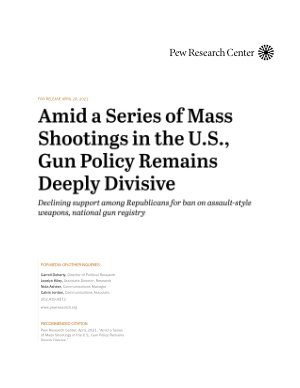
Amid a Series of Mass Shootings in the U.S, Gun Policy Remains Deeply Divisive

By Pew Research Center

In an era marked by deep divisions between Republicans and Democrats, few issues are as politically polarizing as gun policy. While a few specific policy proposals continue to garner bipartisan support, the partisan divisions on other proposals – and even on whether gun violence is a serious national problem – have grown wider over the last few years.

Today, just over half of Americans (53%) say gun laws should be stricter than they currently are, a view held by 81% of Democrats and Democratic-leaning independents but just 20% of Republicans and Republican leaners. Similarly, while nearly three-quarters of Democrats (73%) say making it harder to legally obtain guns would lead to fewer mass shootings, only 20% of Republicans say this, with most (65%) saying this would have no effect.

The new national survey by Pew Research Center, conducted from April 5-11, 2021 among 5,109 adults, finds that 73% of Democrats consider gun violence to be a very big problem for the country today, compared with just 18% of Republicans who say the same. The current partisan gap on this question is 11-percentage-points wider than in 2018 and 19 points wider than in 2016.

Washington, DC: Pew Research Center, 2021. 29p.

download
The National Cost of Gun Violence: The Price Tag for Taxpayers

By The National Institute for Criminal Justice Reform

In 2021, gun violence killed 20,984 people in the United States, more than any single year in the preceding two decades.1 Daily shootings in communities across the country are the most common form of gun violence. On average, 14,062 people are murdered every year by someone using a gun.2 Gun violence is disproportionately concentrated in urban centers, usually in underserved communities of color. Of the more than 13,000 firearm related homicide victims in the US in 2020, 55.8% were Black men.3 Although Black men and boys between the ages 15 and 34 make up just 2% of the nation’s population, they accounted for 37% of gun homicide victims in 2019,4 making homicide the leading cause of death for Black males in this age range.5 According to the American Journal of Medicine, US residents are 25 times more likely to be killed from gun violence than the citizens of any other developed country.6 In addition to its human toll, gun violence imposes a substantial economic cost on society. Direct costs include law enforcement and the criminal justice system, hospital and rehabilitation, incarceration, and victim support. Indirect costs include lost tax revenue, lost business opportunities, reduced property values, and neighborhood population decline and destabilization. When someone is shot, there is an immediate, multifaceted response from an array of government agencies. The fire department dispatches emergency medical technicians (EMTs), government-contracted ambulances respond, and several police department units as well as staff from a city’s office of violence prevention or contracted outreach workers descend on the scene. Investigators from the district attorney’s office also often arrive, and if the victim is declared dead on the scene, the coroner is called. And this is only the immediate aftermath of the shooting. Costs accumulate for many months, even years following a shooting. For surviving victims this includes hospitalization and, in the case of serious injury, rehabilitation–both of which are often paid for by tax dollars. This also includes victim compensation and a protracted investigation by the police department and prosecutors. When there are multiple victims and/ or multiple suspects, the cost of a single shooting incident will increase accordingly.

NICJR has calculated the costs of shootings in numerous cities across the country, deliberately using conservative estimates and only counting documentable direct costs.7 Using these studies as a starting point, this report aggregates the city-specific data and combines it with other data sources to model the direct unit costs and the direct average costs of gun violence nationwide.8 Unit costs reflect all of the potential costs of a single incident of gun violence, while average costs take into account the fact that certain costs are not incurred for every incident. For example, this report estimates the costs that gun violence imposes on the courts, district attorney, and public defender when a suspect is charged and goes to trial. However, because many incidents of gun violence do not result in prosecution or a trial, these estimates, or unit costs, are deflated to calculate the average cost per shooting

NICJR calculates that the unit cost of a single gun-related homicide is just over $1.2 million, while the average cost, or the cost per homicide, is approximately $625,000. This means that, on average, the total direct cost of gun-related homicides in the United States is more than $8.7 billion each year. For non-fatal injury shootings, NICJR calculates the unit cost at almost $700,000, with an average per-shooting cost of about $337,000, for an annual total of $11.7 billion.9 Combined, the total cost of gun homicides and non-fatal shootings is over $20 billion per year. If indirect expenses were included, the total cost of shootings would be much higher.

National Institute for Criminal Justice Reform, 19p.

download
Effective and Innovative Practices among European Civilian Firearm Registries

By Emile LeBrun and Aline Shaban

The fight against illicit firearms proliferation and misuse in the EU and its neighbors is a multifaceted challenge. This challenge encompasses the diversion of arms from national stocks and actors; trafficking from inside and outside the region; the illicit manufacture or transfer of parts, components, accessories, and ammunition; and the conversion of alarm, signal, acoustic, and air guns.

An equally important dimension is the administration, management, and control of legally held small arms through civilian firearms registries. Ensuring national authorities have visibility and insight into the import, sale, use, export, or destruction of all legally held firearms across their life cycle is essential in preventing civilian firearm movement into the illicit market and subsequent misuse or violence.

Effective and Innovative Practices among European Civilian Firearm Registries—a new report co-published by the Survey and its REGISYNC project partners Arquebus, the Centre for the Study of Democracy (CSD), and Ecorys—provides an assessment of current civilian firearm registry standards and practices, and identifies particularly innovative and effective measures to enhance firearms registries beyond common standards in the EU.

Sofia, Bulgaria: Centre for the Study of Democracy , 2023. 75p.

download
Weapons Compass: The Caribbean Firearms Study

By Anne-Séverine Fabre, Nicolas Florquin, Aaron Karp, and Matt Schroeder

The Caribbean region suffers from some of the world’s highest rates of violent deaths, with firearms used in the majority of these crimes. Although most homicide victims are men, the Caribbean as a region also faces one of the world’s highest rates of violent deaths among women. While much emphasis has been placed on firearms control at both the political and operational levels, illicit firearms and the dynamics of illicit arms markets in this region have received little research attention. In response, the Caribbean Community (CARICOM) Implementation Agency for Crime and Security (IMPACS) partnered with the Small Arms Survey to carry out a comprehensive evidence-based study of illicit arms trafficking to and within the Caribbean, and the socio-economic costs of firearm-related violence in the region. This Report examines these issues by drawing on data and information collected from 13 of the 15 CARICOM member states and from 22 Caribbean states in total. The study also incorporates the results of original fieldwork undertaken by regional partners, including interviews with prison inmates serving firearm-related sentences, and research in selected hospitals related to gunshot wounds and the associated medical costs and productivity losses for patients..

Geneva, sWIT: Small Arms Survey, 2023. 178p.

download
Notes From the Field: Firearm Homicide Rates, by Race and Ethnicity — United States, 2019–2022

By Scott R. Kegler, Thomas R. Simon, Steven A. Sumner,

The rate of firearm homicide in the United States rose sharply from 2019 through 2020, reaching a level not seen in more than 2 decades, with ongoing and widening racial and ethnic disparities (1). During 2020–2021, the rate increased again (2). This report provides provisional firearm homicide data for 2022, stratified by race and ethnicity, presented both annually and by month (or quarter) to document subannual changes.

MMWR Morb Mortal Wkly Rep 2023;72:1149–1150.

download
Strategic Stability in Outer Space After Russia's Invasion of Ukraine

By Baklitskiy, Andrey

From the document: "The space dimension is crucial in nuclear relations between the US and Russia. Space systems support vital functions like early warning, communication, reconnaissance, and targeting directly connected to strategic stability. However, shifting geopolitics and the disappearance of arms control agreements put the space dimension under strain. The Russian invasion of Ukraine showcases modern warfare's reliance on space assets. It also influences space dynamics and US-Russian relations. Although the current impact on strategic stability is limited, it is important to consider it. The most essential element of strategic stability in the space domain--the taboo against kinetic satellite attacks--endures, but there are reasons for concern. The broad use of civilian satellites for military purposes, Russia's evolving stance regarding targeting space objects, cyber-attacks against space infrastructure, the disappearance of provisions for noninterference with space assets, and sanctions affecting space industry--all of these in their separate ways could lead to crisis and undermine strategic stability. On top of this, the lack of dedicated channels for US-Russian dialogue on space security diminishes prospects for crisis prevention or mitigation."

CNA Corporation. 2023. 34p.

download