

The Pinkertons: A Detective Dynasty
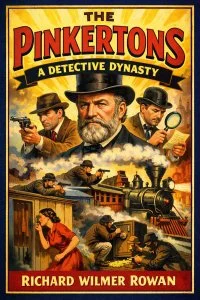
By Richard Wilmer Rowan/ Introduction Graeme R. Newman
The enduring legacy of the Pinkerton National Detective Agency serves as a foundational blueprint for modern private security and state surveillance, making Richard Wilmer Rowan’s 1931 chronicle, The Pinkertons: A Detective Dynasty, an essential text for understanding the evolution of policing in the twenty-first century. When Rowan published this work, the United States was grappling with the rise of organized crime and the professionalization of the FBI under J. Edgar Hoover, yet the shadow of the Pinkerton "Eye" remained the most potent symbol of investigative authority in the American consciousness. To read this book today is to witness the birth of the surveillance state and the privatization of law enforcement, themes that have only intensified with the advent of digital tracking and global security conglomerates. Rowan provides a meticulous window into how a single family transformed from a small Midwestern agency into a quasi-governmental force that, at its peak, employed more men than the standing army of the United States. This historical dominance raises uncomfortable but necessary questions about the blurred lines between private profit and public safety, a tension that remains at the heart of contemporary debates regarding police reform and the rise of private military contractors.
Rowan’s examination of Allan Pinkerton’s tenure as the head of the Union Intelligence Service during the Civil War—the precursor to the Federal Secret Service—highlights the original sin of American intelligence: the reliance on private entities to perform core state functions. The portrait of Pinkerton that opens the book is not merely a likeness of a man but an icon of the "Eye that never sleeps," a concept that has evolved from a physical detective on a street corner to the algorithmic "always-on" monitoring of the internet and public spaces. In today’s context, the methods pioneered by the Pinkertons, such as the systematic collection of "mug shots" and the creation of detailed criminal databases, are the direct ancestors of facial recognition technology and predictive policing. By studying Rowan’s account of these early techniques, a modern reader can trace the genealogy of modern privacy erosion, recognizing that the desire for total information awareness is not a product of the silicon age but a nineteenth-century ambition codified by the Pinkerton dynasty.
Furthermore, the book’s detailed accounts of the agency’s role in labor disputes offer a sobering reflection on the current state of corporate security and workers' rights. The Pinkertons became synonymous with "union-busting" and the violent suppression of strikes, most notably during the Homestead Strike of 1892, an event that Rowan treats with the gravity of a military campaign. In an era where modern tech giants and multinational corporations are frequently accused of using sophisticated surveillance and psychological tactics to discourage unionization, the tactics described in this 1931 text feel disturbingly fresh. Rowan allows us to see that the privatization of force has historically served to protect capital at the expense of civil liberties, providing a historical mirror for today’s discussions on the "gig economy" and the power dynamics between massive employers and their workforces.
Ultimately, Rowan’s narrative is relevant because it captures the transition of the detective from a romanticized figure of justice into a cold instrument of institutional power. While the book was written nearly a century ago, its exploration of how information is gathered, how secrets are traded, and how private individuals can wield the authority of the law remains the central drama of our digital age. It serves as a reminder that the "Lawless Police" described by Hopkins and the "Detective Dynasty" described by Rowan are two sides of the same coin—a persistent struggle to define where the power of the state ends and the rights of the individual begin. As we navigate an era defined by data breaches, private security patrols in residential neighborhoods, and state-sponsored cyber-espionage, Rowan’s history provides the necessary context to understand that we are not living in a new world, but rather a more technologically advanced version of the one the Pinkertons built.
Boston. Little, Brown, And Company. I931. Read-Me.Org Inc. New York-Philadelphia-Australia. 2026. p.208.