
New Light on Delinquency -- A Reader's Guide
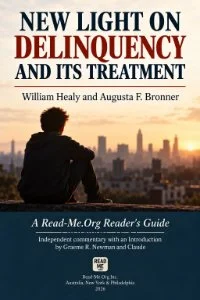
New Light on Delinquency and Its Treatment: A Read-Me.Org Reader's Guide
by Graeme R. Newman and Claude
Why does one child in a family become delinquent while a brother or sister, raised under the same roof in the same neighborhood, does not? In 1936 William Healy and Augusta F. Bronner, pioneers of the American child guidance movement, set out to answer that question in a landmark study for Yale's Institute of Human Relations. Working with 133 families in Boston, New Haven, and Detroit, they compared delinquents with their own non-delinquent siblings, treated the family rather than the child as the unit of care, and followed the results for years afterward. Their conclusion was that serious delinquency almost always grows out of frustrated needs for affection, recognition, and security within the family. It shaped juvenile justice and social work for a generation.
This Reader's Guide is an independent commentary organized around the questions a thoughtful reader might ask:
how the research was designed and what it found;
what delinquency means to the young person who commits it;
which offenders responded to treatment, and which did not.
It also places the book in its time, alongside Shaw and McKay, Sutherland, and the Gluecks, and weighs its findings against later research on attachment, hyperactivity, risk assessment, and family-based treatment. Review questions, a glossary, a timeline, and suggestions for further reading make it suitable for students, reading groups, and practitioners.
The original 1936 work remains under copyright. This guide does not reproduce its text, tables, or case histories. Read the original book online
Read-Me.Org Inc. New York-Philadelphia-Australia. 2026. p.48