
Pathological Lying, Accusation, and Swindling: A Reader's Guide
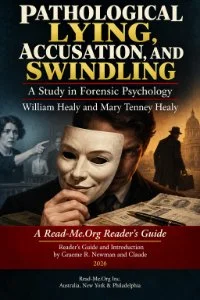
Edited and adapted by Graeme R. Newman and Claude. of the classic by William Healy and Mary Tenney Healy.
Why would someone tell elaborate lies that bring no gain, damage their own interests, and are certain to be exposed? Why would a fifteen-year-old falsely accuse her own mother of murder, or a university student confess to a killing that never happened?
In 1915, William Healy, America's pioneer of scientific delinquency research, and his wife, Mary Tenney Healy, published the first major study in English of this baffling behavior. Pathological Lying, Accusation, and Swindling drew on case records from the Juvenile Psychopathic Institute of the Chicago Juvenile Court. It defined a phenomenon that courts, lawyers, and physicians barely recognized: falsification "entirely disproportionate to any discernible end in view," by people who were otherwise mentally normal.
The Healys' cases are unforgettable:
a young woman who posed as a missing heiress and inserted a hairpin into her own surgical scar to gain admission to hospitals
a nine-year-old whose false accusation sent her father and brother to jail
a German immigrant boy who haunted New York courtrooms as a self-taught "lawyer" while swindling his way across the country
a girl whose false story of vice, told after a revival meeting, set the police investigating the city's underworld
Tracing each career back to childhood, the Healys found its roots in deception that worked, in households where lying was normal, in early experiences that had to be kept secret, and in hidden mental conflicts. Their most striking conclusion was that, contrary to earlier European opinion, many pathological liars could be cured.
This Read-Me.Org Reader's Guide explains the book question by question in clear, modern English. It includes:
summaries of all 27 case histories, with fuller treatment of the most important ones
the earlier German studies that introduced the term pseudologia phantastica
the Healys' findings on causes, testimony, and treatment
a new Introduction, and a section connecting the book to Munchausen syndrome, false confessions, eyewitness research, child testimony, and famous impostors
a guide to the cases, a chronology, suggestions for further reading, a glossary of historical terms, and 28 review and discussion questions
Essential reading for students and practitioners in criminology, psychology, psychiatry, law, social work, and anyone who has ever wondered why some people cannot stop lying.
Read-Me.Org Inc. New York-Philadelphia-Australia. 2026. 46p..