
Open Access Publisher and Free Library
CRIMINAL JUSTICE.jpeg

CRIMINAL JUSTICE

CRIMINAL JUSTICE-CRIMINAL LAW-PROCDEDURE-SENTENCING-COURTS

Posts in Police Brutality
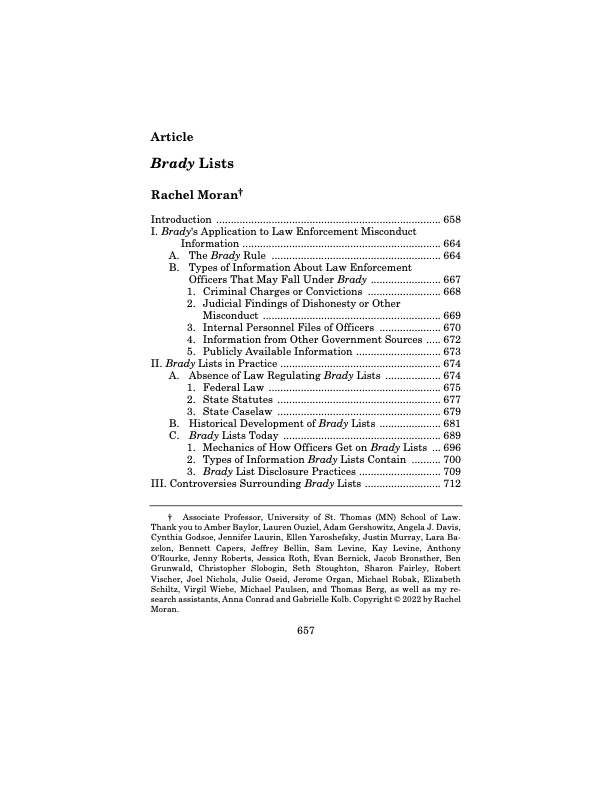
Brady Lists 

By Rachel Moran

Brady lists, named after the Supreme Court decision Brady v. Maryland,1 are lists some prosecutors maintain of law enforcement officers with histories of misconduct that could impact the officers’ credibility in criminal cases.2 Brady and its progeny require prosecutors to disclose exculpatory evidence within the government’s possession or control to defendants in criminal cases.3 This includes evidence that could impeach a witness’s credibility.4 Evidence that a police officer involved in a criminal case has, for example, previously written a false police report, lied in court, or used racial slurs during an arrest may be exculpatory because it casts doubt on the officer’s truthfulness, credibility, and impartiality.5 Brady lists originated from this disclosure obligation: the lists ostensibly allow prosecutors to keep track of, and disclose to defense counsel when necessary, information that negatively impacts officers’ credibility.6 Brady lists are simple in concept and complicated in practice. Prosecutorial practices around maintaining and using Brady lists vary widely and are almost completely unregulated.7Neither federal nor most state laws require prosecutors to maintain Brady lists, and recent journalist investigations suggest that most prosecutor offices do not maintain such lists.8 The lists that do exist are not all equal. Some prosecutor agencies maintain expansive lists of police officers who are accused of or found to have committed misconduct of nearly any kind,9 while others limit their Brady lists to officers with histories of dishonesty orcriminal convictions.10 Disclosure practices are similarly inconsistent: some prosecutors maintain Brady lists as internal mechanisms for assessing credibility concerns about their own officerwitnesses and refuse to provide their lists to people outside the office.11 Others affirmatively disclose their lists to defendants in criminal cases.12 Some make the lists available to the public.

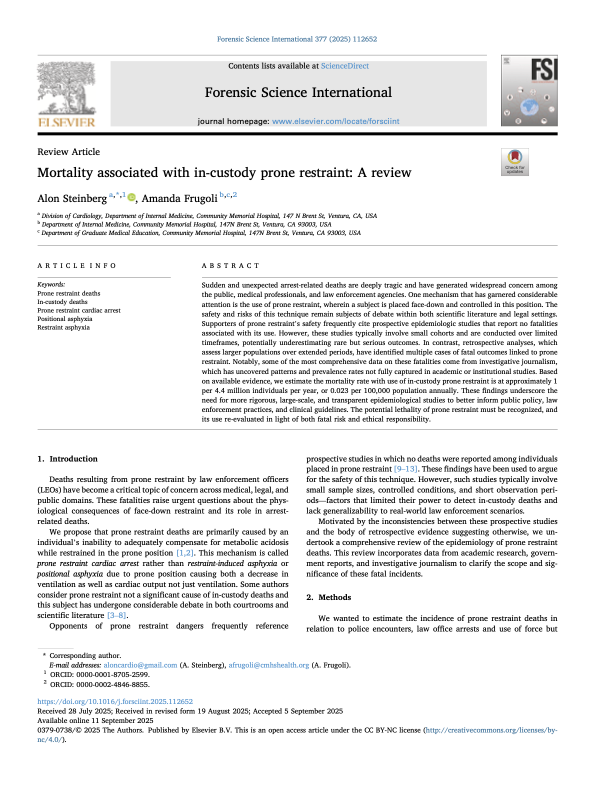
Mortality Associated with In-Custody Prone Restraint: A Review

By Alon Steinberg and Amanda Frugoli 

Sudden and unexpected arrest-related deaths are deeply tragic and have generated widespread concern among the public, medical professionals, and law enforcement agencies. One mechanism that has garnered considerable attention is the use of prone restraint, wherein a subject is placed face-down and controlled in this position. The safety and risks of this technique remain subjects of debate within both scientific literature and legal settings. Supporters of prone restraint’s safety frequently cite prospective epidemiologic studies that report no fatalities associated with its use. However, these studies typically involve small cohorts and are conducted over limited timeframes, potentially underestimating rare but serious outcomes. In contrast, retrospective analyses, which assess larger populations over extended periods, have identified multiple cases of fatal outcomes linked to prone restraint. Notably, some of the most comprehensive data on these fatalities come from investigative journalism, which has uncovered patterns and prevalence rates not fully captured in academic or institutional studies. Based on available evidence, we estimate the mortality rate with use of in-custody prone restraint is at approximately 1 per 4.4 million individuals per year, or 0.023 per 100,000 population annually. These findings underscore the need for more rigorous, large-scale, and transparent epidemiological studies to better inform public policy, law enforcement practices, and clinical guidelines. The potential lethality of prone restraint must be recognized, and its use re-evaluated in light of both fatal risk and ethical responsibility.