
Open Access Publisher and Free Library
CRIMINAL JUSTICE.jpeg

CRIMINAL JUSTICE

CRIMINAL JUSTICE-CRIMINAL LAW-PROCDEDURE-SENTENCING-COURTS

Posts in Traffickers
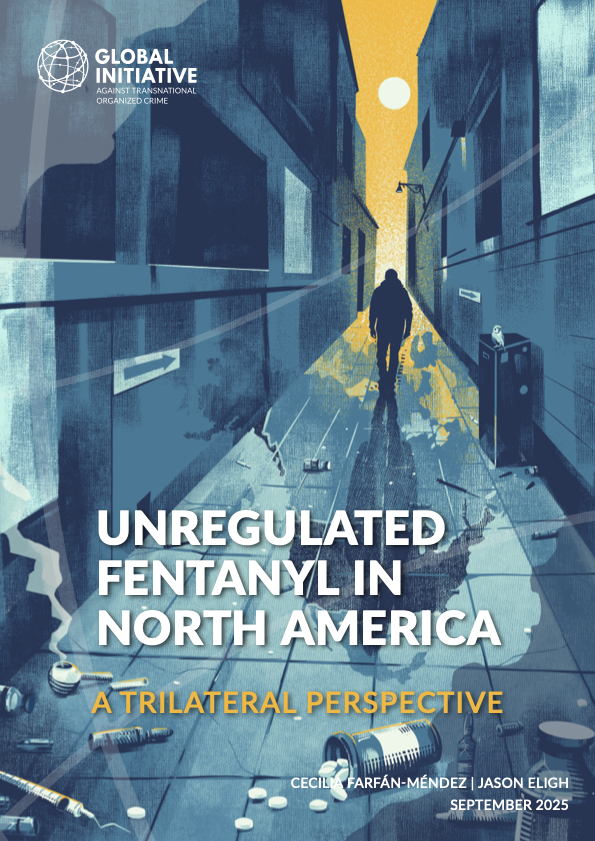
Unregulated Fentanyl in North America: A Trilateral Perspective

By CECILIA FARFÁN-MÉNDEZ | JASON ELIGH

More than 1.1 million people in the United States have died from opioid overdoses since 2000. In Canada, over 50,000 lives have been lost to opioid-related overdoses since 2016. Meanwhile, in Mexico, homicide—mostly committed with illegally trafficked firearms—is the leading cause of death among men aged 15 to 44. These overlapping crises reveal that the harms associated with synthetic opioids are not confined to one country but span all of North America.

This policy brief sheds light on how illicitly manufactured fentanyl (IMF) is produced and distributed within and across Mexico, the US, and Canada. The report reveals a complex and highly integrated system of production, tablet pressing, trafficking, and consumption. Far from being a product trafficked into North America, IMF is increasingly produced on its soil.

Key insights include the emergence of a new “golden triangle” of trafficking and violence between the Mexican states of Baja California, Sonora, and Sinaloa, where fentanyl production overlaps with high levels of firearm-related homicides. Fentanyl production in Mexico is closely linked to firearms trafficking from the United States, with Arizona emerging as a predominant source. In Canada, production largely serves the domestic market using chemical precursors imported directly and processed in clandestine labs. In the US, criminal actors engage in adulteration and tablet pressing—often making use of legal trade flows and customs loopholes to facilitate trafficking.

The paper also challenges common assumptions: 83.5% of those convicted of fentanyl trafficking in the US in 2024 were US citizens, and most trafficking across the Mexico–US border occurs through legal ports of entry, not between them.

Recommendations for all three countries focus on data transparency, coordinated public health responses, and transnational cooperation. The paper calls for more investment in evidence-based interventions and a shift away from unilateral or enforcement-only strategies.

Deaths in North America from overdoses and homicides linked to fentanyl are not inevitable. But addressing it requires governments to exchange know-how and coordinate action across borders, just as criminal networks do.
The Process of Transnationalization of Drug Trafficking Organisations: The case of the Mexican Cartels    

By Laura Diorella Islas Limiñana

This thesis seeks to develop a better understanding of the transnational behaviour of drug trafficking organisations (DTOs) by documenting the role that Mexican DTOs had in the cocaine trafficking to Europe after 2008. This was the year when the Italian authorities announced their discoveries that there were business interaction between the Mexican DTOs and the Italian mafia groups. At the same time the Italian authorities were announcing their findings, my literature review showed a lack of analysis and documentation regarding the transnationalization of Mexican DTOs to Europe.

While most of the literature focuses on the explanation of the cartels inside Mexico, my research question focused on clarifying whether or not the Mexican DTOs are expanding their cocaine trafficking activities to Europe. At this point I considered the reports of the Italian authorities that affirm that the Mexican DTOs are relevant drug trafficking intermediaries in the cocaine trafficking routes to Europe.

To answer my research question, and to systematically describe the evolution of DTOs, a qualitative methods approach was deployed (Mohajan, 2018) with a case study design adapted from Yin (2003). My analysis was carried out through the use of multiple triangulation techniques that helped me to collect and study different types of data to understand the subject. I collected empirical information through 28 interviews with security personnel with experience in countering Mexican DTOs or in the cocaine routes to Europe. The information gathered from the security personnel, complemented by official reports and open source information, was useful to answer my research question and test my hypothesis.

The analysis showed that despite Italian authorities’ claims and perceptions, the power of the Mexican cartels is very limited when talking about their presence and links in Europe, and resulted in four key findings. Firstly, that the perception of the Mexican DTOs as having trans-Atlantic powers is erroneous, because the evidence showed that there is no transatlantic expansion. Secondly, the analysis uncovered the internal, national and international variables that were observed to alter the evolution and behaviour of the Mexican DTOs. At the internal level, the variables included the loss of leadership and the grievances between groups. At the national level the identified variables were the democratic transitions, corruption and impunity networks. And at the international level the variables were the international drug demand, the changes in the international illicit world, the situation of governance and corruption in foreign countries and the geography of the region where the illicit business are taking place.

Billion-Dollar Blind Spot: Brazil’s Drug Traffickers and the Florida Corporate Registry

By C4ADS Staff

On August 28, 2025, Brazil launched Operation Carbono Oculto, reportedly the largest police operation targeting organized crime in its history. As part of Operation Carbono Oculto, at least 1,400 law enforcement agents executed 200 search and arrest warrants against 350 individuals and companies across 10 Brazilian states. The ongoing operation seeks to dismantle a network of individuals and companies accused of laundering money for the TCO Primeiro Comando da Capital (PCC). In São Paulo’s Faria Lima financial district—known as the Brazilian Wall Street—alone, the police served warrants at 42 fintech, real estate, and asset management firms. PCC’s infiltration of financial systems is not restricted to Brazil. Publicly available information exposes how the criminal group has extended its malign presence internationally, including in the United States. Founded in 1993 by eight inmates at the Taubaté Penitentiary in São Paulo, PCC has since expanded to a network of an estimated 40,000 members4 operating across five continents in at least 29 countries. While the PCC’s expansion was predominantly fueled by drug trafficking, which it likely continues to prioritize, it is now a “multinational of crime,” infiltrating multiple sectors in Brazil and worldwide.6When the U.S. Department of the Treasury sanctioned the PCC in December 2021, it described the group as “the most powerful organized crime group in Brazil and among the most powerful in the world.”7 In January 2024, the Brookings Institution called the PCC “a transnational criminal ‘leviathan’,”8 and in February 2025, The Washington Post described it as “South America’s most powerful drug-trafficking gang.”9 Despite its notoriety within law enforcement and policy circles, the PCC—and its access to the U.S. financial system—remain virtually unknown to the U.S. public. By leveraging publicly available corporate, judicial, and police records in the United States and Brazil, C4ADS identified an active Florida company, Bozhanaj Group Corporation, that may be servicing two alleged PCC members: Marinel Bozhanaj and Sebastião Cazula. C4ADS also uncovered alleged PCC money launderer João Gabriel de Mello Yamawaki’s Florida-registered companies from 2017.

Washington DC: C4ADS, 2025. 12p.