

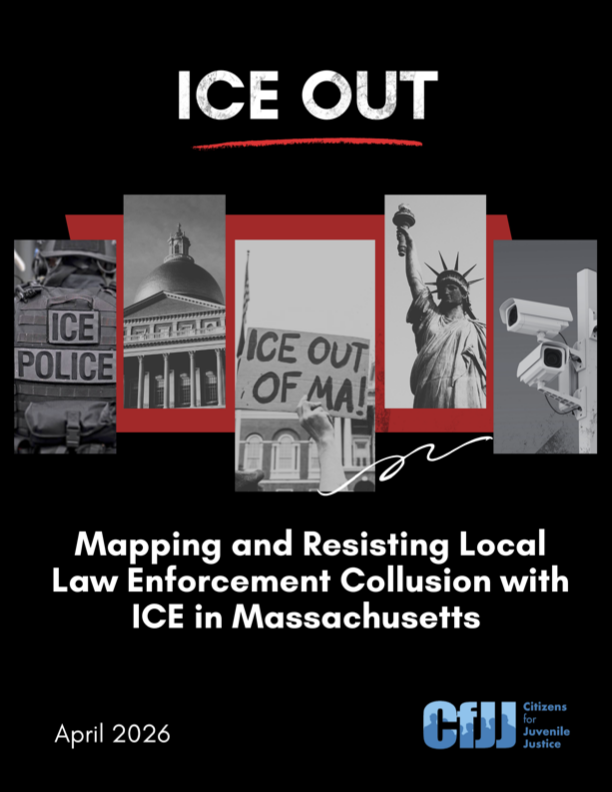
By Citizens for Juvenile Justice
This report by Citizens for Juvenile Justice (CfJJ) investigates the level of information sharing and collusion between police and courthouse staff with federal Immigration and Customs Enforcement (ICE) in Massachusetts. CfJJ filed more than 90 public records requests in the state and found that police and courthouse staff regularly share information with ICE, effectively becoming “force multipliers” for ICE. This report details specific ways police and courthouse staff are cooperating with ICE and cautions that this
practice undermines public trust, legitimacy, and democratic accountability. This report offers key policy and narrative recommendations to create guardrails around information sharing practices with ICE, including a proposed ban on transmitting youth fingerprints to the FBI (which are then shared with ICE).
By Kristin R Laurens, Lauren M Piltz. Linda J Graham, Emma J Carpendale. Stacy Tzoumakis. Felicity Harris. Tyson Whitten, Kimberlie Dean, Melissa J Green
The aim of this study was to examine the association between out-of-school suspension from primary school and early contact with police (by approximately 14 years of age). Using data from the New South Wales Child Development Study, this study determined the prevalence and pattern of suspension (by timing, total number, total days, and reason) and police contact (any, person of interest, victim, and/or witness) among 68,121 children who attended NSW public schools during 2012 to 2015 (Years 3 to 6). Associations between suspension and police contact were analysed using a demographically matched sample that compared all 3,291 suspended children with 6,582 like non-suspended peers. Suspended children had almost quadruple the odds of police contact relative to nonsuspended children after controlling for other factors. Children with more suspensions, and suspensions for more serious reasons, had even greater likelihood of police contact, especially as a person of interest. Findings highlight a need for systemic education and interagency reform to enact effective alternatives to suspension.
By The Australian Human Rights Commission'
The Commission's submission to the NSW Select Committee on Youth Justice highlights the need to move away from punitive responses to children’s offending and towards evidence‑based approaches that address underlying causes and improve outcomes for children and communities.
By Haoyao He
The phenomenon of delinquency among young people is one that is pervasive in the culture of today. Criminal laws in many countries frequently adopt unique procedures that are separate from those that are used to deal with adult delinquency when dealing with juveniles. These strategies are employed to deal with juveniles. It is because of the distinct psychological, physiological, and socialization levels that are linked with juveniles that this is the case. Not only does this unique scenario serve as an illustration of the humanitarian principles of criminal law, but it also serves as an illustration of the fundamental value orientation of giving precedence to the preservation and correction of the rights of children. In the framework of China's criminal law, the objective of this article is to analyze the legal underpinnings that underpin the specialized treatment of juvenile delinquency, as well as its institutional practice and process of optimization. Specifically, the study will focus on the treatment of juveniles who have committed crimes.
Assessing Multi-disciplinary Response Mechanisms
Edited by Paromita Chattoraj
Child Protection in India: Assessing Multi-disciplinary Response Mechanisms offers a comprehensive exploration of the institutional, legal, and social frameworks surrounding child protection in India. Anchored in a multidisciplinary approach, the book brings together insights from law, social work, psychology, education, and public policy to examine how various systems interact in addressing the issues related to protection of children from abuse, neglect, trafficking, and exploitation. This book is intended for researchers, academicians, legal professionals, social workers, policymakers, child rights activists, and students engaged in child welfare and protection studies. It critically analyses existing response mechanisms by stakeholders such as the Juvenile Justice Boards, Child Welfare Committees, Child Care Institutions, police, and the judiciary, and the implementation of various laws, including Juvenile Justice (Care and Protection) Act, the POCSO Act, Prohibition of Child Marriage Act, while also highlighting challenges in inter-agency coordination. By combining chapters under four broad themes focusing on empirical research, policy review, and case studies, this volume equips readers with a nuanced understanding of the gaps and strengths in current practices and highlights of best practices around the world. The book aims to foster a rights-based and child-centric approach, encouraging collaboration across disciplines and sectors. It is a valuable resource for anyone seeking to engage meaningfully with child protection frameworks in India and to contribute to more effective, sustainable interventions.
London: Routledge, 2026.
By Richard A. Miech, Lloyd D. Johnston, Megan E. Patrick, Patrick M. O’Malley
Substance use is a leading cause of preventable morbidity and mortality; it is in large part why, among 17 high-income nations, people in the United States have the highest probability of dying by age 50.1,2,3 Substance use is also an important contributor to many social problems including domestic violence, violence more generally, criminal behavior, suicide, and more—and it is typically initiated during adolescence. It warrants our sustained attention. Monitoring the Future (MTF) is designed to give such attention to substance use among the nation’s youth and adults. It is an investigator-initiated study that originated with, and is conducted by, teams of research professors at the University of Michigan’s Institute for Social Research. Since its onset in 1975, MTF has been funded continuously by the National Institute on Drug Abuse—one of the National Institutes of Health—under a series of peer reviewed, competitive research grants. The 2024 survey, reported here, is the 50th consecutive national survey of 12th grade students and the 34th national survey of 8th and 10th grade students (who were added to the study in 1991). MTF contains ongoing national surveys of both adolescents and adults in the United States. It provides the nation with a vital window into the important but often hidden problem behaviors of use of illegal drugs, alcohol, tobacco, and psychotherapeutic drugs used without a doctor’s orders. For nearly five decades, MTF has helped provide a clearer view of the changing topography of these problems among adolescents and adults, a better understanding of the dynamic factors that drive some of these problems, and a better understanding of some of their consequences. It has also given policymakers, government agencies, public health professionals, and nongovernmental organizations (NGOs) in the field some practical approaches for intervening. A widespread epidemic of illicit drug use emerged in the 1960s among U.S. youth, and since then dramatic changes have occurred in the use of nearly all types of illicit drugs as well as alcohol and tobacco. Of particular importance, as discussed in detail below, are the many new illicit drugs that have emerged, along with new forms of alcoholic beverages and nicotine products. Among the substances and devices that have emerged over the life of the survey are new classes of drugs that include vaping devices, hookah smoking, synthetic marijuana, and drugs taken for performance enhancement. New devices and methods for taking drugs, such as vaporizers and e-cigarettes,number of new substances added to the list over the years substantially outnumbers the number removed because so many substances remain in active use. Throughout these many changes, substance use among the nation’s youth has remained a major concern for parents, educators, health professionals, law enforcement, and policymakers, largely because substance misuse is one of the largest and yet most preventable causes of morbidity and mortality during and after adolescence. The MTF annual monograph series is a key vehicle for disseminating MTF’s epidemiological findings. In addition to this monograph, the series includes a separate, annual monograph that presents prevalence and trends among U.S. adults now ages 19 to 65, including both college students and their age peers who are not attending college (scheduled for publication this summer), as well as an additional, periodic monograph that presents information on risk and protective behaviors for HIV among young adults. All MTF publications, including press releases, are available on the project website at www.monitoringthefuture.org
Ann Arbor: University of Michigan Institute for Social Research , 2025. 484p.