Open Access Publisher and Free Library
CRIMINAL JUSTICE.jpeg

CRIMINAL JUSTICE

CRIMINAL JUSTICE-CRIMINAL LAW-PROCDEDURE-SENTENCING-COURTS

Posts tagged Fraud
The Scam Economy: The True Cost of Online Scams and Crimes in America

By  Consumer Federation of America

Federal agencies, third parties, and other groups report on scam losses each year, but these numbers are only the tip of the iceberg in measuring the size and devastation experienced by those who are targeted. Behind these reports and big spreadsheets describing reported losses are shattered families, rent money lost, and grandmothers exploited. Newer technology is leading to a rise in these scams – in both severity and number: AI is supercharging these scams, social media platforms are enabling the spread, and data brokers facilitate targeting of victims, allowing criminals to reach consumers at massive scales while exploiting highly precise profiling to victimize vulnerable people. One of the biggest problems in fully understanding the scope of these scams is underreporting. Due to reporting fragmentation and communication, as well as the understandable devastation, embarrassment, and confusion that victims often feel, estimates on how many people report their losses to scams put it extremely low – often in the single digit percent of the actual number, according to conservative key government estimations. CFA is proud to publish this report that takes the most conservative estimate of underreporting and uses it to estimate The True Cost of Scams. While this issue is complicated to solve completely, there are significant unrealized opportunities for legislators, enforcement agencies, and industry to step up to address it.

Washington, DC: Consumer Federation of America, 2026, 31p.
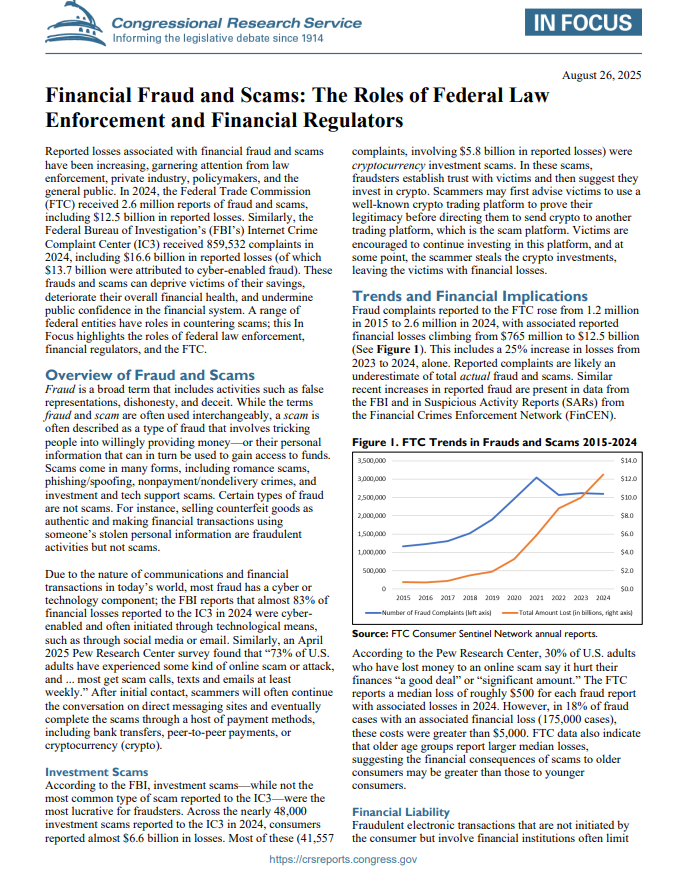
Financial Fraud and Scams: The Roles of Federal Law Enforcement and Financial Regulators

By the Federal Trade Commission

Reported losses associated with financial fraud and scams have been increasing, garnering attention from law enforcement, private industry, policymakers, and the general public. In 2024, the Federal Trade Commission (FTC) received 2.6 million reports of fraud and scams, including $12.5 billion in reported losses. Similarly, the Federal Bureau of Investigation’s (FBI’s) Internet Crime Complaint Center (IC3) received 859,532 complaints in 2024, including $16.6 billion in reported losses (of which $13.7 billion were attributed to cyber-enabled fraud). These frauds and scams can deprive victims of their savings, deteriorate their overall financial health, and undermine public confidence in the financial system. A range of federal entities have roles in countering scams; this In Focus highlights the roles of federal law enforcement, financial regulators, and the FTC.

Washington, DC: Federal Trade Commission, 2026. 3p.

State-Corporate Crime, Systemic Risk, and Governance Failures in Mass Transportation: Insights from the Tempi Train Tragedy

By Nikos Passas, Stratos Georgoulas, Christos Kouroutzas, Dimitris Paraskevopoulos 

This paper analyzes the Tempi railway tragedy of 28 February 2023 as a case of state-corporate crime and institutional corruption rather than a mere accident, focusing on the systemic endangerment of Greece’s mass transportation system. Drawing on qualitative content analysis of official documents and media records, 76 semi-structured interviews, and ongoing participant observation, the study reconstructs how safety-critical investments and controls were undermined by corrupt practices, regulatory neglect, and austerity-driven privatization. The analysis shows how criminogenic asymmetries, dysnomie, and the normalization of deviance allowed unlawful and “lawful but awful” policies to hollow out the railways’ safety function while serving mutually reinforcing state and corporate interests. These governance failures obscured systemic risk, facilitated the misrepresentation of violations as “human error,” and weakened transparency, accountability, and effective compliance in the rail sector. By situating Tempi within a comparative framework of state-corporate crimes and transport disasters, the paper highlights the blurred boundaries between financial crime, institutional corruption, and regulatory failure in critical infrastructure. It concludes with policy and compliance recommendations aimed at strengthening structural accountability, restoring institutional integrity, and reducing systemic risk in mass transportation governance.

Journal of Illicit Trade, Financial Crime, and Compliance, vol. 1, 205.

The Limits of Individual Prosecutions in Deterring Corporate Fraud

By Samuel W. Buell

Fifteen years after the largest financial scandal and economic crisis in a century, discussion of the problem of corporate crime too often borders on cliché. Endless calls from Congress, the media, the public, many scholars, and even the Justice Department itself, to recommit, over and over, to locking up more managers and executives to deter corporate wrongdoing portray the problem as relatively straightforward and blame legislative and executive failure of will. Through examination of the litigation record from over 100 prosecutions spanning the period from the 2008 financial crisis to the present, this Article presents evidence that relying on individual prosecutions to deter the most significant corporate crimes, especially those involving fraud in the financial sector, is less promising than believed. Structural features of crimes in the largest corporate organizations have made securing individual convictions and imprisonment, especially at senior levels, a chancy project for prosecutors. The Article further argues that its evidence relating both to failure rates and causes of those failures should point policymakers and enforcers beyond hackneyed calls for perp walks and prison and towards deeper thinking about a full suite of preventive tools, especially regulatory design.

Wake Forest Law Review, Vol. 59. 2024, 78pg