
Open Access Publisher and Free Library
CRIMINAL JUSTICE.jpeg

CRIMINAL JUSTICE

CRIMINAL JUSTICE-CRIMINAL LAW-PROCDEDURE-SENTENCING-COURTS

Posts tagged Parental incarceration
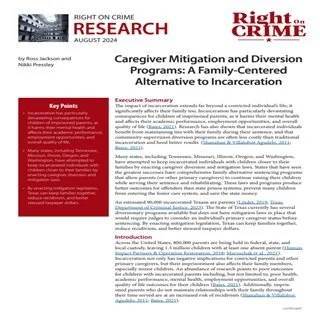
Caregiver Mitigation and Diversion Programs: A Family-Centered Alternative to Incarceration

By Ross Jackson, Nikki Pressley

The incarceration of parents has devastating effects on the family unit, especially on health, education, employment, and quality of life outcomes for children. Texas should enact mitigation laws that redirect parents who commit non-violent, non-serious crimes to diversionary programs that keep them at home with their children while serving their sentence.

KEY POINTS

  • Incarceration has particularly devastating consequences for children of imprisoned parents, as it harms their mental health and affects their academic performance, employment opportunities, and overall quality of life.

  • Many states, including Tennessee, Missouri, Illinois, Oregon, and Washington, have attempted to keep individuals with children closer to their families by enacting caregiver diversion and mitigation laws.

  • By enacting mitigation legislation, Texas can keep families together, reduce recidivism, and better steward taxpayer dollars.

Austin TX: Right On Crime, 2024. 12p.

link
The Intergenerational Transmission of Criminal Justice Contact 

By Christopher Wildeman

This article provides a critical overview in five stages of roughly 50 years of research on the intergenerational transmission of criminal justice contact. In the first stage, I document that research on the intergenerational transmission of crime and criminal justice contact focused primarily on crime until the mid-1990s, at which point research rapidly shifted in the direction of criminal justice contact (specifically, incarceration). In the second stage, I document that research on the intergenerational transmission of crime and the intergenerational transmission of criminal justice contact tended to use the same measures—i.e., self-reported and administrative indicators of criminal justice contact with minimal information on criminal activity—but discussed them in different ways. In the third stage, I review research on the broader effects of incarceration to highlight mechanisms through which parental criminal justice contact may independently influence children's criminal activity. In the fourth stage, I review research on the intergenerational transmission of criminal justice contact. In the final stage, I conclude by calling for new data collection efforts that provide high-quality measures of both crime and criminal justice contact of both parents and children.

Annual Review of Criminology, 2020.

download