
Open Access Publisher and Free Library
CRIMINAL JUSTICE.jpeg

CRIMINAL JUSTICE

CRIMINAL JUSTICE-CRIMINAL LAW-PROCDEDURE-SENTENCING-COURTS

Posts tagged carceral citizenship
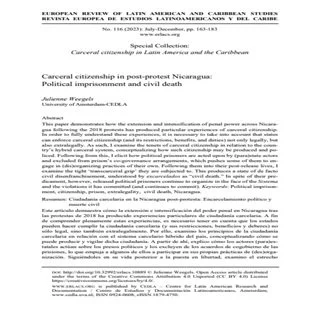
Carceral Citizenship in Post-Protest Nicaragua: Political Imprisonment and Civil Death

By Julienne Weegels University of Amsterdam

This paper demonstrates how the extension and intensification of penal power across Nicaragua following the 2018 protests has produced particular experiences of carceral citizenship. In order to fully understand these experiences, it is necessary to take into account that states can enforce carceral citizenship (and its restrictions, benefits, and duties) not only legally, but also extralegally. As such, I examine the tenets of carceral citizenship in relation to the country’s hybrid carceral system, conceptualizing how such citizenship may be produced and policed. Following from this, I elicit how political prisoners are acted upon by (para)state actors and excluded from prison’s co-governance arrangements, which pushes some of them to engage in (dis)organizing practices of their own. Following them into their post-release lives, I examine the tight ‘transcarceral grip’ they are subjected to. This produces a state of de facto civil disenfranchisement, understood by ex-carcelados as “civil death.” In spite of their predicament, however, released political prisoners continue to organize in the face of the Sistema and the violations it has committed (and continues to commit). 

EUROPEAN REVIEW OF LATIN AMERICAN AND CARIBBEAN STUDIES, No. 116 (2023): July-December, pp. 163-183
download
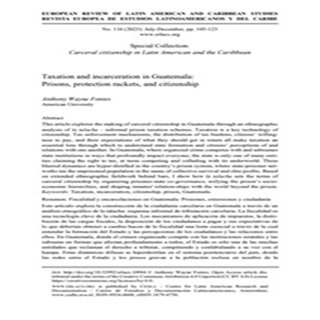
Taxation and Incarceration in Guatemala: Prisons, Protection Rackets, and Citizenship

By Anhony Wayne Fontes

This article explores the making of carceral citizenship in Guatemala through an ethnographic analysis of la talacha – informal prison taxation schemes. Taxation is a key technology of citizenship. Tax enforcement mechanisms, the distribution of tax burdens, citizens’ willingness to pay, and their expectations of what they should get in return all make taxation an essential lens through which to understand state formation and citizens’ perceptions of and relations with one another. In Guatemala, where organized crime competes with and subsumes state institutions in ways that profoundly impact everyone, the state is only one of many entities claiming the right to tax, at turns competing and colluding with its underworld. These blurred dynamics are hyper-distilled in the country’s prison system, where state-prisoner networks tax the imprisoned population in the name of collective survival and elite profits. Based on extended ethnographic fieldwork behind bars, I show how la talacha sets the terms of carceral citizenship by organizing prisoner-state co-governance, reifying the prison’s socioeconomic hierarchies, and shaping inmates' relationships with the world beyond the prison. 

EUROPEAN REVIEW OF LATIN AMERICAN AND CARIBBEAN STUDIES No. 116 (2023): July-December, pp. 105-123

download