

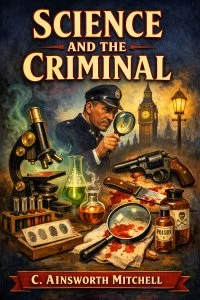
By C. Ainsworth Mitchell. Preface by Graeme R. Newman
Science and the Criminal (1911) stands as one of the earliest comprehensive guides to the emerging field of forensic science. In this landmark work, British chemist and criminologist C. Ainsworth Mitchell reveals how the laboratory was beginning to reshape the detective’s craft and the courtroom’s understanding of truth. From the identification of poisons and trace substances to handwriting analysis, fingerprinting, microscopy, and early forensic photography, Mitchell shows how scientific method was transforming criminal investigation at a moment when traditional policing still relied heavily on intuition, confession, and circumstantial inference. Far more than a technical manual, this book captures the excitement and uncertainty of an era when scientific evidence first began to challenge long-established legal traditions. Mitchell writes with clarity, skepticism, and enthusiasm, advocating for a justice system grounded in demonstrable fact rather than prejudice or speculation.
For modern readers, Science and the Criminal offers both a vivid historical portrait of forensic science in its infancy and a reminder of enduring questions about expertise, evidence, and the pursuit of truth—questions that remain as urgent in today’s digital and biometric age as they were in the Edwardian courtroom. A foundational text brought back to life for contemporary audiences, this Read-Me.Org edition invites a deeper understanding of how science became one of society’s most powerful tools for uncovering—and proving—the truth.
Little Brown. 1911. Read-Me.Org. 2026. 168p