
By Brandon Garrett
Most jurisdictions in the United States now record interrogations, including all federal law enforcement agencies, thirty states, and the District of Columbia. This memo provides updated information about the state-level adoption of electronic recording requirements, in a table displayed below, through statutes, court rulings and rules, and police policies. In addition, many localities now require the recording of some of all interrogations. 1 Leading law, psychology, criminal procedure, and policing experts have long recommended electronically recording interrogations, preferably by videotaping the full interrogation. The American Psychology-Law Society has set out what is known about police-induced confessions and has recommended mandatory electronic recording. 2 The International Association of Chiefs of Police recommends recording “all interviews involving major crimes” and prefers video recordings.3 The American Law Institute’s Principles of Policing set out the principle that: “Written policies should set out the procedures for the recording of questioning, and for the disclosure and the retention of recorded evidence.” 4 A large body of high-profile exonerations of innocent persons have occurred in cases in which false confessions were obtained during interrogations that were not recorded. In cases of “confession contamination,” law enforcement falsely reports that a suspect had volunteered supposedly inside information during an interrogation. Almost all of the persons exonerated by post-conviction DNA testing, who had falsely confessed, also had reports by law enforcement that the defendant had volunteered key crime scene details. We now know, with the benefit of DNA testing, that law enforcement contaminated these interrogations through the use of leading questions or feeding facts to the suspect. And none of the interrogations in those cases of DNA exonerations had been recorded in their entirety.5 Recording police questioning assists law-enforcement agencies by furthering the important goal of documenting evidence and ensuring the conviction of those who commit wrongdoing.6 Video recordings also empower judges to better assess the reliability of interrogation evidence, both to reject false claims of police overreaching and to examine potential wrongful convictions. 7 Agencies have reported positive experiences with recording interrogations because it provides powerful documentation that interrogations are conducted professionally and non-coercively.8 Fears that “few would allow themselves to be interviewed or interrogated” if it were known that interviews and interrogations are recorded have not been realized in jurisdictions in which recording has been introduced. 9 That said, the Principles of Policing noted that some flexibility with reluctant witnesses may be important. In addition, it may be increasingly feasible to conduct video recording in the field, as body-worn cameras are utilized more widely by agencies. And that said, states do often provide for exceptions due to exigent circumstances, equipment malfunction and the like.10 As summarized below, state statutes increasingly have required recording at least some categories of police questioning of Justice has a memorandum setting out a policy for recording interrogations; several states have done the same. Although the Principles of Policing took no position on the admissibility of unrecorded statements, others have. For example, the Alaska Supreme Court has ruled that judges should suppress unrecorded statements unless failure to record is excused by good cause; other courts have adopted court rules or rules of evidence requiring electronic recording of interrogations. 12 The table below summarizes these statutes, court rulings, rules, and policies.
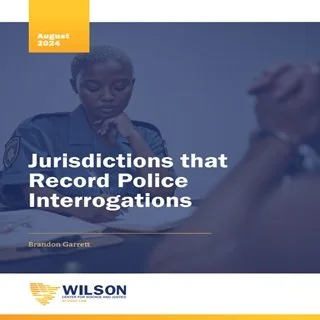
Durham, NC: Wilson Center for Science and Justice Duke University School of Law. 2024. 7p.
