
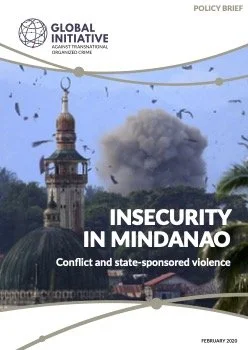
Insecurity in Mindanao: Conflict and State-Sponsored Violence
By Jason Eligh
This brief provides an overview of the challenges facing the various autonomous government authorities of Mindanao, in the southern Philippines, in transitioning the region from conflict to peacebuilding, and to assess the response of the Philippine state to these challenges. Mindanao has long been fractured by a toxic mixture of political violence, identity-based armed conflict, and ethnic and clan divisions, and has been beset by sustained rebel and terrorist violence. These divisive factors have militated against regional political unity and social coherence, exacerbated by the area’s socioeconomic and development challenges. This context has also provided fertile ground for non-state armed groups involved in criminal enterprises to develop. When strongman Rodrigo Duterte was elected mayor of Davao, the capital of Mindanao, before he became president of the country, his approach to regional insecurity took the form of a highly securitized crackdown involving state-sanctioned and extrajudicial violence meted out by death squads. The methodology is qualitative and presents a narrative grounded in both primary and secondary data sets. These are supplemented by publicly available resources from news, research and civil-society organizations. Key points ■ State-sponsored violence has been deployed in Mindanao, and the Philippines more broadly, as a national policy. ■ Extrajudicial killings have continued in the war on drugs across the Philippines, following the same pattern as the earlier violence under Duterte’s Davao Death Squad. ■ The government implemented martial law in the Mindanao region for two years – purportedly for security, but conveniently hindering investigations of human-rights abuses by the state
has also provided fertile ground for non-state armed groups involved in criminal enterprises to develop. When strongman Rodrigo Duterte was elected mayor of Davao, the capital of Mindanao, before he became president of the country, his approach to regional insecurity took the form of a highly securitized crackdown involving state-sanctioned and extrajudicial violence meted out by death squads. The methodology is qualitative and presents a narrative grounded in both primary and secondary data sets. These are supplemented by publicly available resources from news, research and civil-society organizations. Key points ■ State-sponsored violence has been deployed in Mindanao, and the Philippines more broadly, as a national policy. ■ Extrajudicial killings have continued in the war on drugs across the Philippines, following the same pattern as the earlier violence under Duterte’s Davao Death Squad. ■ The government implemented martial law in the Mindanao region for two years – purportedly for security, but conveniently hindering investigations of human-rights abuses by the state. ■ Mindanao has seen a disproportionately high number of killings of human-rights advocates and activists. ■ Extremist and rebel groups in Mindanao are involved in criminal economies, deriving financing from drug and arms trafficking, kidnapping and extortion. ■ There is evidence that political elites in the region are involved in illicit drug markets. ■ A fundamental factor in promoting regional security and stability will be the need to support Mindanao in its transition to a peaceful, resilient post-conflict future
Geneva: Global Initiative against Transnational Organized Crime, 2020. 25p.