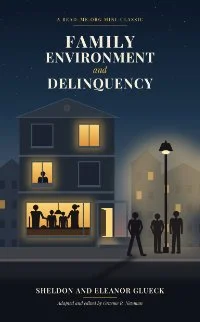
by Graeme Newman (Author), Sheldon Glueck (Author), Eleanor Glueck
Why do some children in a family, or on the same street, turn to delinquency while their brothers, sisters and neighbors do not?
In Family Environment and Delinquency (1962), Sheldon and Eleanor Glueck, the most celebrated husband-and-wife team in the history of criminology, set out to answer one of the oldest and most stubborn questions in the study of crime. Drawing on their landmark comparison of 500 persistent delinquents and 500 matched non-delinquents from the poor neighborhoods of Boston, they traced how the home, what they called the "under-the-roof culture," shapes children's traits, and how those traits and family conditions combine to push some boys over the edge.
Their answer was startling for its time and remains compelling today: the family environment works selectively. A drunken father, a chaotic household, harsh or erratic discipline, chronic poverty: none of these alone reliably produces a delinquent. What matters is the meeting of a particular pressure with a particular child. The Gluecks called it "differential contamination," which depends "not merely on exposure but also on susceptibility." It is an idea that anticipates today's research on gene-environment interaction and differential susceptibility.
The original book is dense with thousands of statistical tables. This Mini-Classic sets out its argument clearly and concisely, chapter by chapter. It includes an introduction to the book and its central ideas; a profile of Sheldon and Eleanor Glueck and their four-decade research partnership; the historical context of Unraveling Juvenile Delinquency, Physique and Delinquency, and the Gluecks' battle with differential association theory; a clear summary of every chapter, from the origins of traits to the practical management of delinquency; a chapter on modern relevance, from Sampson and Laub's rediscovery of the Glueck files to today's family-based prevention programs, with a frank account of what has not survived; and twenty review questions for students and discussion groups.
Ideal for students of criminology, sociology, psychology and social work, for practitioners working with young people and families, and for anyone interested in the enduring question of Nature and Nurture.
Read-Me.Org Mini-Classics make the landmark works of social science accessible to modern readers in brief, readable editions. Download the original book here.
Read-Me.Org Inc. New York-Philadelphia-Australia. 2026. p.67.