Open Access Publisher and Free Library
PUNISHMENT.jpeg

PUNISHMENT

PUNISHMENT-PRISON-HISTORY-CORPORAL-PUNISHMENT-PAROLE-ALTERNATIVES. MORE in the Toch Library Collection

Posts tagged Diversity
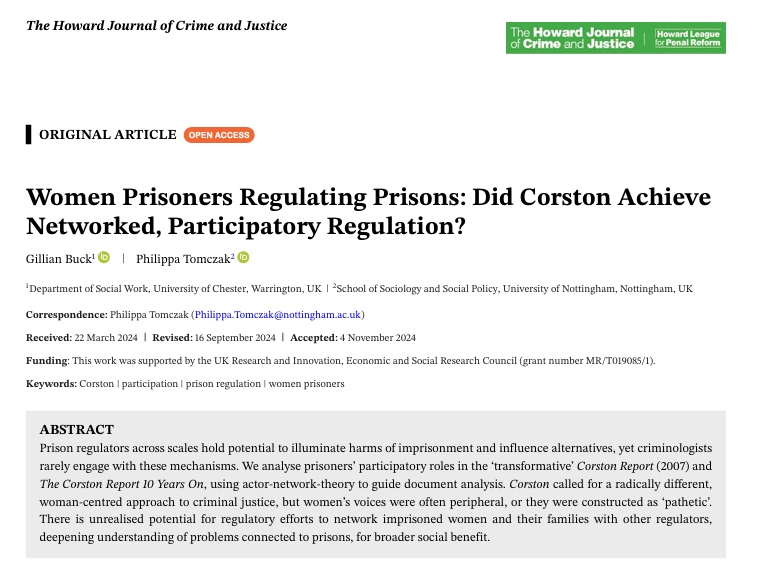
Women Prisoners Regulating Prisons: Did Corston Achieve Networked, Participatory Regulation?

By Gillian Buck, Philippa Tomczak


 Prison regulators across scales hold potential to illuminate harms of imprisonment and influence alternatives, yet criminologists rarely engage with these mechanisms. We analyse prisoners’ participatory roles in the ‘transformative’ Corston Report (2007) and The Corston Report 10 Years On, using actor-network-theory to guide document analysis. Corston called for a radically different, woman-centred approach to criminal justice, but women’s voices were often peripheral, or they were constructed as ‘pathetic’. There is unrealised potential for regulatory efforts to network imprisoned women and their families with other regulators, deepening understanding of problems connected to prisons, for broader social benefit.


The Howard Journal of Crime and Justice, 64(3), 405-414.
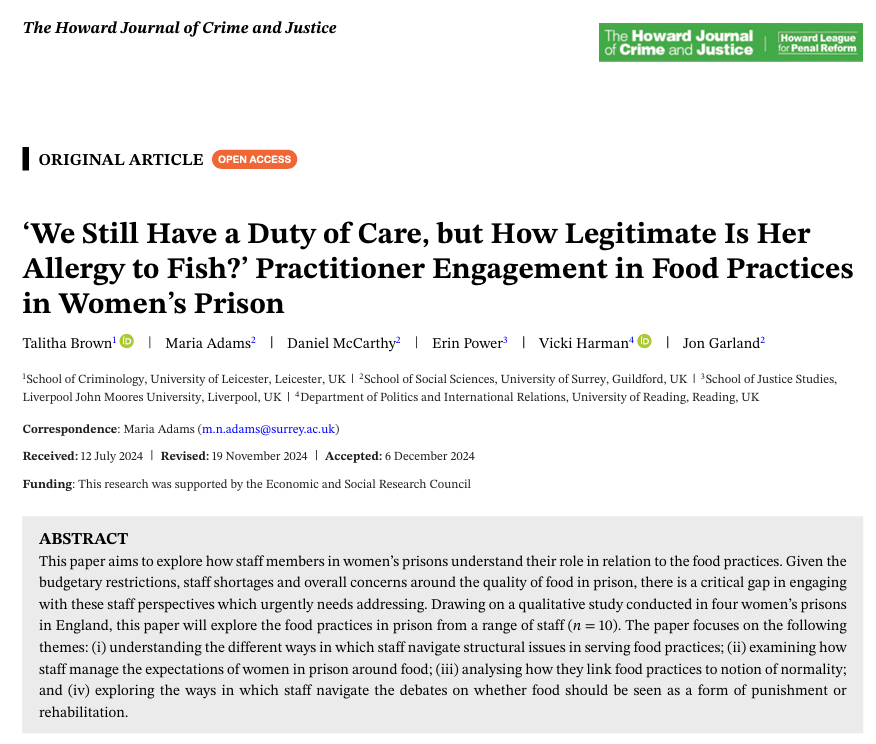
‘We Still Have a Duty of Care, but How Legitimate Is Her Allergy to Fish?’ Practitioner Engagement in Food Practices in Women's Prison

By Talitha Brown, Maria Adams, Daniel McCarthy, Erin Power, Vicki Harman, Jon Garland


This paper aims to explore how staff members in women’s prisons understand their role in relation to the food practices. Given the budgetary restrictions, staff shortages and overall concerns around the quality of food in prison, there is a critical gap in engaging with these staff perspectives which urgently needs addressing. Drawing on a qualitative study conducted in four women’s prisons in England, this paper will explore the food practices in prison from a range of staff (n = 10). The paper focuses on the following themes: (i) understanding the different ways in which staff navigate structural issues in serving food practices; (ii) examining how staff manage the expectations of women in prison around food; (iii) analysing how they link food practices to notion of normality; and (iv) exploring the ways in which staff navigate the debates on whether food should be seen as a form of punishment or rehabilitation.

The Howard Journal of Crime and Justice.