
Open Access Publisher and Free Library
SOCIAL SCIENCES.jpeg

SOCIAL SCIENCES

Social sciences examine human behavior, social structures, and interactions in various settings. Fields such as sociology, psychology, anthropology, and economics study social relationships, cultural norms, and institutions. By using different research methods, social scientists seek to understand community dynamics, the effects of policies, and factors driving social change. This field is important for tackling current issues, guiding public discussions, and developing strategies for social progress and innovation.

Posts in Mexico
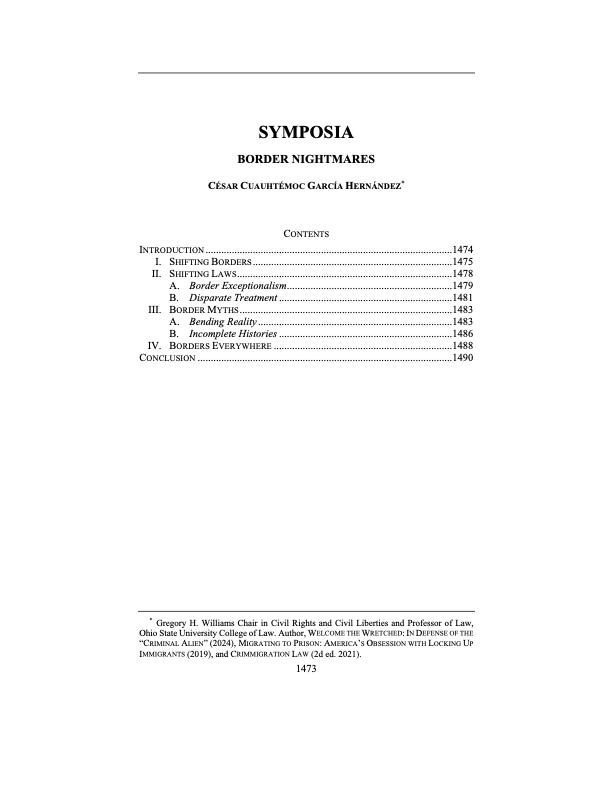
Border Nightmares

By César Cuauhtémoc García Hernández

The border that the United States shares with México is extraordinary and illusive. It meanders through political conversations and moves from place to place, leaving courts to wonder where it is and what it means to the lives of the ordinary people who occupy this extraordinary space. Courts imagine the border as a site of exceptional danger to which they have responded by creating a law of border exceptionalism. This essay describes the normative and empirical justifications and legal doctrine of border exceptionalism before challenging its foundations. Unmoored from its justifications, there is nothing to stop the law of border exceptionalism to spread far from the borderlands.
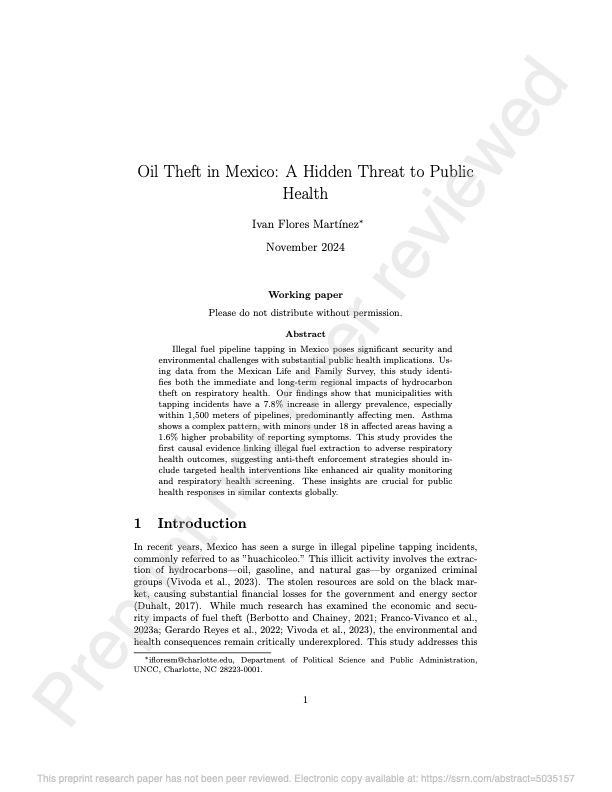
Oil Theft in Mexico: A Hidden Threat to Public Health

By Ivan Flores Martinez

Illegal fuel pipeline tapping in Mexico poses significant security and environmental challenges with substantial public health implications. Using data from the Mexican Life and Family Survey, this study identifies both the immediate and long-term regional impacts of hydrocarbon theft on respiratory health. Our findings show that municipalities with tapping incidents have a 7.8% increase in allergy prevalence, especially within 1,500 meters of pipelines, predominantly affecting men. Asthma shows a complex pattern, with minors under 18 in affected areas having a 1.6% higher probability of reporting symptoms. This study provides the first causal evidence linking illegal fuel extraction to adverse respiratory health outcomes, suggesting anti-theft enforcement strategies should include targeted health interventions like enhanced air quality monitoring and respiratory health screening. These insights are crucial for public health responses in similar contexts globally.