Open Access Free Library
SOCIAL SCIENCES.jpeg

SOCIAL SCIENCES

Social sciences examine human behavior, social structures, and interactions in various settings. Fields such as sociology, psychology, anthropology, and economics study social relationships, cultural norms, and institutions. By using different research methods, social scientists seek to understand community dynamics, the effects of policies, and factors driving social change. This field is important for tackling current issues, guiding public discussions, and developing strategies for social progress and innovation.

Posts in Misinformation
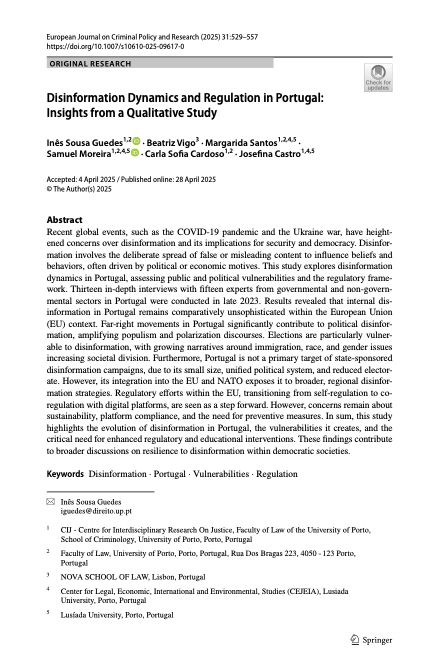
Disinformation Dynamics and Regulation in Portugal: Insights from a Qualitative Study

By Inês Sousa Guedes, Beatriz Vigo, Margarida Santos, Samuel Moreira, Carla Sofia Cardoso, Josefina Castro

Recent global events, such as the COVID-19 pandemic and the Ukraine war, have heightened concerns over disinformation and its implications for security and democracy. Disinformation involves the deliberate spread of false or misleading content to influence beliefs and behaviors, often driven by political or economic motives. This study explores disinformation dynamics in Portugal, assessing public and political vulnerabilities and the regulatory framework. Thirteen in-depth interviews with fifteen experts from governmental and non-governmental sectors in Portugal were conducted in late 2023. Results revealed that internal disinformation in Portugal remains comparatively unsophisticated within the European Union (EU) context. Far-right movements in Portugal significantly contribute to political disinformation, amplifying populism and polarization discourses. Elections are particularly vulnerable to disinformation, with growing narratives around immigration, race, and gender issues increasing societal division. Furthermore, Portugal is not a primary target of state-sponsored disinformation campaigns, due to its small size, unified political system, and reduced electorate. However, its integration into the EU and NATO exposes it to broader, regional disinformation strategies. Regulatory efforts within the EU, transitioning from self-regulation to co-regulation with digital platforms, are seen as a step forward. However, concerns remain about sustainability, platform compliance, and the need for preventive measures. In sum, this study highlights the evolution of disinformation in Portugal, the vulnerabilities it creates, and the critical need for enhanced regulatory and educational interventions. These findings contribute to broader discussions on resilience to disinformation within democratic societies.
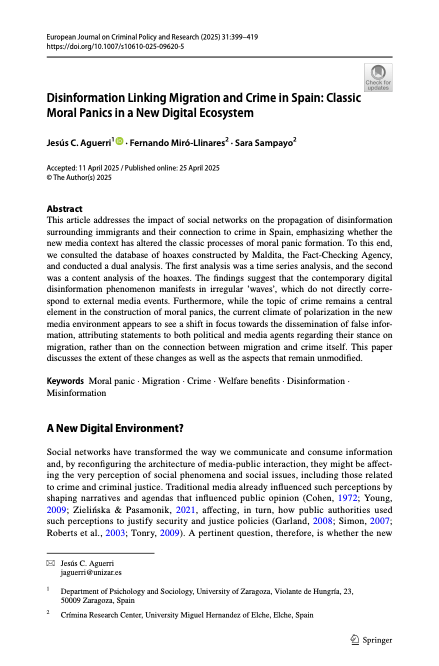
 Disinformation Linking Migration and Crime in Spain: Classic Moral Panics in a New Digital Ecosystem

By Jesús C. Aguerri, Fernando Miró-Llinares, Sara Sampayo

This article addresses the impact of social networks on the propagation of disinformation surrounding immigrants and their connection to crime in Spain, emphasizing whether the new media context has altered the classic processes of moral panic formation. To this end, we consulted the database of hoaxes constructed by Maldita, the Fact-Checking Agency, and conducted a dual analysis. The first analysis was a time series analysis, and the second was a content analysis of the hoaxes. The findings suggest that the contemporary digital disinformation phenomenon manifests in irregular 'waves', which do not directly correspond to external media events. Furthermore, while the topic of crime remains a central element in the construction of moral panics, the current climate of polarization in the new media environment appears to see a shift in focus towards the dissemination of false information, attributing statements to both political and media agents regarding their stance on migration, rather than on the connection between migration and crime itself. This paper discusses the extent of these changes as well as the aspects that remain unmodified.

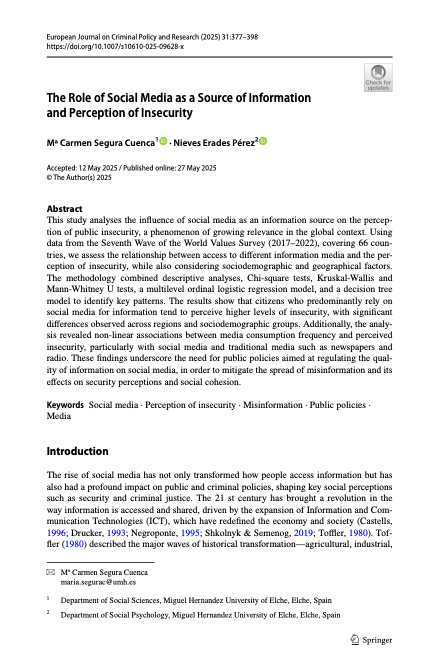
The Role of Social Media as a Source of Information and Perception of Insecurity

By Mª Carmen Segura Cuenca, Nieves Erades Pérez

This study analyses the influence of social media as an information source on the perception of public insecurity, a phenomenon of growing relevance in the global context. Using data from the Seventh Wave of the World Values Survey (2017–2022), covering 66 countries, we assess the relationship between access to different information media and the perception of insecurity, while also considering sociodemographic and geographical factors. The methodology combined descriptive analyses, Chi-square tests, Kruskal-Wallis and Mann-Whitney U tests, a multilevel ordinal logistic regression model, and a decision tree model to identify key patterns. The results show that citizens who predominantly rely on social media for information tend to perceive higher levels of insecurity, with significant differences observed across regions and sociodemographic groups. Additionally, the analysis revealed non-linear associations between media consumption frequency and perceived insecurity, particularly with social media and traditional media such as newspapers and radio. These findings underscore the need for public policies aimed at regulating the quality of information on social media, in order to mitigate the spread of misinformation and its effects on security perceptions and social cohesion.