Open Access Publisher and Free Library
SOCIAL SCIENCES.jpeg

SOCIAL SCIENCES

Social sciences examine human behavior, social structures, and interactions in various settings. Fields such as sociology, psychology, anthropology, and economics study social relationships, cultural norms, and institutions. By using different research methods, social scientists seek to understand community dynamics, the effects of policies, and factors driving social change. This field is important for tackling current issues, guiding public discussions, and developing strategies for social progress and innovation.

Posts in equity
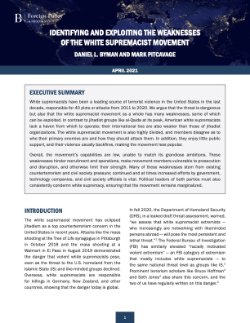
Identifying and exploiting the weaknesses of the white supremacist movement

Daniel L. Byman and Mark Pitcavage

White supremacists have been a leading source of terrorist violence in the United States in the last decade, responsible for 40 plots or attacks from 2011 to 2020. We argue that the threat is dangerous but also that the white supremacist movement as a whole has many weaknesses, some of which can be exploited. In contrast to jihadist groups like al-Qaida at its peak, American white supremacists lack a haven from which to operate; their international ties are also weaker than those of jihadist organizations. The white supremacist movement is also highly divided, and members disagree as to who their primary enemies are and how they should attack them. In addition, they enjoy little public support, and their violence usually backfires, making the movement less popular.

Overall, the movement’s capabilities are low, unable to match its grandiose ambitions. These weaknesses hinder recruitment and operations, make movement members vulnerable to prosecution and disruption, and otherwise limit their strength. Many of these weaknesses stem from existing counterterrorism and civil society pressure; continued and at times increased efforts by government, technology companies, and civil society officials is vital. Political leaders of both parties must also consistently condemn white supremacy, ensuring that the movement remains marginalized.

Washington, Dc:Brookings Institution,2021. 12P.

download
Women in Violent Extremism in Sweden

By Hernan Mondania and Tina Askanius, etc.

Women have generally been treated as “side shows” in the literature on war, terrorism and violent extremism and have thus been given scant scholarly attention. In mainstream media discourse, when the role of women is in fact raised, they tend to be framed as unwitting, passive agents or brainwashed victims pulled into violent extremist movements only through the relations of their husbands, boyfriends, or fathers. The lack of attention to female actors in violent extremism limits our ability to understand these movements and deforms theoretical understandings of the processes whereby individuals become radicalized. Ultimately this undermines efforts to design effective strategies to counter and prevent violent extremism. This report presents a quantitative assessment of women in violent extremism in contemporary Sweden. Specifically, we study women in violent Islamic extremism, violent far-right extremism, and violent far-left extremism. The analyses are based on data compiled from Swedish governmental registers on crime, mental health, education, child welfare intervention, labor market attachment, and information from the Swedish Police and Swedish Security Service about known affiliation to violent extremist milieus. The longitudinal data covers the period 2007–2016 and affiliation data from the Swedish Police and Swedish Security Service is a cross-section from 2017. We use descriptive statistics and network analysis to compare women in violent extremism to three reference groups: biological sisters, men that belong to the three violent extremist milieus, and women that belong to other antagonistic milieus.

Copenhagen: Nordisk Ministerråd, 2021. 53p.

download
Democracy in America Vo.1.

By Alexis De Tocqueville.

“Amongst the novel objects that attracted my attention during my stay in the United States, nothing struck me more forcibly than the general equality of conditions. I readily discovered the prodigious influence which this primary fact exercises on the whole course of society, by giving a certain direction to public opinion, and a certain tenor to the laws; by imparting new maxims to the governing powers, and peculiar habits to the governed.”

London. Saunders and Otley (1835) 487p.

download