

Open Access Publisher and Free Library
SOCIAL SCIENCES.jpeg

SOCIAL SCIENCES

Social sciences examine human behavior, social structures, and interactions in various settings. Fields such as sociology, psychology, anthropology, and economics study social relationships, cultural norms, and institutions. By using different research methods, social scientists seek to understand community dynamics, the effects of policies, and factors driving social change. This field is important for tackling current issues, guiding public discussions, and developing strategies for social progress and innovation.

Posts in justice
Undercover Reporting: The Truth About Deception

By Brooke Kroeger

In her provocative book, Brooke Kroeger argues for a reconsideration of the place of oft-maligned journalistic practices. While it may seem paradoxical, much of the valuable journalism in the past century and a half has emerged from undercover investigations that employed subterfuge or deception to expose wrong. Kroeger asserts that undercover work is not a separate world, but rather it embodies a central discipline of good reporting—the ability to extract significant information or to create indelible, real-time descriptions of hard-to-penetrate institutions or social situations that deserve the public’s attention. Together with a companion website that gathers some of the best investigative work of the past century, Undercover Reporting serves as a rallying call for an endangered aspect of the journalistic endeavor.

Evanston, IL: Northwestern University Press. 2012. 518p.
download
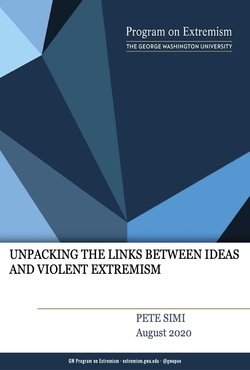
Unpacking the Links Between Ideas and Violent Extremism

By Pete Simi

A hypothetical “lone gunman” walks into a reproductive health care clinic spraying bullets from his assault rifle screaming that “abortion is murder!” and “the Army of God seeks revenge for the unborn fetuses murdered every year!” The shooting rampage leaves three individuals dead and 11 others injured. Additional weapons and explosives are discovered in the shooter’s van parked outside the clinic. Inside the van, a slew of literature explains how abortion is part of a liberal, feminist initiative to “enslave white Americans.” During the shooter’s interview with law enforcement later that day, he explains his motive was to “intimidate the general public by enforcing God’s law while sending a message to any other abortion killers that they might want to find another line of work.” In the days following the attack, scattered media coverage describes the gunman as “deranged,” “crazed,” and “unstable.” Few, if any, note the clear political and religious motivation nor do any of the articles describe the incident as “terrorism” or the shooter as a “terrorist.” What should we conclude about this scenario? The fact that the shooter was driven by ideological concerns seems obvious, yet the response suggests the link is apparently not so obvious. Understanding the relationship between ideas and violence presents several substantial challenges. These challenges are magnified given our tendency toward employing a highly inconsistent assessment of when and how ideas influence violence.

  • We tend to perceive a close connection between ideas and violence when the incident involves a Muslim perpetrator, while relying on a far different metric when the perpetrator is not Muslim. And the consequences are tremendous with major differences in terms of public perceptions and legal treatment.

Washington, DC: George Washington University, Program on Extremism, 2020. 12.

download
Street People and the Contested Realms of Public Space

By Randall Amster

Amster studies the social and spatial implications of homelessness in America. Increasingly, commentators have lamented the erosion of public space, charting its decline along with the rise of commercialization and privatization. A result is the criminalization of homelessness, a phenomenon revealed here through participant observations, informal conversations, and in-depth interviews with street people, city officials, and social service providers. Amster explores the interconnections among: (i) the impetus of development and gentrification; (ii) the enactment of anti-homeless ordinances and regulations; (iii) the material and ideological erosion of public space; (iv) emerging forces of resistance to these trends; and (v) the continuing viability of anti-systemic movements.

New York: LFB Scholarly Publishing, 2004. 235p.

download