Open Access Publisher and Free Library
CRIMINAL JUSTICE.jpeg

CRIMINAL JUSTICE

CRIMINAL JUSTICE-CRIMINAL LAW-PROCDEDURE-SENTENCING-COURTS

Posts in Diversity
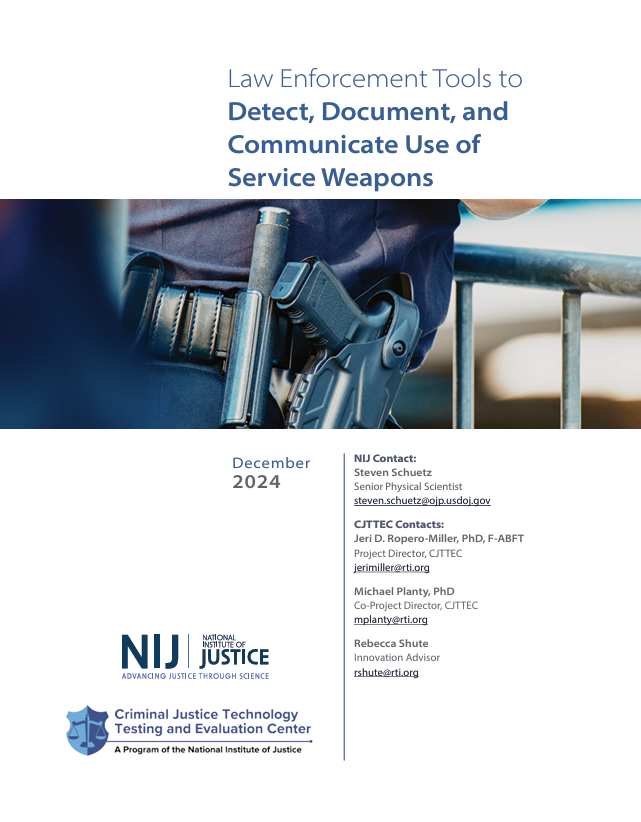
Law Enforcement Tools to Detect, Document, and Communicate Use of Service Weapons

By Steven Schuetz, et al.

  Context Service weapon activity, including instances where an officer’s firearm is drawn, pointed, or discharged, plays an important role in understanding events transpiring during a police–public encounter. Detection, documentation, and communication of these events in a way that is accurate, timely, and dependable is vital for enhancing transparency and accountability of law enforcement service weapon use. About this Report The National Institute of Justice (NIJ) requested the Criminal Justice Technology Testing and Evaluation Center (CJTTEC) to investigate the landscape of commercially available and emerging technologies that could meet this need. CJTTEC conducted a review of technologies capable of detecting when a service weapon has been unholstered, pointed, or discharged; documenting when a law enforcement officer discharges their service weapon (or initiating documentation such as body-worn camera (BWC) recordings in such incidents); and communicating the information to dispatchers. CJTTEC’s methodology to understand this technology landscape included secondary research (e.g., reviewing patents, trade literature, press releases, news articles, and publications) and primary research with technology experts, product representatives, and researchers. This brief provides a high-level summary of technology systems capable of documenting, detecting, and communicating service weapon activity, focusing specifically on technology integrated into or onto the weapon, in a holster, in a BWC, in a wearable device, or in environmental sensing tools. Conclusion Although no single commercially available tool is capable of detecting, documenting, and communicating service weapon activity, law enforcement agencies may be able to rely on a suite of products to help them address these needs.  Key Takeaways ¡ Agencies are facing increased pressure to document service weapon activity. From 2015 through 2020, on average, an estimated 1,769 people were injured annually—979 fatally and 790 nonfatally— from shootings by police in the United States.1 Because of the impact that officer-involved shootings (OISs) have on the community, law enforcement agencies are facing increased public pressure and policy mandates to document service weapon activity. ¡ There is a need for tools or technologies that can objectively detect, document, and communicate service weapon activity. OISs are stressful incidents that can occur quickly and under poor visual circumstances, which can impact accurate documentation of events. Further, obtaining reliable service weapon activity data can be challenging because of noncompliance with body-worn camera (BWC) policies, lack of BWCs, or inaccurate witness and officer accounts. ¡ There is no single commercially available product that meets service weapon activity needs. No single product can currently (1) detect service weapon activity, such as recording actual shots fired in an incident involving law enforcement weapons; (2) document the activity, such as initiating BWC recordings; and (3) communicate information about service weapon activity to police dispatchers. ¡ Agencies can rely on a suite of products to address these needs or choose specific products, each with strengths and limitations. Available technologies may be integrated into or onto the weapon, in a holster, in a BWC, in a wearable device, or in environmental sensing tools. Weapon-integrated tools offer the most functionality to detect and document multiple types of service weapon activity during a use-of-force incident, but many of these products, such as those developed by Armaments Research Company and Yardarm, are not commercially available. These products often lack the capability to communicate updates in real-time with dispatch. Holster-integrated tools can sense officer unholstering activity, activate BWC, and communicate with dispatch, but they cannot detect activity related to pointing or firing a weapon. BWCs, activated by multiple types of triggers, can document audio and video of the incident and communicate with dispatch, but they cannot specifically detect officer firearm activities (e.g., weapon unholstering, pointing, gunshot detection). Wearable devices can detect officer firearm activities, document metadata, and communicate with dispatch, but most products are still in a development phase for law enforcement applications. Environmental sensing tools may detect and document activities transpiring within a certain area, including shots fired in an incident, and communicate information to dispatch, but they cannot detect or attribute gunshot activities specifically to an officer's service weapon. ¡ Technology advancements and independent testing, evaluation, and implementation research are needed to accelerate adoption. Technology developers are currently working through several technical hurdles and are leveraging insights from BWC to improve technology uptake. Some commercially available products have been evaluated for performance, but more studies are needed as technologies are further developed and released into the market.  

Criminal Justice Testing (and Evaluation Consortium, 2024. 15p.

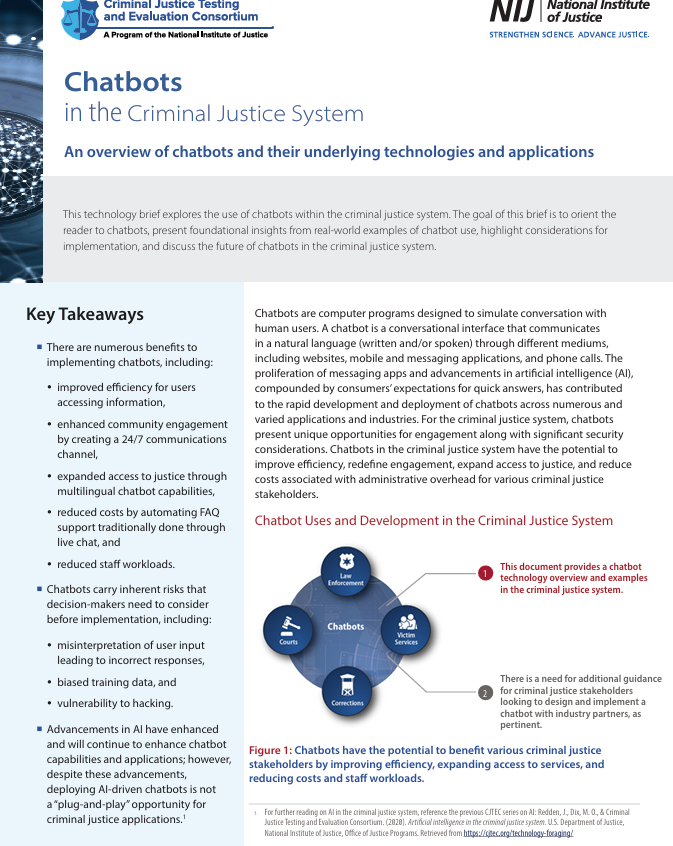
Chatbots in the Criminal Justice System An overview of chatbots and their underlying technologies and applications

By Camello, M. L., Houston-Kolnik, J. D., & Planty, M

This technology brief explores the use of chatbots within the criminal justice system. The goal of this brief is to orient the reader to chatbots, present foundational insights from real-world examples of chatbot use, highlight considerations for implementation, and discuss the future of chatbots in the criminal justice system  

  Key Takeaways ¡ There are numerous benefits to implementing chatbots, including: Ÿ improved efficiency for users accessing information, Ÿ enhanced community engagement by creating a 24/7 communications channel, Ÿ expanded access to justice through multilingual chatbot capabilities, Ÿ reduced costs by automating FAQ support traditionally done through live chat, and Ÿ reduced staff workloads. ¡ Chatbots carry inherent risks that decision-makers need to consider before implementation, including: Ÿ misinterpretation of user input leading to incorrect responses, Ÿ biased training data, and Ÿ vulnerability to hacking. ¡ Advancements in AI have enhanced and will continue to enhance chatbot capabilities and applications; however, despite these advancements, deploying AI-driven chatbots is not a “plug-and-play” opportunity for criminal justice applications

Research Triangle Park, NC:RTI International, 2021. 15p.  

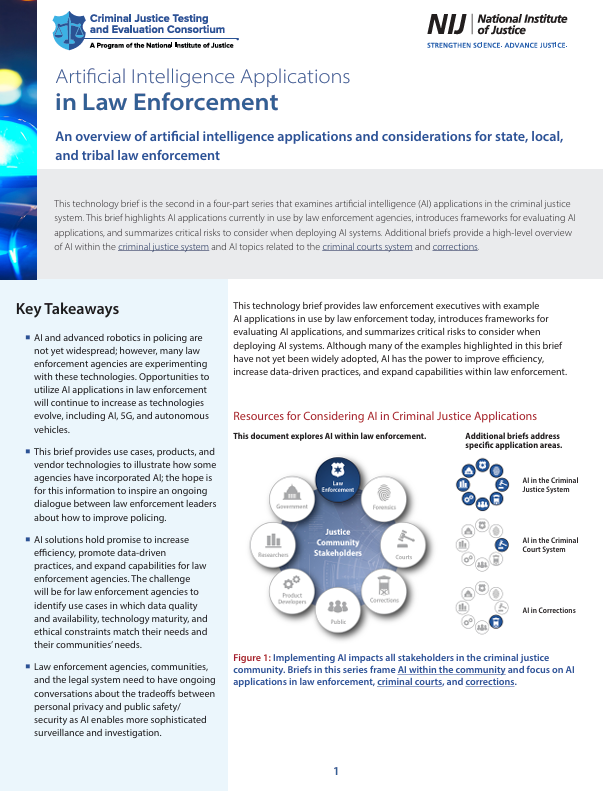
Artificial Intelligence Applications in Law Enforcement. An overview of artificial intelligence applications and considerations for state, local, and tribal law enforcement

By Redden, J., Aagaard,B., Taniguchi, T  

 This technology brief is the second in a four-part series that examines artificial intelligence (AI) applications in the criminal justice system. This brief highlights AI applications currently in use by law enforcement agencies, introduces frameworks for evaluating AI applications, and summarizes critical risks to consider when deploying AI systems. Additional briefs provide a high-level overview of AI within the criminal justice system and AI topics related to the criminal courts system and corrections.   

  Key Takeaways ¡ AI and advanced robotics in policing are not yet widespread; however, many law enforcement agencies are experimenting with these technologies. Opportunities to utilize AI applications in law enforcement will continue to increase as technologies evolve, including AI, 5G, and autonomous vehicles. ¡ This brief provides use cases, products, and vendor technologies to illustrate how some agencies have incorporated AI; the hope is for this information to inspire an ongoing dialogue between law enforcement leaders about how to improve policing. ¡ AI solutions hold promise to increase efficiency, promote data-driven practices, and expand capabilities for law enforcement agencies. The challenge will be for law enforcement agencies to identify use cases in which data quality and availability, technology maturity, and ethical constraints match their needs and their communities’ needs. ¡ Law enforcement agencies, communities, and the legal system need to have ongoing conversations about the tradeoffs between personal privacy and public safety/ security as AI enables more sophisticated surveillance and investigation

Criminal Justice Testing (and Evaluation Consortium, 2020. 10p.

Artificial Intelligence Applications for Criminal Courts.  An overview of artificial intelligence applications and associated considerations for the criminal court system 

By Redden, J., Banks, D.,   

Key Takeaways ¡ AI has the potential to transform many aspects of the court system in the years to come. Although not yet ubiquitous, AI-enabled tools are already being used in various applications relevant to the court system. ¡ AI-enabled tools may address pressing needs within the court system—including managing staffing and resources, processing digital information, improving court operations, managing cases, maintaining accountability, and creating partnerships and collaboration. ¡ AI systems that provide recommendations or predictions in the context of the court system should be approached with caution and evaluated carefully. ¡ Deploying AI-enabled tools effectively requires investing in a strategy for the operational, procedural, and change management efforts required for successful implementation. This technology brief is the third in a four-part series that examines artificial intelligence (AI) applications in the criminal justice system. This brief focuses on AI applications within criminal courts, with particular emphasis on AI’s role in addressing prosecutorial needs. These AI applications and associated needs may also be relevant to other types of courts, such as traffic and civil courts, as well as to other officers of the court—including defense counsel, judges, and court administrators. It also introduces frameworks for evaluating AI applications and highlights critical risks to consider when deploying AI systems. Although many of the examples in this brief have not yet been widely adopted, AI has the potential to address various needs within the court system. Additional briefs include a high-level overview of AI within the criminal justice system and AI topics specifically related to law enforcement and corrections

  The courts play a critical role in the criminal justice system in ensuring the fair and impartial administration of justice for all. As AI becomes more prevalent across society, many criminal justice leaders are asking if AI-enabled technologies can help improve the court system. In other industries, AI has dramatically increased efficiency, expanded capabilities, and automated repetitive or mundane tasks. In the years ahead, AI will likely impact many aspects of the court system, including the prosecution and defense of crimes and the practice of law in both private and public service settings. This brief (1) offers mental models for leaders in the criminal court system to use when evaluating AI applications, (2) presents example AI applications and use cases, and (3) highlights key risk considerations within the criminal courts context.

Criminal Justice Testing (and Evaluation Consortium . 2020. 11p.

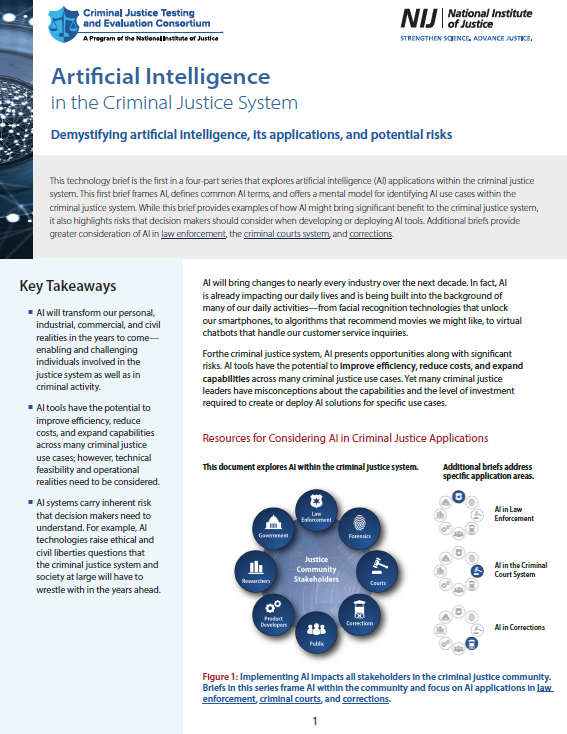
Artificial Intelligence in the Criminal Justice System.  Demystifying artificial intelligence, its applications, and potential risks 

By James Redden; Molly O'Donovan Dix

This technology brief is the first in a four-part series that explores artificial intelligence (AI) applications within the criminal justice system. This first brief frames AI, defines common AI terms, and offers a mental model for identifying AI use cases within the criminal justice system. While this brief provides examples of how AI might bring significant benefit to the criminal justice system, it also highlights risks that decision makers should consider when developing or deploying AI tools. Additional briefs provide greater consideration of AI in law enforcement, the criminal courts system, and corrections.   

  Key Takeaways ¡ AI will transform our personal, industrial, commercial, and civil realities in the years to come— enabling and challenging individuals involved in the justice system as well as in criminal activity. ¡ AI tools have the potential to improve efficiency, reduce costs, and expand capabilities across many criminal justice use cases; however, technical feasibility and operational realities need to be considered. ¡ AI systems carry inherent risk that decision makers need to understand. For example, AI technologies raise ethical and civil liberties questions that the criminal justice system and society at large will have to wrestle with in the years ahead. AI will bring changes to nearly every industry over the next decade. In fact, AI is already impacting our daily lives and is being built into the background of many of our daily activities—from facial recognition technologies that unlock our smartphones, to algorithms that recommend movies we might like, to virtual chatbots that handle our customer service inquiries. Forthe criminal justice system, AI presents opportunities along with significant risks. AI tools have the potential to improve efficiency, reduce costs, and expand capabilities across many criminal justice use cases. Yet many criminal justice leaders have misconceptions about the capabilities and the level of investment required to create or deploy AI solutions for specific use cases

Research Triangle Park, NC:RTI International.,   . 

2020. 10p.

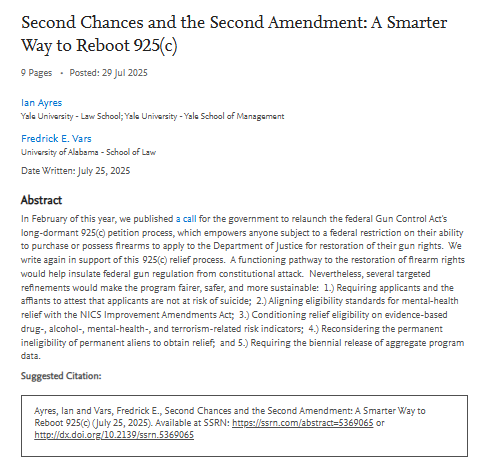
Second Chances and the Second Amendment: A Smarter Way to Reboot 925(c

By Ian Ayres and Fredrick E. Vars

In February of this year, we published a call for the government to relaunch the federal Gun Control Act's long-dormant 925(c) petition process, which empowers anyone subject to a federal restriction on their ability to purchase or possess firearms to apply to the Department of Justice for restoration of their gun rights.  We write again in support of this  925(c) relief process.  A functioning pathway to the restoration of firearm rights would help insulate federal gun regulation from constitutional attack.  Nevertheless, several targeted refinements would make the program fairer, safer, and more sustainable:  1.) Requiring applicants and the affiants to attest that applicants are not at risk of suicide;  2.) Aligning eligibility standards for mental‑health relief with the NICS Improvement Amendments Act;  3.) Conditioning relief eligibility on evidence-based drug-, alcohol-, mental-health-, and terrorism-related risk indicators;  4.) Reconsidering the permanent ineligibility of permanent aliens to obtain relief;  and 5.) Requiring the biennial release of aggregate program data.

U of Alabama Legal Studies Research Paper 2025

Ban the Box, Convictions, and Public Employment

By Terry-Ann Craigie

Ban the Box (BTB) policies mandate deferred access to criminal history until later in the hiring process. However, these policies chiefly target public employers. The study is the first to focus on the primary goal of BTB reform, by measuring the impact of BTB policies on the probability of public employment for those with convictions. To execute the analyses, the study uses data from the National Longitudinal Survey of Youth 1997 Cohort (2005–2015) and difference-in-difference (DD) estimation. The study finds that BTB policies raise the probability of public employment for those with convictions by about 30% on average. Some scholars argue that BTB policies encourage statistical discrimination against young low-skilled minority males. The study employs triple-difference (DDD) estimation to test for statistical discrimination, but uncovers no evidence to support the hypothesis.

Economic Inquiry, Volume 58, Issue 1 Jan 2020, 75p.