By Jonathan Katz, Renée Rippberger, and Eric Urby
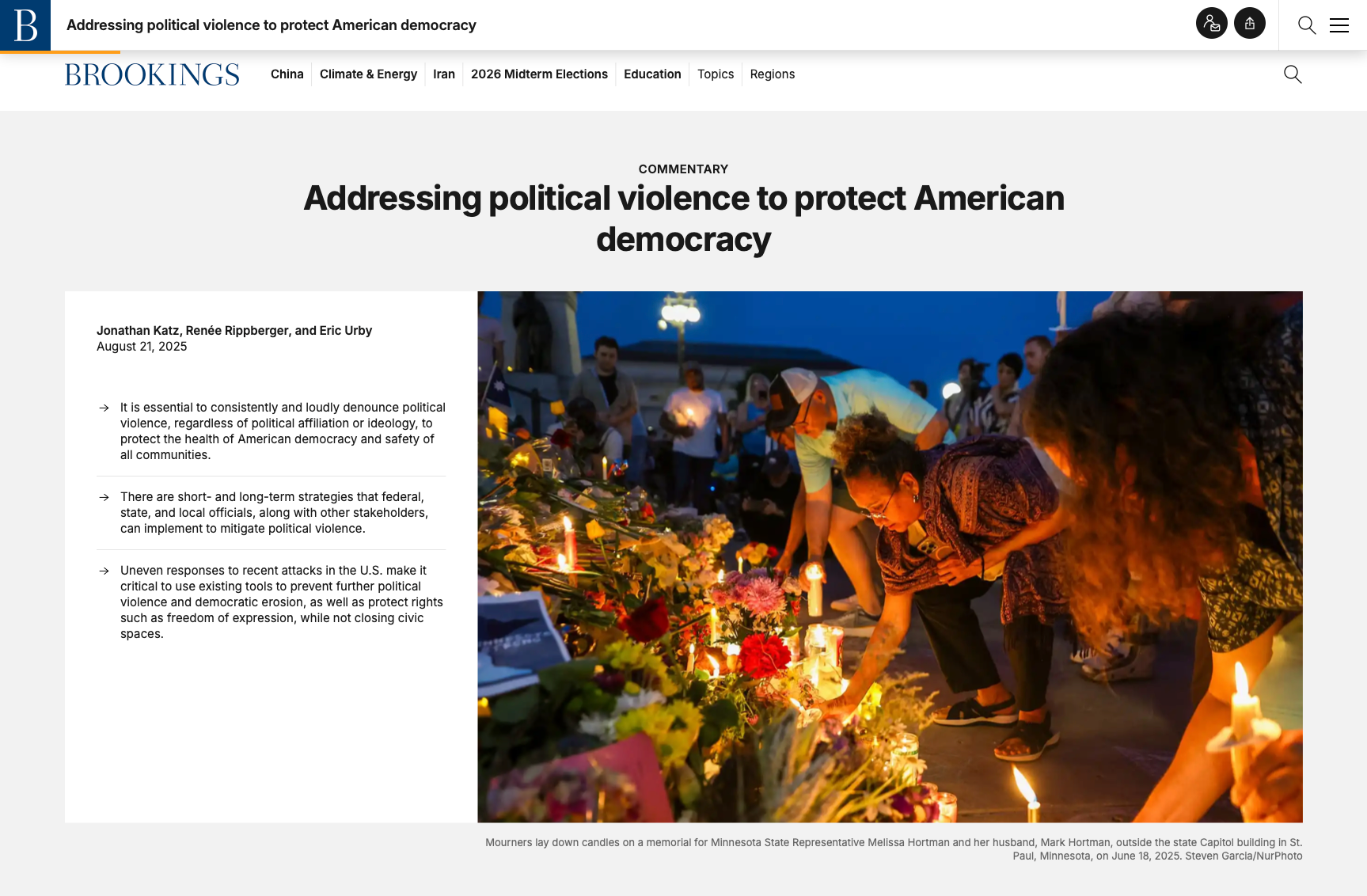
he assassinations of Minnesota State Representative Melissa Hortman and her husband Mark, as well as the attempted murders of Minnesota State Senator John Hoffman and his wife Yvette, are disturbing examples of the rise in political violence in the United States. Political violence includes “[t]he use of physical force, coercion, or intimidation to achieve political goals” ranging “from violent acts against individuals or groups, to state-sponsored violence, and to physical violence and intimidation used by both state and non-state actors.” To protect the health of our democracy and safety of our communities, Americans—especially political leaders—must consistently and loudly denounce such violence and take steps to address this growing threat, while remaining cautious not to restrict civic freedoms.
Politically motivated violence is a major concern for a vast majority of Americans, regardless of political identification. The impacts of political violence on a democratic society are far-reaching. In addition to the devastating effects on victims, their families, and their communities, political violence can also stifle critical forms of public engagement—such as voting, community organizing, and running for office—and chill free expression. Due to its harmful effects, and the troubling uptick following the Jan. 6, 2021 insurrection, we highlighted the urgent need to swiftly and “vigorously oppose” political violence or harassment in all forms in the Brookings Democracy Playbook 2025.
Election officials, judges, and lawmakers from across the political spectrum have faced increasing threats of political violence. There were assassination attempts against President Donald Trump in 2024 and Pennsylvania Governor Josh Shapiro in April 2025. More recently, a bomb threat was made at an Illinois hotel where several Texas lawmakers were staying—quickly followed by a second. This rise in intimidation and violence is dangerous not only for the safety of Americans, but for the health of U.S. democracy. This deeply concerning trend is linked to inflammatory rhetoric and policy by leaders and their supporters, the spread of disinformation online, and other factors.
There are short- and long-term strategies that federal, state, and local officials—as well as other stakeholders—can implement to mitigate the risk of violence and harassment. These strategies include consistently enforcing relevant laws to address immediate threats, speaking out against agitators regardless of political affiliation, and tackling the root causes of political violence, both physical and psychological.
Amid the federal government’s recent cuts to programs aimed at reducing violent extremism, it is especially important for subnational and nongovernmental actors to provide funding, tools, and other resources to address the risks and counter the impacts of political violence. This includes the private sector, specifically the technology industry, which can do more to redesign social media features that are exploited by hostile actors, implement high-quality standards for threat assessment, and otherwise guard against political violence.
While implementing these strategies, it is essential that government, civil society, community leaders, and citizens at every level of society—regardless of political affiliation or ideology—cooperate to swiftly and unequivocally condemn political violence. Government and civil society leaders should champion nonviolent methods of conflict resolution and reaffirm democratic principles such as freedom of speech, assembly, and expression.
Political leaders’ immediate reactions to the Minnesota assassinations included both appropriate and concerning responses. On the former, the U.S. Senate and House of Representatives passed bipartisan resolutions that condemned political violence and called for reconciliation of differences through civic dialogue and debate. Similar responses emerged from state legislatures and lawmakers across the country, from Georgia to Washington. In contrast, we saw troubling responses from some lawmakers and other actors.
It is extremely important to caution U.S. policymakers in this heated environment to act responsibly and not use the specter of political violence as an excuse to suppress nonviolent movements, curb freedoms of assembly and expression, encourage retaliation, or otherwise close civic spaces. Weaponizing calls for stability and peace in response to political violence is a real threat in democratic and nondemocratic countries globally