Open Access Publisher and Free Library
CRIMINAL JUSTICE.jpeg

CRIMINAL JUSTICE

CRIMINAL JUSTICE-CRIMINAL LAW-PROCDEDURE-SENTENCING-COURTS

Posts tagged Law enforcement accountability
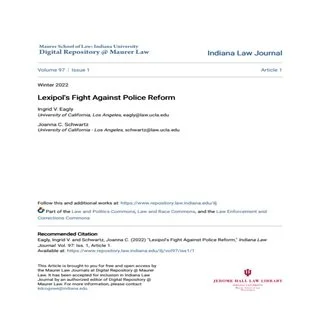
Lexipol's Fight Against Police Reform

By Ingrid V. Eagly and Joanna C. Schwartz

We are in the midst of a critically important moment in police reform. National and local attention is fixed on how to reduce the number of people killed and injured by the police. One approach—which has been recognized for decades to reduce police killings—is to limit police power to use force. This Article is the first to uncover how an often-overlooked private company, Lexipol LLC, has become one of the most powerful voices pushing against reform of use-of-force standards. Founded in 2003, Lexipol now writes police policies and trainings for over one-fifth of American law enforcement agencies. As this Article documents, Lexipol has refused to incorporate common reform proposals into the policies it writes for its subscribers, including a use-of-force matrix, policies requiring de-escalation, or bright-line rules prohibiting chokeholds and shooting into cars. Lexipol has also taken an active advocacy role in opposition to proposed reforms of police use-of-force standards, pushing, instead, for departments to hew closely to Graham v. Connor’s “objectively reasonable” standard. Finally, when use-of-force reforms have been enacted, Lexipol has attempted to minimize their impact. Local governments, police departments, and insurers have long viewed Lexipol as a critically important partner in keeping policies lawful and up to date. This Article makes clear that they should take a closer look. Lexipol’s aggressive efforts to retain wide officer discretion to use force may ultimately expose officers and agencies to liability instead of shielding them from it. It is time for advocacy groups seeking policing improvements to train their sights on Lexipol. Unless and until Lexipol changes its approach, the company should be viewed as a barrier to reform.
 
Indiana Law Journal: Vol. 97: Iss. 1, Article 1. 2022.

download
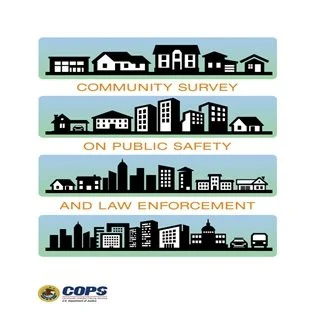
Community Survey on Public Safety and Law Enforcement

By  U.S. Department of Justice, Office of Community Oriented Policing Services (COPS Office)

To help law enforcement agencies improve their services, processes, and reputation, agencies can disseminate this survey to community members to gather their opinions and experiences. The survey asks community members to assess five key components of their local agency: community involvement, safety, procedural justice, performance, and contact and satisfaction. The survey takes approximately five minutes to complete, and responses are confidential to the extent provided by law. This survey is available in Spanish at https://portal.cops.usdoj.gov/resourcecenter?item=COPS-W0807.

Washington, DC: COPS Office, 2025. 8p.

download
Police whistleblowing: A systematic review of the likelihood (and the barriers and facilitators) of the willingness of police officers to report the misconduct of fellow officers 

By Olivia  Elizabeth Vere Taylor, Richard Philpot, Oliver Fitton, Zoë Walkington, Mark Levine

Introduction: Recent high-profile cases of police misconduct have revealed that officers were often aware of misconduct, but remained silent, compromising public trust in law enforcement. Here, we systematically review ‘police whistleblowing’ literature to identify barriers and facilitators to officers challenging misconduct. Methodology: Employing PRISMA guidelines, we systematically reviewed 118 relevant papers, extracting data and coding key variables including who the ‘target’ of the research was; whether reporting practices were studied, and whether practical solutions were offered. A reflexive thematic analysis then assessed consensus among researchers within the literature. Results: Five themes - 1) knowledge and rules, 2) consequences, 3) interpersonal relations, 4) responsibility, and 5) police culture and group relations – emerged as barriers and facilitators to whistleblowing. The review revealed relatively poorer representation of internal police reporting structures and limited practical solutions, with only 40 papers proposing strategies, predominantly centred on training and education. Discussion: This review highlights methodological limitations in existing research, with an overreliance on survey methods and a dominant focus on the characteristics of individuals over the structural constraints of reporting. The positive impacts of whistleblowing on policing as an institution and the development of practical strategies to overcome officers’ reluctance to report misconduct remain largely unexplored. 

Journal of Criminal Justice, 2024, 15 pages

download