Open Access Publisher and Free Library
CRIMINAL JUSTICE.jpeg

CRIMINAL JUSTICE

CRIMINAL JUSTICE-CRIMINAL LAW-PROCDEDURE-SENTENCING-COURTS

Posts tagged civil liberties
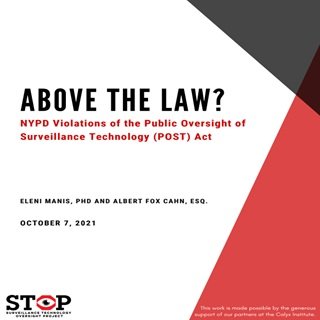
Above the Law? NYPD Violations of the Public Oversight of Surveillance Technology (POST) Act--

By Eleni Manis, PHD and Albert Fox Cahn, Esq

In this report, S.T.O.P. documents the New York City Police Department (NYPD)’s repeated failures to comply with New York City’s Public Oversight of Surveillance Technology Act (POST Act). Enacted in 2020, the POST Act is the first law to oversee the NYPD’s use of surveillance technology. A first attempt to regulate NYPD’s surveillance tools, the law only requires NYPD disclose its surveillance tools. As this report establishes, NYPD falls far short of the reporting norms set by other police departments subject to similar surveillance technology oversight laws. The report concludes by calling on the New York City Council to use its oversight authority to ensure that the bill is not ignored. S.T.O.P. also recommends that individual lawmakers and civil society organizations continue to evaluate potential litigation, seeking judicial intervention to compel the NYPD to comply with the POST Act.

download
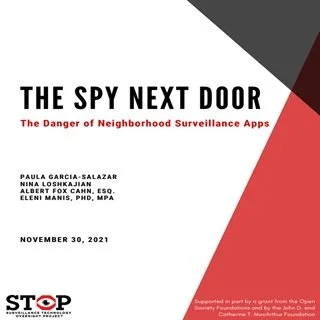
The Spy Next Door: The Danger of Neighborhood Surveillance Apps

By Paula Garcia-Salazar, Nina Loshkajian, Albert Fox Cahn, ESQ., Eleni Manis, PHD, MPA

Everyone sees them: signs “welcoming” you to a neighborhood with the warning that “All Suspicious Persons and Activities Reported to Law Enforcement.” In the 1960’s, Neighborhood Watch groups proliferated in supposed response to increased burglaries. 1 In fact, the groups appear to have been a direct response to increased residential integration.2 A brainchild of the National Sheriffs Association, Neighborhood Watch groups were touted as a way to increase community involvement in crime prevention by encouraging residents to patrol their own streets and act as the eyes and ears of the local police. 3 But too often, local residents have interpreted this as a chance to become vigilantes, in many cases acting purely on bias to raise false alarms and profile fellow community members, endangering the very people these groups are allegedly designed to protect. 4 The groups have proliferated across the country even as they have been demonstrated to promote profiling and distract from actual public safety, there being little evidence that Neighborhood Watch programs reduce crime. 5 Now, a new form of Neighborhood Watch is here: smartphone-based apps that supplant the classic program with online forums for local neighborhoods. Nextdoor (27 million regular users),6 Neighbors by Ring (10 million users),7 Citizen (7 million users),8 and recently piloted Facebook Neighborhoods deliver “hyperlocal” updates to geographic “neighbors.” Nextdoor and Facebook Neighborhoods invite users to post on a range of local-interest content: upcoming events, business reviews, goods for sale, and so on. But the backbone of neighborhood surveillance apps is crime, both real and imagined. Apps encourage users to upload video footage, photos and descriptions of suspected crimes and supposedly “suspicious” people near their homes, producing reports riddled with dog whistles and overt racism. Apps court a police audience for these posts and enable police to request app users’ video footage, photos, and input. Apps even drive user engagement by inviting bystanders join in on the crime-oriented conversation: as on Facebook, users can comment, “like” and otherwise interact with posts with the click of a button.


download
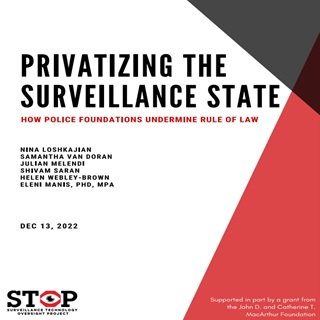
Privatizing The Surveillance State: How Police Foundations Undermine Rule of Law

Police foundations allow police departments to secretly fund controversial programs and equipment.

  • Foundations invest in dangerous surveillance tools like predictive policing software, digital surveillance platforms, cellphone hacking devices, and robotic spy dogs. 

  • Foundations allow departments and officers to accept gifts from contractors in a way that would normally be illegal for city employees.

  • Foundations violate good-government standards for city agencies and transparency standards for nonprofit organizations. Ideally, they should be abolished, but at a minimum, cities must end untraceable donations and corporate influence peddling.

download
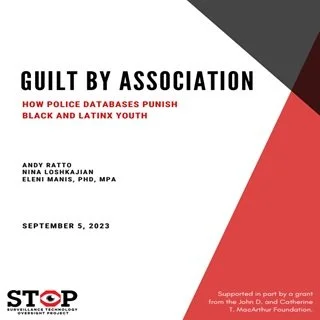
Guilt By Association: How Police Databases Punish Black and Latinx

By Andy Ratto, Nino Loshkajian, Eleni Manis, PHD, MPA

  • Police increasingly replace stop-and-frisk practices with databases that crudely profile Black and Latinx youth based on their neighborhoods, peer groups, and clothing.

  • These databases ruin lives: police typecast minority youths as gang members without evidence, putting them at risk of false arrest and wrongful deportation.

  • Many police departments refuse to implement due process safeguards despite clear evidence that their databases are based on racial profiling, not evidence.

  • Even the most rigorous safeguards would be insufficient to mitigate the full range of harms that these databases pose. They must be eliminated in their entirety.

download
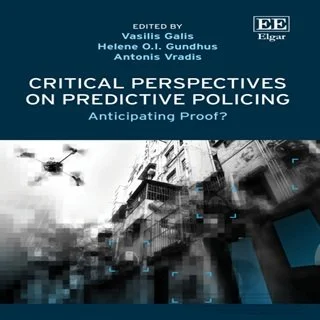
Critical Perspectives on Predictive Policing: Anticipating Proof?

Edited by Vasilis Galis, Helene O.I. Gundhus, and Antonis Vradis

Taking a critical approach, this book advances understanding of the social, legal and ethical aspects of digitalisation in law enforcement and the reliance on data-driven tools to predict and prevent crime. It shows how the proliferation of data analytics challenges citizens’ rights, at a time when what counts as ‘safety’ or ‘policing’ is being fundamentally transformed.

Cheltenham, UK · Northampton, MA; Edward Elgar, 2025.

download
The Kids Won't Be Alright: The Looming Threat of Child Surveillance Laws

Across the country, an array of new state and federal surveillance bills pose an unprecedented and existential threat to privacy, safety, and the promise of an open internet. This legislative wolf dressed in sheep’s clothing is framed around a noble goal: protecting children. Sadly, these laws are just the latest example of misguided tech policies built on a fundamental misunderstanding of the thing lawmakers seek to regulate—harming the very communities officials seek to protect.

The key flaw of these state surveillance bills is that they create a two-tiered internet, one for children, and one for adults. This is an intuitive step, but one that simply cannot be implemented in practice, as there is no effective, let alone privacy-preserving way, to determine users’ identities. These laws mandate or coerce the use of new, invasive measures that verify users’ legal name, age, and address for nearly every internet service they use. Suddenly, every online purchase and search engine query will come with state-mandated tracking, and anonymity will be a thing of the past. This change would be invasive and insecure for every user, but it would pose a particularly potent threat to undocumented communities, LGBTQ+ communities, and those seeking reproductive care. The data would be a ticking time bomb, a powerful new surveillance source for police, prosecutors, Immigration and Customs Enforcement (ICE), and private anti-choice groups.

download
Genetic Surveillance: The NYPD's Rogue DNA Database

By Nina Loshkajian, Anissa Arakal, Aaron Greenberg, Tanisha Narine, Corinne Worthington, and Eleni Manis

For years, the NYPD violated New York State DNA privacy protections by collecting New Yorkers’ DNA secretly, banking children’s DNA without parental permission, and conducting stop-and-spit campaigns in BIPOC communities, DNA dragnets that invade thousands of New Yorkers’ genetic privacy in the hope of stumbling across a single suspect.

Those the NYPD puts in its rogue database become permanent suspects, their DNA scanned thousands of times a year in cases where they have no connection whatsoever.

Every scan is an invitation for injustice, with DNA contamination and laboratory mix-ups driving false arrests and wrongful convictions. Even worse, the NYPD’s experimental DNA techniques may leave many of their claims (and resulting convictions) in doubt.

download
Liberty Against Government: The Rise, Flowering and Decline of a Famous Juridical Concept

By Corwin,Edward S

L^he history of American liberty is far more complicated than most people would at first blush have imagined. Indeed, until Professor Corwin, out of a lifetime of study devoted to American public law, distilled into a volume of modest compass the essential ingredients of American liberty, there was, to my knowledge, no one book to which the citizen might turn to learn its fascinating story. The story starts, as do so many of the great things of life, with the Greeks and the Romans. The wisdom of the political philosophers, ancient and modem, in their search for the foundations of human liberty is presented in its relation to the crucial events of English and American political experience, particularly such great documents as Magna Carta, the Declaration of Independence, the federal Constitution and our State constitutions.

LOUISIANA STATE UNIVERSITY PRESS, 1948, 222p.

download