Open Access Publisher and Free Library
CRIMINAL JUSTICE.jpeg

CRIMINAL JUSTICE

CRIMINAL JUSTICE-CRIMINAL LAW-PROCDEDURE-SENTENCING-COURTS

Posts tagged racial inequality
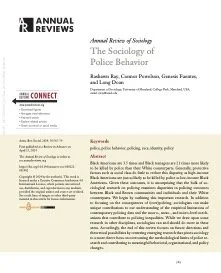
The Sociology of Police Behavior

By Rashawn Ray, Connor Powelson, Genesis Fuentes, and Long Doan

Black Americans are 3.5 times and Black teenagers are 21 times more likely to be killed by police than their White counterparts. Generally, protective factors such as social class do little to reduce this disparity, as high-income Black Americans are just as likely to be killed by police as low-income Black Americans. Given these outcomes, it is unsurprising that the bulk of sociological research on policing examines disparities in policing outcomes between Black and Brown communities and individuals and their White counterparts. We begin by outlining this important research. In addition to focusing on the consequences of (over)policing, sociologists can make unique contributions to our understanding of the empirical limitations of contemporary policing data and the macro-, meso-, and micro-level mechanisms that contribute to policing inequalities. While we draw upon some research in other disciplines, sociologists can and should do more in these areas. Accordingly, the end of this review focuses on future directions and theoretical possibilities by centering emerging research that pivots sociology to a more direct focus on overcoming the methodological limits of police research and contributing to meaningful behavioral, organizational, and policy changes.

ANNUAL REVIEW OF SOCIOLOGY Volume 50, 2024
download
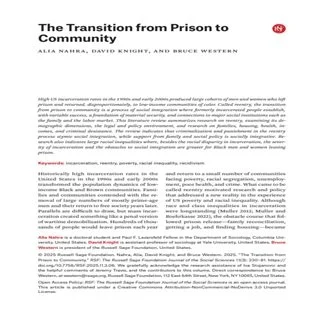
The Transition from Prison to Community

By Alia Nahra, David Knight and Bruce Western

High US incarceration rates in the 1990s and early 2000s produced large cohorts of men and women who left prison and returned, disproportionately, to low-income communities of color. Called reentry, the transition from prison to community is a process of social integration where formerly incarcerated people establish, with variable success, a foundation of material security, and connections to major social institutions such as the family and the labor market. This literature review summarizes research on reentry, examining its demographic dimensions, the legal and policy environment, and research on families, housing, health, incomes, and criminal desistance. The review indicates that criminalization and punishment in the reentry process stymie social integration, while support from family and social policy is socially integrative. Research also indicates large racial inequalities where, besides the racial disparity in incarceration, the severity of incarceration and the obstacles to social integration are greater for Black men and women leaving prison

RSF: The Russell Sage Foundation Journal of the Social Sciences 11(3): 174–229.

download
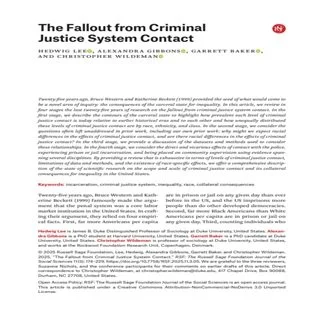
The Fallout from Criminal Justice System Contact

By Hedwig Lee, Alexandra Gibbons, Garrett Baker and Christopher Wildeman

Twenty-five years ago, Bruce Western and Katherine Beckett (1999) provided the seed of what would come to be a novel area of inquiry: the consequences of the carceral state for inequality. In this article, we review in four stages the last twenty-five years of research on the fallout from criminal justice system contact. In the first stage, we describe the contours of the carceral state to highlight how prevalent each level of criminal justice contact is today relative to earlier historical eras and to each other and how unequally distributed these levels of criminal justice contact are by race, ethnicity, and class. In the second stage, we consider the questions often left unaddressed in prior work, including our own prior work: why might we expect racial differences in the effects of criminal justice contact, and are there racial differences in the effects of criminal justice contact? In the third stage, we provide a discussion of the datasets and methods used to consider these relationships. In the fourth stage, we consider the direct and vicarious effects of contact with the police, experiencing prison or jail incarceration, and being placed on community supervision using evidence spanning several disciplines. By providing a review that is exhaustive in terms of levels of criminal justice contact, limitations of data and methods, and the existence of race-specific effects, we offer a comprehensive description of the state of scientific research on the scope and scale of criminal justice contact and its collateral consequences for inequality in the United States. 

” RSF: The Russell Sage Foundation Journal of the Social Sciences 11(3): 174–229.

download
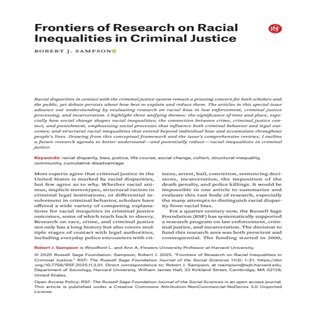
Frontiers of Research on Racial Inequalities in Criminal Justice

By Robert J. Sampson

Racial disparities in contact with the criminal justice system remain a pressing concern for both scholars and the public, yet debate persists about how best to explain and reduce them. The articles in this special issue advance our understanding by evaluating research on racial bias in law enforcement, criminal justice processing, and incarceration. I highlight three unifying themes: the significance of time and place, especially how social change shapes racial inequalities; the connection between crime, criminal justice contact, and punishment, emphasizing social processes that influence both criminal behavior and legal outcomes; and structural racial inequalities that extend beyond individual bias and accumulate throughout people’s lives. Drawing from this conceptual framework and the issue’s comprehensive reviews, I outline a future research agenda to better understand—and potentially reduce—racial inequalities in criminal justice.

RSF: The Russell Sage Foundation Journal of the Social Sciences 11(3): 1–21.

download