
Open Access Publisher and Free Library
CRIMINAL JUSTICE.jpeg

CRIMINAL JUSTICE

CRIMINAL JUSTICE-CRIMINAL LAW-PROCDEDURE-SENTENCING-COURTS

Posts in equity
Borderlands

By Emmanuel Baunet-Jailly.

Comparing Border Security in North America and Europe. This book addresses this gap between security needs and an understanding of borders and borderlands. Specifically, the chapters in this volume ask policy-makers to recognize that two fundamental elements define borders and borderlands: first, human activities (the agency and agent power of individual ties and forces spanning a border), and second, the broader social processes that frame individual action, such as market forces, government activities (law, regulations, and policies), and the regional culture and politics of a borderland.

University of Ottawa Press (2007) 404 pages.

download
Criminal Responsibility and Social Restraint

Ray Madding McConnell.

“ Among the most expensive functions of government is that which is concerned with the detection, arrest, trial, and punishment of criminals. The expenditures in connection with police, courts, and prisons exceed in amount the outlay for the conservation and improvement of health, the necessities and conveniences of travel and intercourse, highways, parks, and playgrounds, and about equal the costs of education. When any one begins to philosophize about the raison d'etre of this enormously expensive arrangement for dealing with crime and criminals, he naturally asks first for its purpose, What is the object of it all? What kind of return does this investment bring in?”

NY. Charles Scribner’s (1912) 337 pages.

download
Sentencing in the Netherlands. Taking risk-related offender characteristics into account

By Sigrid Geralde Clara van Wingerden.

The sentencing decision of the judge might be the most important decision in the criminal proceedings, not only because of the impact the punishment has on the offender, but also because the sentencing decision is a cornerstone of the legitimacy of the entire criminal justice system. Nonetheless, there still are questions about the factors judges take into account when making their sentencing decision. This study aims to improve our understanding of the sentencing decisions judges make.The developments in criminal justice practices as regards the emergence of ‘actuarial justice' have directed the focus of this study to risk-based sentencing: are offenders with a high risk of reoffending more likely to be sentenced to imprisonment and to longer prison terms than low-risk offenders? To what extent do judges take information into account on the risk-related personal characteristics of the offender, such as unemployment, ties to family or friends, or drug usage, when making their sentencing decision?Using uniquely detailed data on risk-related social circumstances of the offender, and advanced quantitative and qualitative research methods, this study provides in-depth insight into sentencing.

Leiden: Leiden University, 2014. 215p.

download
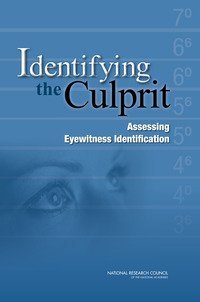
Identifying the Culprit: Assessing Eyewitness Identification

National Research Council.

Identifying the Culprit: Assessing Eyewitness Identification makes the case that better data collection and research on eyewitness identification, new law enforcement training protocols, standardized procedures for administering line-ups, and improvements in the handling of eyewitness identification in court can increase the chances that accurate identifications are made. This report explains the science that has emerged during the past 30 years on eyewitness identifications and identifies best practices in eyewitness procedures for the law enforcement community and in the presentation of eyewitness evidence in the courtroom. In order to continue the advancement of eyewitness identification research, the report recommends a focused research agenda.

Washington, DC: The National Academies Press. 2014. 170p,

download