Open Access Publisher and Free Library
CRIMINAL JUSTICE.jpeg

CRIMINAL JUSTICE

CRIMINAL JUSTICE-CRIMINAL LAW-PROCDEDURE-SENTENCING-COURTS

Posts in violence & oppression
Beyond the Jihadist Label: Understanding the ADF’s Multilayered Violence

By Kristof Titeca and Giovanni Salvaggio

This report argues that violence attributed to the Allied Democratic Forces (ADF) in eastern Democratic Republic of Congo cannot be understood through a single lens, such as jihadism, but must instead be analysed as a multilayered phenomenon in which ideological, military, political, and economic logics coexist and overlap. While the ADF’s pledge of allegiance to the Islamic State and subsequent financial and ideological links are real and consequential, an exclusive focus on jihadism obscures the group’s deep embeddedness in local and regional political economies of violence. Drawing on long-term fieldwork in eastern Congo and Uganda, the article shows how ADF violence is intertwined with taxation, trade, resource extraction, and local power struggles, and how the ADF label itself has become a franchise used by a wide range of actors to conceal or legitimise violence. It concludes that monocausal readings - including recent attempts to frame ADF violence primarily as sectarian or anti-Christian - flatten a far more complex reality and hinder a proper understanding of the drivers of violence in eastern Congo. The ADF, in other words, is not an exception to the Congolese conflict dynamics, but an extreme and particularly violent crystallisation of it.

BROKERS AND PATRONS: UNSTITCHING GANGS FROM HAITI’S POLITICAL FABRIC  

By The Global Initiative Against Transnational Organized Crime.

In Haiti, 5 915 people were killed in 2025 (compared to 5 601 in 2024). The national homicide rate got to 49.8 per 100 000 people, and Port-au-Prince, which is home to about a quarter of the population, reached nearly 140 per 100 000 people, ranking it among the most violent cities in the world.

Gangs continued to expand their influence in Haiti, both through territorial control and by consolidating their role as political brokers. This latter dimension remains largely absent from national and international crisis response strategies.By failing to account for the political economy of violence, particularly the importance of addressing politico-criminal relationships, current policies risk perpetuating rather than loosening the links between armed groups and the political system, especially if the 2026 elections proceed without a more comprehensive response adapted to the complexity of the crisis.Haiti’s gangs are neither insurgents nor revolutionaries; they are embedded within circuits of political and economic power. The crisis is sustained by illicit financial flows, arms and drug trafficking, and patronage networks that protect and instrumentalize armed groups.Arrests and targeted operations may weaken certain groups, but as long as the structures that sustain criminal governance remain intact, the system will reconstitute itself. Without measures to dismantle the networks intertwining political competition and criminal governance, electoral processes risk reinforcing rather than transforming the system they are intended to renew.Haiti requires a strategy to combat organized crime that integrates public security, justice and community reconstruction. Any approach focused exclusively on force will fail if it does not address the political and economic foundations that allow violence to persist.To be effective, the Gang Suppression Force (GSF) must be paired with judicial tools capable of targeting gang support networks, particularly financial ones, and not only armed actors. This includes pursuing criminal leaders as well as their political and financial sponsors. Only by addressing the broader ecosystem of collusion can Haiti move away from a political order that is shaped by entrenched politico-criminal relationships.A long-term crisis resolution strategy must integrate justice, economic policy, security and political reform. The central question is not whether to negotiate with criminal groups, but how to articulate justice, demobilization and reintegration in a way that prevents the reproduction of violence.

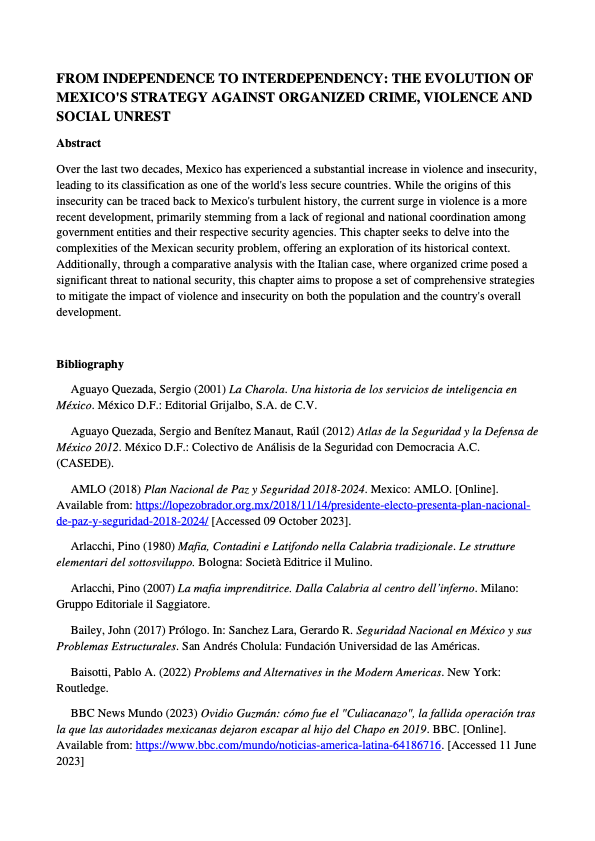
FROM INDEPENDENCE TO INTERDEPENDENCY: THE EVOLUTION OF MEXICO'S STRATEGY AGAINST ORGANIZED CRIME, VIOLENCE AND SOCIAL UNREST

By Pierfrancesco Moscuzza

Over the last two decades, Mexico has experienced a substantial increase in violence and insecurity, leading to its classification as one of the world's less secure countries. While the origins of this insecurity can be traced back to Mexico's turbulent history, the current surge in violence is a more recent development, primarily stemming from a lack of regional and national coordination among government entities and their respective security agencies. This chapter seeks to delve into the complexities of the Mexican security problem, offering an exploration of its historical context. Additionally, through a comparative analysis with the Italian case, where organized crime posed a significant threat to national security, this chapter aims to propose a set of comprehensive strategies to mitigate the impact of violence and insecurity on both the population and the country's overall development.

The Independent Inquiry into Grooming Gangs

By Alice Baxter

The government has announced that it is establishing a statutory public inquiry into grooming gangs. The inquiry begins work on 13 April 2026. Why have there been calls for an inquiry? By the early 2010s, multiple child sexual abuse scandals had prompted public concern about the state response to organised and systematic child sexual abuse. These included revelations about media personalities such as Jimmy Savile and Rolf Harris as well as about organised child sexual abuse in towns such as Rotherham, Oldham and Rochdale. In 2014 Theresa May, then Home Secretary, established a non-statutory inquiry panel into the issue. The inquiry panel was replaced by a statutory public inquiry (the Independent Inquiry into Child Sexual Abuse, or IICSA) in 2015, after the Home Secretary told the House of Commons that the panel had lost the trust of victims and survivors. IICSA took seven years to complete, making 20 recommendations in its final report in 2022. In July 2024, Oldham Council wrote to the Home Secretary requesting a public inquiry into child sexual exploitation in the local area. In October 2024, the Minister for Safeguarding and Violence Against Women and Girls, Jess Phillips, refused Oldham Council’s request (PDF). The minister wrote that it should be for Oldham Council itself to decide to commission a local inquiry, rather than for the government to intervene. This decision became the focus of considerable parliamentary and press attention in January 2025, in part driven by comments made by the US tech CEO Elon Musk on social media. Also in January 2025, the then Home Secretary, Yvette Cooper, told the House of Commons that none of IICSA’s recommendations had been implemented. The government asked Baroness Casey of Blackstock to run a “rapid audit” on gang-based exploitation and report to the government on what further work was needed. Baroness Casey reported in June 2025, recommending that the government establish both a national police operation and a national inquiry

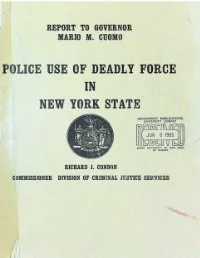
Police Use Of Deadly Force In New York State: A Report To Governor Mario M. Cuomo

Richard J. Condon Commissioner Division Of Criminal Justice Services

Police Use of Deadly Force in New York State: A Report to Governor Mario M. Cuomo (1985) offers one of the earliest systematic examinations of how and why lethal force was deployed by law enforcement across the state during a period of intense public scrutiny. Commissioned at a time when debates over police accountability, training standards, and civil rights were gaining national prominence, the report evaluates legal frameworks, departmental policies, and patterns of police–citizen encounters to assess the necessity and proportionality of deadly force incidents. Drawing on case reviews, agency surveys, and statistical analyses, it seeks to identify structural weaknesses and propose reforms aimed at reducing unnecessary violence and strengthening public trust.

Viewed from today’s perspective, the report stands as an important precursor to contemporary discussions about policing and the appropriate limits of state power. In the decades since its publication, nationwide movements such as Black Lives Matter, advances in data transparency, increased availability of video evidence, and evolving constitutional standards have intensified scrutiny of deadly force practices. Modern debates continue to revolve around issues the 1985 report identified early on: the need for clear and consistent use‑of‑force policies, robust training in de‑escalation, improved data collection, and stronger mechanisms of accountability. As current policymakers and communities grapple with how to balance public safety, civil liberties, and equitable treatment, this historical report offers valuable insight into the longstanding nature of these challenges and the enduring need for thoughtful, evidence‑based reform.

If you'd like, I can also turn this into a full foreword, integrate it into a larger document, or tailor the tone for academic, policy, or public audiences.

NY. Division Of Criminal Justice Services. 1985. p.273.

The Law Of Nations Applied To The Conduct And Affairs Of Nations And Sovereigns.

By M. D. Vattel. Introduction by Graeme R. Newman

A foundational work of international law, still resonant today.

First published in the eighteenth century and issued in authoritative English editions throughout the nineteenth, The Law of Nations by Emer de Vattel shaped how statesmen, jurists, and diplomats understood the rights and duties of sovereign powers. In this monumental treatise, Vattel applies the principles of natural law to the real conduct of nations, addressing war and peace, treaties and alliances, commerce and neutrality, diplomacy, and the limits of lawful power.

Rejecting both utopian idealism and brute realpolitik, Vattel argues that true national interest is inseparable from justice, restraint, and respect for sovereignty. Nations, like individuals, are bound by moral obligations arising from their coexistence in a shared international society. His careful analysis of war, intervention, and treaty obligations established enduring standards that influenced constitutional debates, foreign policy doctrine, and the development of modern international law.

This edition preserves a work that continues to illuminate contemporary conflicts and global challenges. Clear-eyed, systematic, and profoundly influential, The Law of Nations remains essential reading for anyone seeking to understand how lawful order, moral principle, and power intersect in the affairs of nations.

The theses advanced in The Law of Nations remain strikingly relevant to contemporary international disputes, particularly those involving intervention, recognition of governments, and claims of humanitarian necessity. Vattel’s insistence on sovereignty as the cornerstone of international order places clear limits on the legitimacy of external interference in the internal affairs of states. While he allows that extreme cases—such as manifest tyranny threatening the very existence of a people—may raise difficult moral questions, he consistently warns that powerful states are prone to disguise ambition and interest under the language of justice.

This caution is especially pertinent when considering recent controversies surrounding efforts by the United States to promote regime change in Venezuela, including diplomatic, economic, and political measures aimed at displacing the government of Nicolás Maduro. From a Vattelian perspective, such actions raise fundamental questions about lawful authority, the limits of collective judgment, and the distinction between moral condemnation and legal right. Vattel argues that no nation may unilaterally assume the role of judge over another sovereign without undermining the mutual independence on which international society depends. To do so, he suggests, risks converting international law into a mere instrument of power.

At the same time, Vattel’s framework does not deny the reality of gross misrule or humanitarian suffering. Rather, it demands rigorous scrutiny of motives and means. Economic coercion, diplomatic isolation, and recognition of alternative authorities would, in his analysis, need to be justified not by ideological preference or strategic advantage, but by clear evidence that such measures genuinely serve the common good of nations and do not erode the general security of the international system. His emphasis on proportionality, necessity, and respect for established sovereignty stands in tension with modern practices of intervention that rely on contested doctrines of legitimacy.

Viewed through this lens, contemporary debates over Venezuela illustrate the enduring force of Vattel’s central warning: that the stability of international relations depends less on the moral claims of individual powers than on shared restraint. His work reminds modern readers that the erosion of sovereignty in one case—however rhetorically justified—sets precedents that may ultimately weaken the legal protections upon which all nations, strong and weak alike, rely.

P.H. Nicklitn etc. Philadelphia. 1829. Read-Me.Org Inc. New York-Philadelphia-Australia. 2026 p.424.

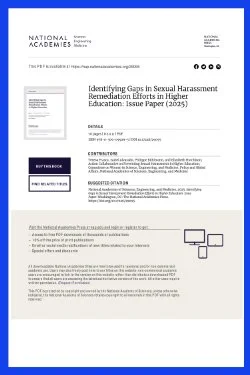
Identifying Gaps in Sexual Harassment Remediation Efforts in Higher Education:

By TERESA FRASCA et al.

Sexual harassment continues to be a persistent problem in institutions of higher education, despite the creation of new resources, policies, and programs aimed at combatting high rates on campuses (NASEM, 2018). Historically, these institutions have focused sexual harassment 1 prevention and response efforts on complying with the requirements of the law (NASEM, 2018). Specifically, institutions in the United States have focused on responding to formal reports of sexual harassment through complying with Title IX and Title VII2 —which prohibit discrimination against employees, students, staff, and/or faculty on the basis of sex—rather than identifying what harm has been caused by the sexual harassment, who has been harmed, and how that harm can be repaired. Even when institutions provide resources to repair the harm caused by sexual harassment, the harm might extend beyond the conclusions of the institutional response process and provision of the required remedial measures and sanctions (when applicable) (e.g., Grossi, 2017; Karp and Frank, 2016; McMahon et al., 2019; NASEM, 2018; Smith and Freyd, 2014). Put simply, there is a lack of attention to remediating (or repairing and limiting) the damage caused by sexual harassment across the timeline of the institutional response process (see Box 1 and Figure 1).

National Academies of Sciences. 2025. 76p.

From Conflict to Courtroom: Indonesia’s Legal Response to Terrorism and Core International Crimes

By Tanya Mehra, Merlina Herbach, Iwa Maulana

According to UNSC 1373(2001), States should bring alleged terrorists to justice, reflecting the seriousness of the crimes they have committed, which forms a vital aspect of an effective counterterrorism strategy. Consequently, States need to ensure that any person who participates in the financing, planning, preparation, or perpetration of terrorist acts or in supporting terrorist acts is brought to justice. States must similarly ensure that such terrorist acts are established as serious criminal offences under domestic law and that the punishment duly reflects the seriousness of such terrorist acts. When committed during armed conflict, some terrorist acts can constitute war crimes, and where terrorist acts are conducted as part of a widespread or systematic attack directed against a civilian population, they can constitute crimes against humanity. In some situations, terrorist acts may also constitute genocide if they are committed with intent to destroy, in whole or in part, a national, ethnic, racial, or religious group. While several terrorist groups such as the Islamic State of Iraq and Syria (ISIS), Boko Horam, Taliban, or the Maute Group are engaged in an armed conflict, one conflict stands out: the conflict in Syria and Iraq. The rise of ISIS resulted in an unprecedented flow of foreigners who travelled to the conflict zone. In response, several United Nations Security Council Resolutions (UNSCRs), in particular 2178(2014) and 2396(2017), oblige States to take measures to prevent such travel and criminalise a range of activities related thereto. Several international independent organisations have documented how ISIS committed attacks against civilians, in particular minorities, pillaged houses, in addition to multiple crimes other crimes such as murder, persecution, enslavement, sexual slavery, and rape. Several of these crimes amount to so-called core international crimes, namely war crimes, crimes against humanity or genocide. Hence, in recent years, several countries have started to prosecute members of ISIS for both terrorist offences and core international crimes. Examples include the prosecution for the war crime of pillaging, where members of a terrorist organisation occupied an estate after the original inhabitants were forced to flee, or for the war crime of outrage upon personal dignity for posting a picture of a mutilated body with degrading comments on social media. By prosecuting terroristrelated acts as core international crimes, perpetrators are being held accountable for the full range of crimes they have committed. This may lead to high(er) sentences and provide justice to victims. Ultimately, prosecuting terrorist-related offences with linkages to core international crimes can strengthen efforts to end impunity. Indonesia has seen a considerable number of its citizens travel to Syria and Iraq to join ISIS and other organisations and, like many other countries, is concerned with the security risks that are involved but also how to adopt effective prosecution, rehabilitation, and reintegration approaches. This report looks at the challenges and opportunities to prosecute alleged terrorists for both terrorism and core international crimes in Indonesia. This report reflects the findings of the project ‘Interlinkages Indonesia’ which was conducted by the International Centre for Counter-Terrorism – The Hague (ICCT) together with the Indonesian Badan Nasional Penanggulangan Terrorisme (BNPT) from 15 June 2023 to 31 March 2025. During this project, two workshops, a closed-door expert meeting ,and a public panel were held. This report reflects the main findings on how cumulative charging for terrorism and core international crimes can be implemented in Indonesia for the so-called foreign terrorist fighters (FTFs), especially in light of the new Indonesian criminal code that will enter into force on 1 January 2026. This report provides a short overview of the status quo concerning Indonesian foreign terrorist fighters and the approach taken thus on prosecuting those that have returned. After discussing some of the legal, institutional, and evidentiary challenges, this report provides an overview of the opportunities for Indonesia to adopt cumulative charging for terrorist offences and core international crimes.

The Hague: The International Centre for Counter-Terrorism (ICCT) , 2025. 30p.

Police Killings as Felony Murder

By Guyora Binder,and Ekow Yankah

The widely applauded conviction of officer Derek Chauvin for the murder of George Floyd employed the widely criticized felony murder rule. Should we use felony murder as a tool to check discriminatory and violent policing? The authors object that felony murder—although perhaps the only murder charge available for this killing under Minnesota law—understated Chauvin’s culpability and thereby inadequately denounced his crime. They show that further opportunities to prosecute police for felony murder are quite limited. Further, a substantial minority of states impose felony murder liability for any death proximately caused by a felony, even if the actual killer was a police officer, not an “agent” of the felony. In these “proximate cause” jurisdictions, felony murder is far more often used to prosecute the (often Black) targets of police violence, than to prosecute culpable police.

Previous scholarship on prosecution of felons for killings by police criticized such proximate cause rules as departures from the “agency” rules required by precedent. But today’s proximate cause felony murder rules were enacted legislatively during the War on Crime and are thus immune to this traditional argument. The authors instead offer a racial justice critique of proximate cause felony murder rules as discriminatory in effect, and as unjustly shifting blame for reckless policing onto its victims. Noting racially disparate patterns of charging felony murder, and particularly in cases where police have killed, the authors call on legislatures to reimpose “agency” limits on felony murder as a prophylactic against discrimination. Finally, the authors widen this racial justice critique to encompass felony murder as a whole, urging legislatures to abolish felony murder wherever racially disparate patterns of charging can be demonstrated.

17 Harv. L. & Pol'y Rev. 157 (2022).

Coercive Control in the Courtroom: The Legal Abuse Scale (LAS)

By Ellen R Gutowski, Lisa A Goodman

Intimate partner violence (IPV) survivors seeking safety and justice for themselves and their children through family court and other legal systems may instead encounter their partners' misuse of court processes to further enact coercive control. To illuminate this harmful process, this study sought to create a measure of legal abuse. We developed a list of 27 potential items on the basis of consultation with 23 experts, qualitative interviews, and existing literature. After piloting these items, we administered them to a sample of 222 survivor-mothers who had been involved in family law proceedings. We then used both exploratory factor analysis (EFA) and Rasch analysis (RA) to create a final measure. Analyses yielded the 14-item Legal Abuse Scale (LAS). Factor analysis supported two subscales: Harm to Self/Motherhood (i.e., using the court to harm the survivor as a person and a mother) and Harm to Finances (i.e., using the court to harm the survivor financially). The LAS is a tool that will enable systematic assessment of legal abuse in family court and other legal proceedings, an expansion of research on this form of coercive control, and further development of policy and practice that recognizes and responds to it.

J Fam Violence. 2023;38(3):527-542

Conflict Mitigation or Governance Choreographies? Scaling Up and Down State-Criminal Negotiations in Medellín and Lessons for Mexico

By Angelica Duran-Martinez

In the mid 2010s discussions about the pertinence of negotiating with criminal groups increased in Latin America. Although controversial, such negotiations are more common than often thought. This article asks: can negotiations reduce violence and generate peace? I argue that the homicide reduction potential of negotiations depends on the cohesion of the state and on the cohesion and hierarchical control of criminal groups. This in turn generates two challenges for peacebuilding: the challenge of scaling up and down security gains beyond homicide reduction, and the challenge of creating three-way arrangements that include civilians and navigate the blurry boundaries between states, civilians, and criminal actors. To conceptualize these challenges, I also distinguish top-down and bottom-up negotiations and argue that addressing these challenges requires bridging a divide between peace building principles emphasizing the importance of local contexts, and peace processes literature focusing on objective power considerations. I substantiate the theory using evidence from long term fieldwork, archival analysis, and forty-three interviews conducted for this project in Medellín-Colombia and extend the insights to assess the potential for peace negotiations in Mexico.

Crime Law and Social Change 82(4):867-891, 2023

Restorative Justice Conferencing for Domestic and Family Violence and Sexual Violence: Evaluation of Phase Three of the ACT Restorative Justice Scheme

By Siobhan Lawler, Hayley Boxall, Christopher Dowling

Research evaluating restorative justice programs for domestic and family violence and sexual violence is limited in Australia and internationally. In 2019 the AIC was commissioned to evaluate the Australian Capital Territory’s Restorative Justice Scheme for domestic and family violence and sexual violence (‘Phase Three’). The evaluation examined the process and outcomes of Phase Three, including barriers to delivery, activities delivered and outcomes associated with participation. A range of data was examined, including interviews with participants (n=16) and stakeholders (n=47), analysis of post-conference surveys (n=28) and analysis of administrative and reoffending data. The evaluation demonstrated Phase Three is working effectively overall. Participants and stakeholders report high levels of satisfaction with Phase Three and the service they received. There was evidence that victim-survivors could meet a range of justice needs with varying levels of offender participation and accountability. Some areas for improving referrals were identified.

Research Report no. 33.

Canberra: Australian Institute of Criminology. 2025. 185p.

Courts and the Abolition Movement

By Matthew Clair & Amanda Woog

This Essay theorizes and reimagines the place of courts in the contemporary struggle for the abolition of racialized punitive systems of legal control and exploitation. In the spring and summer of 2020, the killings of George Floyd, Breonna Taylor, and many other Black and Indigenous people sparked continuous protests against racist police violence and other forms of oppression. Meanwhile, abolitionist organizers and scholars have long critiqued the prison-industrial complex, or the constellation of corporations, media entities, governmental actors, and racist and capitalist ideologies that have driven mass incarceration. But between the police and the prison cell sits the criminal court. Criminal courts are the legal pathway from an arrest to a prison sentence—with myriad systems of control in between, including ones branded as “off-ramps”—and we cannot understand the present crisis without understanding how the criminal courts not only function to legitimate police and funnel people into carceral spaces but also contribute unique forms of violence, social control, and exploitation all their own, revealing the machinations of mass criminalization and injustice operating between the police encounter and the prison cell. Our central argument is that courts—with a focus here on the criminal trial courts and the workgroup of actors within them—function as an unjust social institution; we should therefore work toward abolishing criminal courts and replacing them with other institutions that do not inherently legitimate police, rely on jails and prisons, or themselves operate as tools of racial and economic oppression. Drawing on legal scholarship and empirical social scientific research, Part I describes injustices perpetrated by criminal courts, detailing their role in the present crisis of mass criminalization through legal doctrine, racialized social control and violence, and economic exploitation. In Part II, we describe the contemporary abolition movement, briefly laying out its genesis and three guiding principles we view as typically considered in relation to policing and prisons: (1) power shifting, (2) defunding and reinvesting, and (3) transformation. Part III explores how these principles could operate in relation to the courts, drawing on analysis of existing grassroots efforts as well as offering new possibilities. In the short term, non-reformist reforms could make criminal courts a venue to unmask, and therefore aid in dismantling, police and prisons. Such reforms could complement the broader abolition movement and reduce the churn of people through the system. Ultimately, the goal would be to abolish criminal courts as systems of coercion, violence, and exploitation, and to replace them with other social institutions, such as community-based restorative justice and peacemaking programs while at the same time investing in the robust provision of social, political, and economic resources in marginalized communities.

110 CALIFORNIA LAW REVIEW (Volume 110February 20222022) 45p.

A Review of the Federal Bureau of Investigation’s Handling of Its Confidential Human Sources and Intelligence Collection Efforts in the Lead Up to the January 6, 2021 Electoral Certification

By The U.S. Department of Justice, Office of the Inspector General


  In the aftermath of the riot and breach of the U.S. Capitol on January 6, 2021, among the questions that were raised was how the breach had occurred and what was known by federal law enforcement in advance of January 6 about the possibility of a violent protest that day. On January 15, 2021, the Department of Justice (Department or DOJ) Office of the Inspector General (OIG) announced its review to examine the role and activity of DOJ and its components in preparing for and responding to the events at the U.S. Capitol on January 6, 2021. Separately, the Federal Bureau of Investigation (FBI) and Department prosecutors immediately began criminally investigating individuals who violated federal law in connection with the riot at the U.S. Capitol on January 6. The Department—through the U.S. Attorney’s Office (USAO) for the District of Columbia (DC)— has reported that it has brought charges against over 1,500 individuals and described the January 6 investigations and prosecutions as having “moved forward at an unprecedented speed and scale.” In the public announcement of our review of the events at the U.S. Capitol on January 6, 2021, we took note of these ongoing criminal prosecutions, stating that the OIG was “mindful of the sensitive nature of the ongoing criminal investigations and prosecutions related to the events of January 6. Consistent with longstanding OIG practice, in conducting this review, the DOJ OIG will take care to ensure that the review does not interfere with these investigations or prosecutions.” As is customary for the OIG, we coordinated closely with the Department and the DC USAO to ensure that the OIG’s investigative work did not conflict with or compromise any ongoing criminal investigation or prosecution. To that end, and consistent with OIG practice, in spring 2022 the OIG paused aspects of our review. 1 Once the OIG determined last year, after consultation with federal prosecutors, that our review would no longer potentially interfere with pending prosecutions, we resumed our review. In doing so, we were cognizant of the amount of time that had passed in deference to the ongoing criminal investigations and prosecutions, as well as the number of other non-DOJ OIG oversight reports that have since been publicly released regarding the January 6 events, and we therefore decided to largely focus our inquiry on an issue that has not yet been thoroughly reviewed in oversight conducted by other entities, namely the FBI’s direction and handling of its confidential human sources (CHS) in the lead-up to and on January 6, and whether the FBI exploited its CHSs and other available information to determine the nature of threats in advance of the electoral vote certification on January 6. In addition to the DOJ OIG’s oversight efforts reflected in this report, several other Inspectors General have conducted reviews of their agency’s actions in connection with the events of January 6:  The U.S. Capitol Police (USCP) OIG immediately began a review to determine if the USCP, which is responsible for policing the Capitol Complex, (1) established adequate measures for ensuring the safety and security of the Capitol Complex as well as Members of Congress, (2) established adequate  internal controls and processes for ensuring compliance with Department policies, and (3) complied with applicable policies and procedures as well as applicable laws and regulations.  The Department of Defense (DoD) OIG initiated a review of the relevant events leading up to January 6, including the DoD’s review and approval of the DC government’s request for assistance from the DC National Guard; DoD’s coordination with DC and federal officials in preparation for January 6; DoD’s receipt and approval of the USCP’s request for assistance on January 6; and the planning involved for National Guard forces to help secure the Capitol in the immediate aftermath of the riot.  The Department of Homeland Security (DHS) OIG began a review to examine the role and activity of DHS and its components in preparing for and responding to the events of January 6, 2021, including DHS’s Office of Intelligence & Analysis’s responsibility for providing intelligence to law enforcement and DHS law enforcement components’ roles, responsibilities, and actions on January 6. The U.S. Secret Service (USSS), which was responsible for protecting then Vice President Mike Pence on January 6 during his time at the U.S. Capitol, is a law enforcement component within DHS. In addition, DHS is responsible for designating an event as a national special security event (NSSE) or as a Special Event Assessment Rating (SEAR) event, which it did not do for the electoral vote certification on January 6. 2 The FBI defines a special event as a “significant international event or a domestic event” formally designated as an NSSE event or a SEAR event, which requires the FBI “to plan, coordinate, develop, or provide FBI resources to mitigate potential threats the special event may cause to national security or threats of significant criminal activity that the FBI is responsible for identifying, preventing, investigating, or disrupting.”  The Department of Interior (DOI) OIG initiated a review of the actions of the National Park Service (NPS) and the U.S. Park Police (USPP) in preparing for and responding to the events at the Ellipse and the Capitol on January 6 and in information-sharing between the NPS, the USPP, and their law enforcement partners. The demonstration that preceded the violence at the Capitol occurred at the Ellipse, which is part of President’s Park—a national park under the control of the NPS. The USPP is a unit of the NPS authorized to conduct law enforcement in the national park system and, pursuant to local statutes, within DC generally. A further oversight effort was undertaken by the Government Accountability Office (GAO), at the request of Congress, which announced that it would conduct “a comprehensive overview of events leading up to, during, and following the January 6 attack.” The U.S. Senate and the U.S. House of Representatives also conducted oversight regarding the events of January 6. The Senate Committee on Homeland Security and Governmental Affairs (HSGAC) together with the Senate Committee on Rules and Administration (RAC) announced a joint investigation on January 8, 2021, to “examine the intelligence and security failures” that led to the events of January 6. On January 12, 2021, the House of Representatives and Senate leadership were briefed by senior FBI officials about the FBI’s posture leading up to January 6, its response and investigation into the events of January 6, and the threat picture and operational posture leading into the Inauguration on January 20, 2021. Subsequently, numerous congressional committee hearings addressed how various federal agencies prepared in advance of the January 6 Electoral Certification and how they responded on January 6, with the first one being held by the House of Representatives Appropriations Committee on January 26, 2021. In early March 2021, HSGAC/RAC jointly held an oversight hearing that included testimony from the FBI, Hearing Examining the January 6 Attack on the U.S. Capitol, Part II, as well as from non-FBI witnesses. On June 30, 2021, the House of Representatives established a 13-member Select Committee to investigate the rioting and breaching of the Capitol on January 6, named the “House Select Committee to Investigate the January 6th Attack on the United States Capitol” (House Select Committee). The House Select Committee held 10 televised hearings beginning on June 9, 2022, and concluded the last hearing on December 19, 2022. 

Washington, DC: U.S. Department of Justice, Office of the Inspector General, 2024. 88p.

Deterrence and Denial: The Impact of Sanctions and Designations on Violent Far-Right Groups

By Colin P. Clarke

Because terrorist groups like al-Qaeda and Islamic State in Iraq and Syria (ISIS) have been successful in adapting and innovating in response to counterterrorism measures, it is important to develop a flexible, responsive sanctions regime similar to the 1267 regime, but that can include new organizations and bodies designed to keep it relevant and applicable— and any new regime considered for violent far-right groups should be similarly flexible—both in terms of the various measures employed, but also concerning the individuals and assets to be targeted. • Due to ISIS’ relatively unique ability to capture and administer large swaths of territory as it built a proto-state and diversified its funding portfolio, it is somewhat difficult to assess how effective sanctions were against the group. • If certain terrorist threats concern only a limited number of states—for example, the rightwing threat is likely to be more prominent in North America, Europe, and Oceania, though it certainly exists elsewhere—there may be less of an impetus, or little sense of urgency, for states outside of those immediately impacted to act. In that sense, the threats posed by al-Qaeda and ISIS) were more transnational, and as a result, generated global consensus more easily. Therefore, it will be crucial to work toward creating consensus, as well as to explore other applications of sanctions to counter the violent far-right threat. • One of the primary challenges to evaluating the impact of sanctions against terrorist groups is the lack of an effective assessment framework, in addition to data gaps. The sensitive nature of data related to terrorism and counterterrorism is one of the primary reasons why it has been difficult to provide a comprehensive assessment of the United Nations’ overall impact in this area. • Recommendations include: focus on tailor-made sanctions regimes that can adapt to the terrorist threat, considering both multilateral and national options; establish metrics to assess implementation and impact of sanctions regimes; and invest in international cooperation for implementation. 

New York: Soufan Center, 2022. 72p.

The International Criminal Court Act 2001 and State or Diplomatic Immunity The Case of the Prime Minister of Israel

By Lord Verdirame KC and Professor Richard Ekins KC (Hon)

The International Criminal Court Act 2001 is an Act to give effect to the Statute of the International Criminal Court (the ICC Statute or Rome Statute). Part 2 of the Act makes provision for the arrest, detention and delivery up to the International Criminal Court (ICC) of persons against whom the ICC has issued an arrest warrant. But section 23 of the Act does not allow any action under Part 2 of the Act to be taken in relation to a person to whom state or diplomatic immunity attaches by reason of a connection with a state that is not a State party to the Rome Statute. The only exceptions to this limitation are if (a) the ICC obtains a waiver from that state or (b) the United Nations Security Council (UNSC) makes a resolution. The ICC has issued an arrest warrant against Prime Minister Benjamin Netanyahu of Israel. Israel is not a State party to the Rome Statute and has not waived state or diplomatic immunity. There is no relevant UNSC resolution. As a matter of customary international law, a Head of Government is entitled to absolute immunity against arrest. For this reason, it would be unlawful, as a matter of UK law and international law, to attempt to arrest Prime Minister Netanyahu. If the Government were to attempt to comply with the arrest warrant it would be acting beyond the parameters of the powers conferred on it by an Act of Parliament and would be violating the UK’s obligations in international law to respect state or diplomatic immunity. To the extent that the Government has indicated that it would attempt to execute an arrest warrant, its actions warrant strong denunciation. Any court hearing an application from the Secretary of State under Part 2 of the Act should reject the application on the grounds that it is incompatible with section 23 and with the rules about state or diplomatic immunity incorporated into and having effect in UK law

London: Policy Exchange, 2024. 17p.

Assessing the Impact of Plea Bargaining on Subsequent Violence for Firearm Offenders

By Brian Johnson, Kiminori Nakamura, Lydia Becker, Raquel Hernandez

Firearms violence is a major policy concern in America. How criminal courts address firearm crimes represents a critical opportunity for improving public safety. The overwhelming majority of criminal cases are settled by guilty plea, yet little is known about the ways that plea deals impact criminal punishment for firearms-involved offenders, or how they shape subsequent recidivism. This project investigates the association between plea bargaining, sentencing, and recidivism outcomes in state-wide sample of firearms-involved offenders. It provides a descriptive overview of case characteristics and outcomes in firearms cases, examines the scope and impact of plea bargaining for these offenses, and considers how plea discounts potentially impact future reoffending. Findings indicate that plea negotiations are common in firearms-related offenses – a majority of cases involve multiple filed charges but a single conviction charge, and more than half of all cases include a reduction in the severity of the top charge between filing and conviction. The mean distance traveled, or average magnitude of plea discounts, results in a significant reduction in the likelihood of incarceration and expected sentence lengths. Results also reveal significant relationships between plea discounts and recidivism. Defendants who are convicted and sentenced to longer incarceration terms have lower odds of coming back into the system for a new offense, whereas those who receive charge reductions and are given larger plea discounts are more likely to recidivate during our study period. Because average sentences in firearms cases are substantial, and because our follow-up period is limited, these results likely reflect the short-term incapacitation effects of lengthier incarceration terms. Overall, the current study suggests there may be significant public safety implications of plea discounts in firearms cases, though future research is needed before strong policy recommendations can be offered.

College Park, MD: University of Maryland, 2024. 88p.

Demystifying the Sacred: Blasphemy and Violence from the French Revolution to Today 

Edited by  Eveline G. Bouwers and David Nash

This book investigates the relationship between blasphemy and violence in modern history, with a focus on cases from the European world, including its (post-) colonial ties. Spanning from the late eighteenth century to today, it shows how cultures of blasphemy, and related acts of heresy, apostasy, and sacrilege, have interacted with different forms of violence, committed against both the sacred and the secular.

Berlin; Boston: De Gruyter Oldenbourg, 2022. 

Childhood Innocence?: Mapping Trends in Teenage Terrorism Offenders

By Hannah Rose and Gina Vale

Also‑called ‘new generation of extremists’ has attracted significant media attention but has suffered from a lack of transparent data and comprehensive, youth‑specific analysis. Against the backdrop of a rapidly evolving threat landscape, this report presents the first in‑depth research into child terrorist activity in England and Wales. Through the construction of a unique dataset of children convicted of terrorism offences in England and Wales since 2016 – published live alongside this report – it investigates how domestic policing and the criminal justice system understand child‑terrorism offending. Key Data Points In the UK since 2016, 43 individuals have been convicted of terrorism offences they committed as minors. Of these, 42 were boys, with only one girl. While the oldest offenders were days before their respective 18th birthdays, the youngest was only 13 years old. Two clear waves of child terrorism offending can be identified. The first, dominated by Islamist cases, runs concurrently with the peak of Islamic State’s territorial ‘caliphate’ until its collapse in 2018. The second wave predominantly comprises extreme‑right cases, emerging in 2018 in the context of post-National Action and the decentralisation of extreme‑right online networks. In total, 16 cases relate to Islamist activity, 25 to the extreme right, and two to unknown or unclear ideologies. Almost a third of the children were convicted of preparing an act of terrorism, including the construction of improvised explosive devices, the plotting of complex mass‑casualty attacks, and attempts by seven children to travel independently overseas for the purpose of engaging in terrorism. Eight children – five extreme right and three Islamist – planned to commit domestic acts of terrorism on UK soil. Eleven minors were convicted of encouraging terrorism, one for providing training for terrorism, one for membership of a banned organisation and one for inviting support for a banned organisation. The most common offence, committed by 26 minors, was the collection of terrorist propaganda. Children created their own propaganda, engaged with violent extremist literature and downloaded operational materials. 19 minors disseminated banned materials with friends, family and anonymous online networks. Proportionally, more extreme right than Islamist offenders pleaded guilty, with many denouncing previously held views, citing adverse childhood experiences, explaining their isolation and desire to fit in with online ecosystems, and claiming childhood innocence. The most common sentence was non‑custodial, accompanied by a rehabilitative and monitoring order, which was handed down to twel  sentence, awarded in two separate Islamist cases, was eleven years to life. The disparity in sentencing between ideological categories may be shaped by four factors: the age at sentencing, greater severity of offence, stronger mitigating circumstances among extreme‑right offenders and a higher proportion of not‑guilty pleas entered by Islamist defendants. A New Threat? Children did not merely mimic the actions or do the bidding of older individuals, but proved to be innovators and amplifiers in their own right. Many attempted and managed to recruit peers and older family members, prepare acts of terrorism without the help of adults, and create their own propaganda images, videos and manifestos. In anonymous transnational online extremist ecosystems, which are widely available and have very low barriers to participation, the potential impact of extremist minors is on a par with adults. Children’s support of terrorist networks presents a new threat. While no attack has been committed by a child in the UK to date, late‑stage foiled plots and transnational activism demonstrate this potentiality. However, children cannot merely be treated as ‘small adults’ with heavily securitised policies. An outcome‑focused system must balance the interests of the public and targeted communities with the best interests of the child to address root causes of radicalisation and secure successful reintegration and threat mitigation.  

London: International Centre for the Study of Radicalisation, 2023. 76p.

Opening The Black Box of Child Support: Shining a Light on How Financial Abuse is Perpetrated

By Kay Cook, Adrienne Byrt, Terese Edwards, Ashlea Coen

This report draws on the experiences of 675 single mothers who have engaged with the Australian child support system. It reveals how violence is the backdrop to women’s engagement within each stage of the child support process and the compounding impact of violence and poverty. The report makes four recommendations that would reduce the capacity of the child support system to be weaponised. Child support, despite its straightforward and important aim of transferring payments between separated households, is regarded as a complex area of policy and a ‘black box’ in which there is a lack of data on how the system operates. The system’s opacity means that parents’ experiences are largely unknown – particularly for half of the caseload who transfer payments privately. Policy and service blind spots and loopholes allow harmful behaviour perpetrated through the child support system to go undetected and unaccounted for. The lack of evidence on the harms that the system enables in turn perpetuates the myth that child support is a benign administrative process. The recommendations in this report are a direct result of the survey findings and are intended to: bring about meaningful improvements;empower women with autonomy and choice that is directed by what they want and require for their family; andcreate a system that is safe for women to engage in.

Recommendations

Delink family payments from child support by eliminating the Maintenance Income Test.Co-design family violence processes within the child support system to recognise the high rates of violence experienced by system users.Move all child support collections back into the Australian Tax Office.Make all payment debts owed to and enforced by the Commonwealth.

Hawthorn, VIC: Swinburne University of Technology, 2024. 97p.