Open Access Publisher and Free Library
CRIMINAL JUSTICE.jpeg

CRIMINAL JUSTICE

CRIMINAL JUSTICE-CRIMINAL LAW-PROCDEDURE-SENTENCING-COURTS

Posts in rule of law
Surveillance Technologies and Constitutional Law

By Christopher Slobogin and Sarah Brayne

This review focuses on government use of technology to observe, collect, or record potential criminal activity in real-time, as contrasted with “transaction surveillance” that involves government efforts to access already-existing records and exploit Big Data, topics that have been the focus of previous reviews (Brayne 2018, Ridgeway 2018). Even so limited, surveillance technologies come in many guises, including closed-circuit television, automated license plate and facial readers, aerial cameras, and GPS tracking. Also classifiable as surveillance technology are devices such as thermal and electromagnetic imagers that can “see” through walls and clothing. Finally, surveillance includes wiretapping and other forms of communication interception. The following discussion briefly examines the limited evidence we have about the prevalence and effectiveness of these technologies and then describes the law governing surveillance, focusing principally on constitutional doctrine, and how it might—and might not—limit use of these technologies in the future.

  Annual Review of Criminology,  2023. 6:219–40 
download
Evidence Rules for Decarceration

By Eric R. Collins

  Two observations about the operation of the criminal legal system are so widely accepted that they seem undeniable: First, it is a system of pleas, not trials. Second, the system is too punitive and must be reformed. One could easily think, therefore, that the Federal Rules of Evidence, which apply intentionally and explicitly only to the adjudicatory phase of criminal procedure, have nothing to do with the solution. And legal scholarship focusing on decarceration largely reflects this assumption: while many have explored reforms that target front end system actors and processes that lead people into the system (e.g. police, prosecutors, broad criminal statutes), and back end reforms that that seek to lessen the toll of punitive policies (sentencing reform, alternatives to incarceration), markedly fewer have explored how what happens in the middle — adjudication — contributes to mass incarceration. While this oversight makes sense, it is not justified because it is also equally undeniable that plea bargaining happens in the shadow of trial. This Article examines how the shadow of trial — specifically, the shadow cast by evidentiary rulings about the accused person’s past — contributes to the perpetuation of an expansive carceral state. It identifies how evidence rules have been relaxed, tweaked, specialized, or unmoored from their foundational principles in ways that facilitate prosecution and conviction or essentially force plea deals – without regard for the truth, fairness, or justice of the outcome. In other words, it identifies ways that evidence law undermines the Rules’ primary purpose, which is to advance fair proceedings “to the end of ascertaining the truth and securing a just determination.”   

Fordham Urban Law Journal, 50(3): 2023. 

download
Misdemeanor Prosecution

Amanda Y. AganJennifer L. Doleac & Anna Harvey

Communities across the United States are reconsidering the public safety benefits of prosecuting nonviolent misdemeanor offenses, yet there is little empirical evidence to inform policy in this area. In this paper we report the first estimates of the causal effects of misdemeanor prosecution on defendants' subsequent criminal justice involvement. We leverage the as-if random assignment of nonviolent misdemeanor cases to Assistant District Attorneys (ADAs) who decide whether a case should be prosecuted in the Suffolk County District Attorney's Office in Massachusetts. These ADAs vary in the average leniency of their prosecution decisions. We find that, for the marginal defendant, non-prosecution of a nonviolent misdemeanor offense leads to a 53% reduction in the likelihood of a new criminal complaint, and to a 60% reduction in the number of new criminal complaints, over the next two years. These local average treatment effects are largest for defendants without prior criminal records, suggesting that averting criminal record acquisition is an important mechanism driving our findings. We also present evidence that a recent policy change in Suffolk County imposing a presumption of nonprosecution for nonviolent misdemeanor offenses had similar beneficial effects, decreasing the likelihood of subsequent criminal justice involvement

Cambridge, MA: National Bureau of Economic Research, 2022. 103p.

download
Cost of Discretion; Judicial Decision-Making, Pretrial Detention, and Public Safety in New York City

By Scrutinize

Institute for the Quantitative Study of Inclusion, Diversity, and Equity Zimroth Center on the Administration of Criminal Law at NYU School of Law

An analysis of public pretrial data from 2020-2022 reveals that some New York City judges are disproportionately carceral, i.e., these judges are substantially more likely to order pretrial detention
than their peers, even when accounting for factors such as the severity of the case and the defendant’s
prior criminal history. The fourteen judges who exhibited the most carceral discretion compared to their peers are Felicia Mennin, Gerald Lebovits, Quynda Santacroce, Josh Hanshaft, Kerry Ward, Bruna DiBiase, Gerianne Abriano, Beth Beller, Phyllis Chu, Alan Schiff, Tara Collins, Derefim Neckles, Joseph McCormack, and Lumarie Maldonado-Cruz. These fourteen judges’ disproportionately carceral decisions over 2.5 years resulted in an estimated 580 additional people detained, 154 additional years of pretrial detention, and over $77 million of additional costs borne by New York City taxpayers.

New York: The Authors, 2023. 29p.

download
Destroyed by Discovery: How New York State’s Discovery Law Destabilizes the Criminal Justice System

By Hannah E. Meyers

  All prosecutors are required to hand over relevant material to defense attorneys prior to trial, a process referred to as “discovery.” Discovery is fundamental to a fair trial because it is impossible for defendants to make informed plea-bargain decisions if they do not know the strength of the evidence that prosecutors have against them. However, New York’s 2019 discovery statute, Criminal Procedure Law Article 245 (“245”), has crippled the state’s criminal justice system with an untenable compliance burden that prevents it from being either just or appropriately adversarial. It has forced district attorneys’ offices to triage cases and has harmed both the victims of crime and, in the long run, many criminal offenders. The NYS Legislature can correct the systemic harms caused by 245 and increase fairness to defendants, reduce administrative burdens on police and prosecutors, and rebalance risk so that the consequences of noncompliance align with substantive impacts on due process. New York’s new discovery rules, which went into effect in January 2020, were such an extreme and far-reaching version of “reform” that even famously progressive Manhattan District Attorney Alvin Bragg recently complained: “My Office’s lawyers and support staff continue their herculean efforts in managing discovery-related obligations.” The Legal Aid Society, which represents and advocates for criminal defendants, correctly crowed that, rather than simply reinforcing prosecutors’ discovery duties, as intended, 245 “is transforming New York State’s criminal justice system.” The new discovery obligations are indeed so herculean that NYS prosecutors have been able to meet them within the mandated time frames on only 21% of cases. In statewide local courts, they are met on 16% of cases, and in NYC local courts, that number dwindles to 13%. And because discovery must now be met within New York’s preexisting “speedy trial” time windows, on pain of automatic dismissal, thousands of viable cases have been thrown out—not because justice demands it but simply because the compliance burden has proved too great. In NYC courts, dismissals rose from 44% of all disposed cases in 2019, to 69% in 2021. Statewide, dismissals rose by 14% in that period. Meanwhile, guilty pleas fell in NYC from 45% to 21%—and statewide, from 49% to 33%—as defense attorneys have, correctly, become more confident that cases will be dismissed rather than go to trial.

New York: Manhattan Institute, 2023. 43p.

download
The Poor Reform Prosecutor: So Far From the State Capital, So Close to the Suburbs

By John F. Pfaff

Given the undeniable role that prosecutorial discretion has played in driving mass incarceration, it makes sense to turn to them to scale it back as well. This has certainly been a central motivation of the progressive/reform prosecutor movement that started in the late 2000s. And while this movement has had some notable successes, recent years have shed some important light on the limits it faces as well. In this essay, I want to focus on how the county-ness of prosecutors hems in their power from two different directions. On the one hand, as county officials, prosecutors—at least in most major urban areas—have a large number of constituents who live in the suburbs and regularly oppose reforms … of policies that by and large do not affect them. It’s telling that many, if not most, reform prosecutors have been elected in counties that either have no suburbs at all within their borders (Philadelphia, Baltimore, St. Louis) or where the suburbs are a small fraction of the overall population (Boston, Portland). It’s clear across a wide range of cities that the core support for reform DAs comes from Black communities with high levels of violence, i.e., the communities that bear the brunt of DA decisionmaking. The more suburban voters in a county, however, the more diluted those voices become. On the other hand, as county officials, prosecutors operate at the mercy of state officials, who have a wide range of powers for clipping their wings: legislatures can give state AGs concurrent jurisdiction, for example, and in many places governors can remove elected DAs or take their cases away from them. While states are shielded from (some) federal interventions by the 10th Amendment, county officials have no such protection, as reform DAs in GOP-controlled states are increasingly beginning to discover.

(March 4, 2023). Fordham Urban Law Journal, Forthcoming, Available at SSRN: https://ssrn.com/abstract=4378322

download
Driving Injustice: Consequences and Disparities in North Carolina Criminal Legal and Traffic Debt

By Duke Law School, Wilson Center for Science and Justice

Nationwide harm lasting and severe causes many, people of millions of tens for these pay to poor too are whom of bulk The. fees and fines mandatory perhaps, fees and fines these of lowest the from arise, surprisingly particularly—cases criminal level minor other and cases traffic Police. misdemeanors and infractions traffic of millions of tens conduct the, far by, are they; year every stops between interaction common most .public the and enforcement law debt legal criminal, more s’What ,people Black burdens disparately 1.poor the and, color of communities debt legal criminal, many For fines their because accumulates from unaffordable were fees and require not do states Most. start the before pay to ability s’person a determine to courts waivers cost-no have they do nor, fees and fines imposing judges required has law the, long too For. indigent the for ,cases criminal level-low in collectors debt as act to assessing first without fines collecting and imposing of suspension the in resulting ultimately, pay to ability to barriers experience who those for privileges driving to get cannot people, license s’driver a Without. payment needs basic their get or, families their of care take, work ,doctor a visiting, school to children their taking like, met .  

Durham, NC: Duke Law School, Wilson Center for Science and Justice, 2021. 18p.

download
The Burden of Court Debt on Washingtonians

By Maria Rafael

Nearly every person convicted in a Washington court faces the heavy burden of court debt.2 The vast majority of Washingtonians with criminal cases—as many as 90 percent—meet the indigency standard, indicating that they have limited or no ability to repay their court debt.3 People with court debt are more likely to already be burdened by other types of debt, making it even more difficult for them to free themselves of the financial burden of LFOs.

New York: Vera Institute of Justice, 2023. 10p.

download
Biometric Identification, Law and Ethics

By Marcus Smith and Seumas Miller

This book undertakes a multifaceted and integrated examination of biometric identification, including the current state of the technology, how it is being used, the key ethical issues, and the implications for law and regulation. The five chapters examine the main forms of contemporary biometrics–fingerprint recognition, facial recognition and DNA identification– as well the integration of biometric data with other forms of personal data, analyses key ethical concepts in play, including privacy, individual autonomy, collective responsibility, and joint ownership rights, and proposes a raft of principles to guide the regulation of biometrics in liberal democracies. Biometric identification technology is developing rapidly and being implemented more widely, along with other forms of information technology. As products, services and communication moves online, digital identity and security is becoming more important. Biometric identification facilitates this transition. Citizens now use biometrics to access a smartphone or obtain a passport; law enforcement agencies use biometrics in association with CCTV to identify a terrorist in a crowd, or identify a suspect via their fingerprints or DNA; and companies use biometrics to identify their customers and employees. In some cases the use of biometrics is governed by law, in others the technology has developed and been implemented so quickly that, perhaps because it has been viewed as a valuable security enhancement, laws regulating its use have often not been updated to reflect new applications. However, the technology associated with biometrics raises significant ethical problems, including in relation to individual privacy, ownership of biometric data, dual use and, more generally, as is illustrated by the increasing use of biometrics in authoritarian states such as China, the potential for unregulated biometrics to undermine fundamental principles of liberal democracy. Resolving these ethical problems is a vital step towards more effective regulation.

Cham: Springer Nature, 2021. 99p.

download
Sex Trafficking: Online Platforms and Federal Prosecutions

By The U.S. Government Accountability Office 

  Online marketing and communication platforms can enable sex trafficking— the commercial sexual exploitation of adults through force, fraud or coercion, or children under the age of 18 (with or without force, fraud, or coercion)—by making it easier for traffickers to exploit victims and connect with buyers. Section 3 of FOSTA established criminal penalties for those who promote or facilitate prostitution and sex trafficking through their control of online platforms. It also allows for those injured by an aggravated violation involving the promotion of prostitution of five or more people or reckless disregard of sex trafficking to recover damages in a federal civil action. It also makes federal criminal restitution mandatory for aggravated offenses contributing to sex trafficking. FOSTA includes a provision for GAO to provide detailed information on restitution and civil damages. This report examines: (1) DOJ enforcement efforts against online platforms that promote prostitution and sex trafficking, from 2014 through 2020; and (2) the extent to which criminal restitution and civil damages have been sought and awarded for aggravated violations under section 3 of FOSTA. GAO reviewed federal criminal cases brought against those who controlled platforms in the online commercial sex market from 2014 through 2020; visited a selection of online platforms in this market; and conducted a legal search to identify criminal and civil cases brought pursuant to section 3 of FOSTA. GAO also interviewed DOJ officials and representatives from third parties. 

Washington, DC: U.S. Government Accountability Office, 2021. 56p.

download
Bodies as Evidence: Security, Knowledge, and Power

Edited by  Mark Maguire, Ursula Rao, and Nils Zurawski

From biometrics to predictive policing, contemporary security relies on sophisticated scientific evidence-gathering and knowledge-making focused on the human body. Bringing together new anthropological perspectives on the complexities of security in the present moment, the contributors to Bodies as Evidence reveal how bodies have become critical sources of evidence that is organized and deployed to classify, recognize, and manage human life. Through global case studies that explore biometric identification, border control, forensics, predictive policing, and counterterrorism, the contributors show how security discourses and practices that target the body contribute to new configurations of knowledge and power. At the same time, margins of error, unreliable technologies, and a growing suspicion of scientific evidence in a “post-truth” era contribute to growing insecurity, especially among marginalized populations.

Durham, NC: Duke University Press, 2018. 257p.

download
Affective Justice: The International Criminal Court and the Pan-Africanist Pushback

By Kaman Maxine Clarke

Since its inception in 2001, the International Criminal Court (ICC) has been met with resistance by various African states and their leaders, who see the court as a new iteration of colonial violence and control. In Affective Justice Kamari Maxine Clarke explores the African Union's pushback against the ICC in order to theorize affect's role in shaping forms of justice in the contemporary period. Drawing on fieldwork in The Hague, the African Union in Addis Ababa, sites of post-election violence in Kenya, and Boko Haram's circuits in Northern Nigeria, Clarke formulates the concept of affective justice—an emotional response to competing interpretations of justice—to trace how affect becomes manifest in judicial practices. By detailing the effects of the ICC’s all-African indictments, she outlines how affective responses to these call into question the "objectivity" of the ICC’s mission to protect those victimized by violence and prosecute perpetrators of those crimes. In analyzing the effects of such cases, Clarke provides a fuller theorization of how people articulate what justice is and the mechanisms through which they do so.

Durham, NC: Duke University Press, 2019. 384p.

download
The Impact of Liberalized Concealed Carry Laws on Homicide: An Assessment

By K. Alexander Adams and Youngsung Kim

This paper uses panel data from 1980 to 2018 in all 50 U.S. states and the District of Columbia to examine the relationship between liberalized concealed carry laws, homicide, and firearm homicide. Multivariate regression analysis was conducted with state and time fixed effects. A general-to-specific procedure was also used to reduce the arbitrariness of choosing control variables in the crime equation. Various robustness checks were also employed, including the use of a generalized synthetic control model. The relationship between shall-issue and constitutional carry laws and homicide were statistically insignificant at the 1%, 5%, and even 10% level. The results were robust to multiple alternative model specifications. We find no evidence that looser concealed carry laws pose a significant public health or criminological risk.

Unpublished paper, 2023. 

read/download
Probation and Parole in the United States, 2019

By Danielle Kaeble, BJS Statistician

This report presents national data on adult offenders under community supervision on probation or parole in 2019. It includes characteristics of the population, such as sex, race or Hispanic origin, and most serious offense. The report details how offenders move onto and off community supervision, such as completing their term of supervision, being incarcerated, absconding, or other unsatisfactory outcomes while in the community. Findings are based on data from BJS’s 2019 Annual Probation Survey, Annual Parole Survey, and Federal Justice Statistics Program.

read/download
Probation and Parole in the United States, 2020

By Danielle Kaeble, BJS Statistician

This report is the 29th in a series that began in 1981. It includes characteristics of the population such as sex, race or ethnicity, and most serious offense of adult U.S. residents under correctional supervision in the community. The report details how people move onto and off community supervision, such as completing their term of supervision, being incarcerated, absconding, or other unsatisfactory outcomes while in the community. Findings are based on data from BJS’s 2020 Annual Probation Survey, Annual Parole Survey, and Federal Justice Statistics Program.

read/download
Probation and Parole in the United States, 2021

By Danielle Kaeble, BJS Statistician

This report is the 30th in a series that began in 1981. It includes characteristics of the population such as sex, race or ethnicity, and most serious offense of adult U.S. residents under correctional supervision in the community. The report details how people move onto and off community supervision, such as completing their term of supervision, being incarcerated, absconding, or other unsatisfactory outcomes while in the community.

read/download
Closed Chambers: The Rise, Fall, and Future of the Modern Supreme Court

By Edward Lazarus

From the cover: “ "Lazarus has opened a window on matters that are usually kept secret.... [He] should be praised... for shedding light where it is needed."       —The Washington Post

Operating Within A Network Of Byzantine Secrecy. The United States Supreme Court is the most powerful judicial institution in the world. Nine unelected justices are charged with protecting our most cherished rights and shaping our fundamental laws.

In this eloquent, trailblazing account. Edward Lazarus, who served as a clerk to Justice Harry Blackmun, provides an insider’s guided torn- of a court at war with itself and often in neglect of its constitutional duties. Combining memoir, history, and legal analysis, Lazarus weaves together past and present to reveal how law, politics, and personality collide in the Courts inner sanctum. From conservative Chief Justice Rehnquist’s clandestine assault on Roe v. Wade to liberal champion Justice William Brennan's cam­paign to sabotage the death penalty, he shows us in astonishing detail not only the tragic failings of the modern Court but also what led to them and what it means for the country. The Supreme Court affects the life of every American every day.Closed Chambers will open the eyes of the nation to the realities of what takes place behind the closed doors of the institution that holds the power to resolve the most fiercely disputed issues of our time. Impeccably researched and impressively documented . . . will fascinate diehard court- watchers.”        —The Boston Globe

“The Court needs critics—and members—with Lazarus's intellectual clarity and deep attachment to its best traditions.”     —Los Angeles Times

Read
Crime and Punishment Around the World- 4 Volumes

By Graeme R. Newman, General Editor..

Fewer than 20 percent of countries have prohibited corporal punishment, while 35 percent retain the death penalty. Prison is still a universal punishment, regardless of culture or legal system. But what are the best ways to deter crime, while still recognizing civil rights? What lessons are there in the ways in which justice is administered—or abused—around the world? This comprehensive, detailed account explores crime and punishment throughout the world through the eyes of leading experts, local authors and scholars, and government officials.

NOTE: Theses digital versions are pre-publication proofs and may contain occasional typographical errors. and annotations.

Volume 1. Africa and Middle East. Edited by Mahesh K. Nalla

Read

Volume 2. The Americas. Edited by Janet P. Stamatel And Hung-En Sung,

Read

Volume 3. Asia and Pacific. Edited by Doris C. Chu.

Read

Volume 4. Europe. Edited By Marcelo F. Aebi And Véronique Jaquier.

Read
Pre-trial Detention and its Over-use: Evidence from ten countries

By Catherine Heard and Helen Fair

This report presents our research on the use of pre-trial imprisonment in ten contrasting jurisdictions: Kenya, South Africa, Brazil, the United States of America, India, Thailand, England & Wales, Hungary, the Netherlands and Australia. A key objective of the research is to learn from disparities in the use of pre-trial imprisonment across the ten countries and to identify transferable lessons about how to prevent its misuse.  

London: Institute for Crime & Justice Policy Research, 2019. 52p.

download
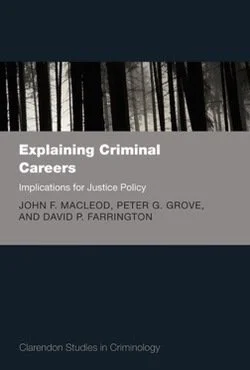
Explaining Criminal Careers: Implications for Justice Policy

By John F. MacLeod, Peter G. Grove, and David P. Farrington

Explaining Criminal Careers presents a simple quantitative theory of crime, conviction and reconviction, the assumptions of the theory are derived directly from a detailed analysis of cohort samples drawn from the “UK Home Office” Offenders Index (OI). Mathematical models based on the theory, together with population trends, are used to make: exact quantitative predictions of features of criminal careers; aggregate crime levels; the prison population; and to explain the age-crime curve, alternative explanations are shown not to be supported by the data. Previous research is reviewed, clearly identifying the foundations of the current work. Using graphical techniques to identify mathematical regularities in the data, recidivism (risk) and frequency (rate) of conviction are analysed and modelled. These models are brought together to identify three categories of offender: high-risk / high-rate, high-risk / low-rate and low-risk / low-rate. The theory is shown to rest on just 6 basic assumptions. Within this theoretical framework the seriousness of offending, specialisation or versatility in offence types and the psychological characteristics of offenders are all explored suggesting that the most serious offenders are a random sample from the risk/rate categories but that those with custody later in their careers are predominantly high-risk/high-rate. In general offenders are shown to be versatile rather than specialist and can be categorised using psychological profiles. The policy implications are drawn out highlighting the importance of conviction in desistance from crime and the absence of any…..

  • additional deterrence effect of imprisonment. The use of the theory in evaluation of interventions is demonstrated.

Oxford, UK; New York: Oxford University Press, 2021. 273p.

download