Open Access Publisher and Free Library
CRIMINAL JUSTICE.jpeg

CRIMINAL JUSTICE

CRIMINAL JUSTICE-CRIMINAL LAW-PROCDEDURE-SENTENCING-COURTS

Incarceration and Crime: A Weak Relationship

By Nazgol Ghandnoosh,  and Kristen M. Budd

  A decade after national protests catapulted the Black Lives Matter movement following the police killing of Mi chael Brown in Ferguson, Missouri and four years after a national racial reckoning triggered by Minneapolis police officers killing George Floyd, lawmakers are wavering on their commitment to making the criminal legal system more just and effective.1 Many are reverting to the failed playbook of the 1990s which, as this brief will show, dramatically increased incarceration, particularly among Black Americans, with limited benefits to community safety. The recent move away from evidence-based policymaking includes New York’s reversal of its bail reform law, Louisiana’s expansion of its already draconian prison sentences, and Oregon’s repeal of Measure 110, which had decriminalized the possession of controlled substances in favor of a public health response.

This shift threatens the modest progress made in recent years in reducing U.S. incarceration levels. The United States now ranks sixth globally in its incarceration rate – as much as eight times the rate of industrialized peer countries.3 Following a nearly 700% buildup in imprison ment since 1972, the U.S. prison population downsized by 25% between 2009 and 2021 – falling to under 1.2 million people.4 A significant portion of this decline occurred in 2020 due to the COVID-19 pandemic, when reduced prison admissions and expedited releases downsized the prison population by 14%.5 Interventions such as the transfer of approximately 11,000 people from fed eral prisons to home confinement demonstrated that in some cases, substantial decarceration could accompany extremely low recidivism rates.6 Nevertheless, imprisonment levels increased in 2022.

Rates of crimes reported to U.S. law enforcement reached peak levels in the 1990s, and fell roughly 50% by year end 2019.8 However, the uptick in the 2022 pris on population – following eight years of modest decline – occurred in the midst of growing concern about crime. The economic, social, and psychological turbulence of the COVID-19 pandemic contributed to a seismic shift for the most serious crime: homicide. Homicides spiked up 27% in 2020 and remained at elevated rates until declin ing substantially in 2023.9 Reported rates of violent and property crime exhibited typical fluctuations amidst the pandemic, although household surveys of violent victimization showed a more dramatic increase across the country.10 Motor vehicle thefts, which were at near-historic lows by 2019, also increased in the subsequent years, as did carjackings.11 These facts, combined with bouts of misleading media coverage have heightened public concern about crime.12 When combined with a growing sense of disorder and the persistence of the drug/opioid overdose crisis, the result has been eroded policy debates about how to create community safety. 

Washington, DC: The Sentencing Project, 2024. 18p.

Download
Read-Me.Org
Worldwide Illicit and Counterfeit Alcoholic Spirits: Problem, Detection, and Prevention

By Michael A. Bryan & Annie E. Hill

Worldwide, counterfeit, illicit, and untaxed alcoholic spirits are responsible for problems with economy, labor, and public health. Estimations of counterfeit spirits range from 25% to 40% of total alcoholic spirits consumed globally. Including knock-on effects, these products cost the EU alone 23,400 lost jobs and at least €3B in lost revenue per year. Annually there is at least €1.2B in lost government revenue. Counterfeit products decrease legitimate sales, both by replacement sales, and by the erosion of consumer product trust and satisfaction of legitimate goods and decrease legitimate manufacturing jobs. We review the worldwide problem, scope, and scale of the spirits counterfeiting problem including specific health issues, and the international plight of reduced labor available resulting directly from production and sale of counterfeited liquor. In addition, we review a wide range of methods and technologies to analytically detect chemically adulterated or substituted products that have been published and group technologies into 4 functional areas highlighting economy, generality, and utility. Approaches to prevention are also discussed.


Journal of the American Society of Brewing Chemists, 1–17. April 2024.

Download
Read-Me.Org
Inspiring futures: An Evaluation of the Meaning and Impact of Arts Programmes in Criminal Justice Settings

By Caroline Lanskey, Sarah Doxat-Pratt, Loraine Gelsthorpe 

  Inspiring Futures (IF) was an ambitious programme of work, led by the National Criminal Justice Arts Alliance and funded by the Paul Hamlyn Foundation, with the research element funded by the Economic and Social Research Council. It reflected a unique collaboration bringing together leading arts in criminal justice organisations and the University of Cambridge’s Institute of Criminology (IoC). Inspiring Futures combined a ground-breaking artistic programme in prisons and the community with embedded participative research. It aimed to advance knowledge into why and how arts interventions affect the lives of people in the criminal justice system and how these effects may be optimised to promote a stepchange in arts programmes embedded in criminal justice settings. It also identified the wider impact of these programmes: for programme facilitators and organisers, for the settings in which the programmes were run, for audiences and for the criminal justice and arts sectors overall. With oversight from the National Criminal Justice Alliance the participating arts organisations (selected through an open process) were: Clean Break, Geese Theatre Company, Good Vibrations, Helix Arts, the Irene Taylor Trust, Koestler Arts, Only Connect, and the Open Clasp Theatre Company. These partner arts organisations ran a range of music and drama projects as part of the Inspiring Futures programme. Data collection started in March 2020 and was intended last 24 months. However, the Covid19 pandemic and related lockdowns led to significant changes to the IF programme of activities, particularly those in prisons. Prisons entered lockdown regimes on 24 March 2020, and all non-essential work, including all IF work, was suspended indefinitely. After the national lockdown ended, a 5-stage regime framework was introduced which prisons moved between, but there was a further prison lockdown in December 2021 and this remained in place until January 2022, and longer in some establishments. There was therefore a long hiatus before arts activities were reinstated, and fieldwork to observe projects and interview participants was intermittent between 2020 and 2023, with some additional set-backs and delays. Our intention to ensure full-scale follow-ups with participants at three intervals suffered from the extended period of fieldwork, with a necessary concentration of effort in data collection at Times 1 and 2, (start of course, end of course) resulting in a limited sample at Time 3 (10-18 month follow-up)  The research builds on notable previous attempts to demonstrate the importance and value of arts programmes and initiatives in criminal justice settings. What is distinctive about the approach in this research is that it consisted of two sets of investigative activities, the first focused on the impact of the arts for participants involved in the programmes(the participant study); the second focussed on the wider impact of the arts programmes, for the arts facilitators and organisations, for the criminal justice and arts sectors, and for audiences (the wider study). The four core research questions were: i) What are the effects of arts programmes in the criminal justice sector? ii) How can these effects be measured in a way 

that is participatory and inclusive and which is accessible, meaningful and empowering to participants, and builds research capacity amongst arts organisations? iii) How can these effects be collated to establish a collective evidence base for impact which can be further developed and sustained by arts organisations in the future? and iv) How can the evidence of arts impact be disseminated to policy makers and the wider public in order to facilitate a transformation of approaches and attitudes towards people in the criminal justice system?    continued....

The Inspiring Futures research report “An Evaluation of the Meaning and Impact of Arts Programmes in Criminal Justice Settings” has just (3 June 2024) been published. Funded by the Economic and Social Research Council and the Paul Hamlyn Foundation, Inspiring Futures was an ambitious programme of work that examined how and why arts interventions impact on the lives of people in the criminal justice system, and how to best optimise their effect. Led by the National Criminal Justice Arts Alliance, the project was a unique collaboration, bringing together eight leading arts in criminal justice organisations, University of Cambridge’s Institute of Criminology, and participants within the criminal justice system.

The research

The research built on previous attempts to demonstrate the importance and value of arts programmes and initiatives in criminal justice settings. It consisted of two studies, the first focused on the impact of the arts for participants involved in the programmes and the second on the wider impact of the arts programmes, for the arts facilitators and organisations, for the criminal justice and arts sectors, and for audiences.

Main findings

The researchers explored participant impact in terms of creative development (‘creative capital’), their inner lives (wellbeing, self-concept and personal development), and their social worlds and opportunities. They found small but statistically significant positive changes from the start to the end of the courses across the whole participant sample.

Participants said they had learned new technical or creative skills, and that being able to be creative gave them confidence to try new activities. They described positive shifts in their wellbeing, their self-concept and their personal development. Some said the programmes gave ‘meaning’ to their lives and a sense of future agency (by attending another project or programme, or by thinking about future aspirations).

In terms of self-concept, two particular themes stand out: a growth in self-understanding and greater confidence to challenge oneself and put oneself in new and potentially demanding situations.

In terms of personal development both the quantitative and qualitative data indicate that participants felt that they had been given an opportunity to develop new skills and capacities that might make a difference in their future. Some said that their desire to work on their personal development had been reignited or inspired.

Participants also reported positively on the social impact of taking part in the programmes and the relationships that were built or strengthened with others, both within and outside the criminal justice settings. Thus there is evidence of ‘bonding social capital’; through participation new connections and friendships were formed. Relatedly, some participants felt that attending the arts programmes had brought them closer to their families – to their children, their partners, and parents – because of having something positive and uplifting to share with them, and because of an increased social confidence which had come about through participation.

Wider impact

Looking at the wider impact, researchers found that the direct participation of staff members in the arts programmes could yield longer-term benefits for relationships between staff and prisoners. The presence of prison staff and managers at performances also demonstrated an important message to participants about the prison’s support for the arts activities and the staff’s interest in prisoners’ achievements.

One strong theme here was that staff and prisoners could see each other as ‘real people’. As well as the individual and relational legacies of the arts programmes on life within the prison setting, people spoke of a broader cultural impact. Instrumentally the programmes contributed to the prisons’ agenda for purposeful activity and rehabilitative programmes, but the courses could also create a ‘buzz’ within the prison that was energising.

Conclusion

This was a substantial study and the research programme was able to generate unique insights into the similarities and differences regarding the effects of different arts forms. While there were many similarities in terms of the positive experiences as described above, there were also differences between the art forms.

Drama activities involved embodiment of the self, with participants drawing on earlier life experiences, and subsequently engaging in intensive self-reflection and reflection on their own and others’ behaviour. The drama programmes also offered a high degree of flexibility in terms of improvised self-expression.

The music programmes provided greater scope for technical skills to be developed – with tangible outcomes.

Overall, the distinguishing feature of the arts programmes in this study was the focus on ‘the social’ – social interactions and relationships were intrinsic to the creative activities, learning, desistance-related and other outcomes for participants.

Suffolk, UK: National Criminal Justice Arts Alliance

Clinks, 2024. 128p.

download
Read-Me.Org
Sentencing for Murder: A Review of Policy and Practice

By Richard Martin

  The only sentence a court can pass for murder is life imprisonment. The mandatory life sentence is comprised of three elements: the minimum term spent in prison (handed down by the sentencing court); the post-term (determined by the Parole Board and its assessment of the offender’s dangerousness); release on licence into the community, subject to conditions and the possibility to recall the offender back to prison. • The challenge facing the sentencing judge in murder cases derives in large part from the range of harm and culpability the offence of murder encompasses in England and Wales. Murder can be committed where the offender intends, or foresees as virtually certain, not only the victim’s death, but also really serious harm and then death in fact results. • Schedule 21 to the Sentencing Act 2020 governs the sentencing of murder. It was originally introduced in the Criminal Justice Act 2003. By creating a series of starting points and providing lists of aggravating and mitigating factors, Schedule 21 recognises that despite the mandatory nature of the life sentence, an identical level of seriousness cannot be attributed to each murder. In a series of cases, the Court of Appeal of England and Wales has interpreted and applied Schedule 21 to ensure sentencing judges achieve a just sentence in accordance with the guidance provided for by Parliament in Schedule 21. • According to the Sentencing Council, the introduction of the higher starting points in Schedule 21 has meant sentences for the vast majority of murder cases increased substantially. The average minimum term has risen from 13 years in 2000 to 21 years in 2021 – an increase of over 60%. This increase in minimum terms has also inflated sentence lengths for other serious offences, most notably manslaughter. • Schedule 21 has been the subject of a series of amendments over the last two decades driven by successive Governments, notably the expansion of cases within the higher-level starting points and the creation of a new starting point (25 years). Recent amendments to Schedule 21 have been announced by the Government and are contained in the Sentencing Bill, Criminal Justice Bill and the Sentencing Act 2020 (Amendment of Schedule 21) Regulations 2023. The first of these seeks to expand the types of cases to which the Whole Life Order will apply, while the latter two are in response to the Domestic Homicide Sentencing Review, which made recommendations to better reflect the causes, characteristics and harms of fatal domestic abuse. • There have been numerous critiques of Schedule 21. A longstanding one has been the very justification for the mandatory, rather than discretionary, life sentence for murder in the first place. As for the sentencing framework in Schedule 21 specifically, criticism has focused on the disproportionality between Schedule 21’s starting points and the offender’s harm and culpability, as well as the ordinal disproportionality across starting points. More recent commentary has questioned the merits and operation of the Whole Life Order, as well as noting the limited empirical research on its effects on offenders.  

London: The Sentencing Academy 2024. 22p.

Download
Read-Me.Org
Always Hope Evaluation Final Report

Claire Durrant, Tamsin Hinton-Smith and Lisa Holmes  

Between June 2021 and June 2023, the Innovation Unit (IU) delivered the Always Hope project to 61 care experienced young men in Brinsford and Swinfen Hall Youth Offender Institutions (YOI). The majority of the young men were under the responsibility of Birmingham, Coventry and Wolverhampton local authorities, however, nine were under the responsibility of Sandwell, Shropshire, Torbay and Worcester local authorities. Always Hope aims to reduce reoffending and improve outcomes for young people (aged 18-25) who have been in both the care system and prison, and comprises two key components. Firstly, Integrated Planning and Assessment (IPAA) which aims to improve how professionals in local authority leaving care services and the prison and probation service work together to provide support for care experienced young people in prison and on release. The second component of Always Hope is to offer opportunities for care experienced young people in prison to connect with a positive and sustainable network of friends, family and community members through either Lifelong Links in Coventry and Birmingham or Group Conferencing in Wolverhampton; notably, Group Conferencing does not include the tools and approaches that are a central part of Lifelong Links.

London: Innovation Unit, 2024. 101p.  

Download
Read-Me.Org
Inspection of the Federal Bureau of Prisons’ Federal Correctional Institution Sheridan

By The U.S. Department of Justice, Office of the Inspector General

  Our unannounced inspection identified several serious safety and security issues at FCI Sheridan affecting both employees and inmates. Most significantly, substantial shortages of Correctional Officers and healthcare workers―which is an issue at many BOP institutions—have created widespread and troubling operational challenges at FCI Sheridan that substantially impact the health, welfare, and safety of employees and inmates. For example, healthcare staffing challenges seriously impact FCI Sheridan’s ability to provide adequate healthcare to inmates. In particular, this affects the performance of routine, daily functions such as drawing blood for laboratory tests, triaging patient requests for care, and ensuring that medical equipment and supplies are ready to be used for routine care and in the event of a medical emergency. Especially alarming was our finding that the institution had a backlog of 725 laboratory orders for blood draws or urine collection and 274 pending x-ray orders. These backlogs cause medical conditions to go undiagnosed and leave providers unable to appropriately treat patients. Specifically, an FCI Sheridan physician told us that the backlog of laboratory orders for blood draws or urine collection has compromised his ability to treat patients and has prevented him from monitoring the effects of medication on his patients’ kidney and liver functions. These limitations are concerning for the treatment of any medical condition, but especially concerning for the treatment of chronic conditions, such as diabetes and hepatitis C, that regularly affect inmates. We note that FCI Sheridan took action to decrease these backlogs after our on-site inspection and after we expressed concern about these issues to the BOP; as of May 2024, the backlog of laboratory orders stood at 44 and the backlog of pending x-ray orders stood at 84. Delayed medical treatment can lead to more serious medical conditions for an inmate, as well as substantially increased costs for the institution. For example, we found that, just prior to our inspection, an inmate feigned a suicide attempt in order to receive medical attention for an untreated ingrown hair that had become infected. When finally examined after the feigned suicide attempt, he required hospitalization for 5 days to treat the infection. Separately, while not directly

Washington, DC: OIG, 2024. 39p.

Download
Read-Me.Org
Gender Justice Pretrial Toolkit : A Model of Participatory Pretrial Justice for Women and Gender-Diverse People

By Erica King, Keilah Joyner, Alison Shames, Kristie Puckett, Darlene George, and Skye Adams

  As more jurisdictions across the country seek to improve their pretrial practices, reducing the number of women who are unnecessarily detained in jail pretrial is of utmost importance. In 2024, there were nearly 190,600 women and girls incarcerated in prisons, jails, and other carceral spaces in the United States.1 Nationwide, women’s state prison populations have grown 834% over nearly 40 years.2 834%--twice the pace of growth of the male prison population.3 Notably, more women are held in local jails—which are often outdated—than in state prisons. Moreover, of the 84,000 women in local jails, more than half (51,200) are presumed innocent and are detained while waiting the final disposition of their case.4 Most of those detained in jail pretrial are likely there not because they are deemed a danger to the community or a flight risk but because they do not have the financial means to satisfy a requirement to pay a relatively nominal monetary bond. This result should come as no surprise given that the median bond amount for a felony charge is $10,000 and the average yearly income for a woman who cannot afford to post bond is $11,000.5

Women who are held in local jails and are not convicted are largely there on accusations of nonviolent behavior: Less than a quarter of the 51,200 women held in jails pretrial (11,400) are charged with violent offenses. Rather, they are arrested for property crimes (16,200), drug offenses (15,300) and crimes against public order (8,000).6   xxxx

Kensington, MD: Center for Effective Public Policy  (CEPP), 2024. 48p.

Download
Read-Me.Org
Time for Change Acquired Brain Injury and Young Adults involved in the Criminal Justice System in England

By Gemma Buckland

  Brain injury is known to be a major factor in impacting maturational development and affecting outcomes for young adults. As Barrow Cadbury Trust’s evidence has carefully documented, neuroscientific research identifies that the typical adult male brain is not fully formed until at least their mid-20s. Over the last three years, since the then Secretary of State for Justice commissioned a review, there has been increased awareness of the prevalence of neurodiverse conditions and their impact on policy and practice in the criminal justice system (CJS). UKABIF received support from Barrow Cadbury Trust under the Transition to Adulthood (T2A) programme to review what policies and practices are in place for young adults (aged 17-25 years) which recognise both Acquired Brain Injury (ABI) and maturity. The review also considered what needs to happen to ensure that practice for this cohort is as effective as possible taking into account available resources and policy priorities. The project has included: ■ Conducting research involving Freedom of Information (FoI) requests which highlighted the limitations of the existing response by the police and liaison and diversion services to young adults with brain injury in terms of awareness of both ABI and maturity ■ Disseminating the results at a national and an international conference ■ Establishing evaluation sites for The Disabilities Trust (now Brainkind) Ask, Understand, Adapt programme (online training modules on ABI), evaluation in four prisons holding young adults, designing evaluation tools and commencing the evaluation. The evaluation was part of an agreement that enabled The Disabilities Trust to make available to His Majesty’s Prison and Probation Service (HMPPS) the training which had been commissioned by National Health Service (NHS) England to all people with a justice.gov.uk email address ■ Co-creating with young adults a leaflet for criminal justice agencies working with young adults with brain injury to signpost them to sources of support ■ Engaging with NHS England to ensure that guidance for Community Sentence Treatment Requirements and Reconnect included content on ABI ■ Developing a policy levers matrix to illustrate the range of touchpoints with the CJS where there is potential to better support young adults with ABI and an accompanying chart with examples of existing initiatives. We conclude that there is significant scope for further work by the T2A Alliance, UKABIF and other members of the ABI Justice Network to continue to promote a distinct approach to young adults with ABI. While there is some recognition of ABI and awareness is rising, how ABI affects the maturity of young adults is not yet considered in the early stages of the CJS (in police custody suites and liaison and diversion schemes). For example, data held in police custody suites and by liaison and diversion services is not yet strong enough to understand the needs of this important cohort or the extent to which they are met. There are also currently not many support pathways specifically for people with ABI, let alone those which are specifically for young adults. This report is for commissioners, senior leaders and practitioners working in criminal justice, health and social care with young adults who are in contact with the CJS.  

London: www.ukabif.org.uk

United Kingdom Acquired Brain Injury Forum, 2024. 28p.

Download
Read-Me.Org
Predicting Police Misconduct

By Greg StoddardDylan J. Fitzpatrick & Jens Ludwig

Whether police misconduct can be prevented depends partly on whether it can be predicted. We show police misconduct is partially predictable and that estimated misconduct risk is not simply an artifact of measurement error or a proxy for officer activity. We also show many officers at risk of on-duty misconduct have elevated off-duty risk too, suggesting a potential link between accountability and officer wellness. We show that targeting preventive interventions even with a simple prediction model – number of past complaints, which is not as predictive as machine learning but lower-cost to deploy – has marginal value of public funds of infinity.

\

WORKING PAPER 32432

Cambridge, MA: National Bureau of Economic Research (NBER), 2024. 

Download
Read-Me.Org
Fraud against the Commonwealth 2022–23.

By Merran McAlister and Samantha Bricknell


This Statistical Bulletin presents the results from the AIC’s 2022–23 Fraud Against the Commonwealth census.

Internal fraud investigations commenced decreased from the previous financial year, whereas external fraud investigations increased. The numbers of internal and external fraud allegations substantiated also decreased compared with the previous financial year.

Program information and program payments were the principal targets of substantiated internal and external fraud allegations respectively. Automatic processes and detection by a staff member were the primary methods of detecting internal and external fraud in 2022–23.

Internal fraud losses were greater and external fraud losses were lower than the losses reported in 2021–22. Australian Government entities reported smaller overall internal and external fraud recoveries in 2022–23 than in the previous financial year.


Statistical Bulletin no. 44. 

Canberra: Australian Institute of Criminology. 2024. 20p.

Download
Read-Me.Org
Profits and poverty: The economics of forced labour

By Francesca Francavilla, Scott Lyon and Michaëlle De Cock 

This report estimates the profits generated from forced labour in the world today. These profits reflect the wages effectively stolen from the pockets of workers by the perpetrators of forced labour through their coercive practices. Understanding and addressing these illicit profits is critical to achieve progress in the fight against forced labour. 28 million people were trapped in forced labour on any given day in 2021. Forced labour is a criminal offence and a serious violation of fundamental human rights. Beyond the individual consequences for the victims, forced labour comes with economic and social costs for the entire society. This ILO report, which is funded by the government of France, will shed light on the link between forced labour and the economic incentive structures driving it.

 Geneva:  International Labour Organization Fundamental Principles and Rights at Work (FUNDAMENTALS) Branch 2024 48p.

Download
Read-Me.Org
2023 Capital Crimes: State and Federal Cases

By Ohio. Office of the Attorney General (Dave Yost: Attorney General

The Ohio Legislative Service Commission has estimated that the cost of capital cases range from $1 to $3 million per case based on a collection of quantitative and qualitative studies in other states. “If these estimates apply to Ohio, then the extra cost of imposing the death penalty 121 times on the 119 people currently on Death Row might range from $121 million to $363 million,” notes the Report. “[I]t’s a stunning amount of money to spend on a program that doesn’t achieve its purpose.” 

Of the 341 death sentences imposed on 336 prisoners from the state’s enactment of the death penalty in 1981 through the end of 2023, only one of every six sentences, or 56 executions, have been carried out. The Report notes that “87 death sentences have been removed by judicial action resulting in resentencing or release.” Twenty-one prisoners have had their sentences commuted. Forty prisoners have died of natural causes or suicide, which the Report notes are more likely causes of death than execution. Nine prisoners with intellectual disabilities were removed from death row after the Supreme Court held that executing people with intellectual disabilities was unconstitutional in Atkins v. Virginia (2002). Under Ohio’s 2021 law barring the death penalty for individuals with severe mental illness – only one of two states with such legislation – six people have been removed from death row and another 35 petitions are currently pending review. 

As of December 31, 2023, 119 people with 121 death sentences remain on Ohio’s death row, nine fewer people than 2022. As of April 1, 2024, prisoners spent an average of 7805 days or 21 years on Ohio’s death row – a number that has consistently increased with each year. Prisoners are an average of 55.5 years old today and were an average of 34 years old at their time of sentencing (figures used the most current resentencing). Due to difficulty obtaining lethal injection drugs, the state has not carried out executions since 2018, at which time the average time spent on death row was 6,280 days or 17.19 years. Currently, there is a bill in the state legislature proposing the authorization of nitrogen gas in executions, described by AG Yost as a way to “kickstart” executions. The report identifies eight cases in which an execution date could be filed. 

Columbus: Office of the Attorney General, 2024. 424p.

Download
Read-Me.Org
Police/Civilian Encounters: OFFICERS’ PERSPECTIVES ON TRAFFIC STOPS AND THE CLIMATE FOR POLICING

By JAMES B. HYMAN

Periodically, the nation’s attention is captured by press coverage of a needless death of a Black person at the hands of police. And, in each case, the police department of jurisdiction launches an investigation into the circumstances surrounding the incident. These investigations focus on the actual (or alleged), real-time, behaviors of both the officer and the decedent in an attempt to elucidate the incident and determine culpability. Several questions must be answered. What were the circumstances? How did the incident escalate? What did the deceased do? How did the officer respond? And was the response justified? What these investigations don’t do is shed light on any antecedent factors that may have conditioned the behaviors of either party. Indeed, missing from these investigations, and from research into police-involved deaths more generally, is an understanding of attitudes and perceptions held by the officers and victims prior to their interaction. The pre-dispositions of each, toward each other, may be contributing factors in how these incidents unfold. This study explores only one side of these dynamics – the attitudes and perceptions of police officers with respect to their encounters with civilians during traffic stops. The study gathers information about the officers themselves and their feelings about their jobs. It queries their experiences with, and reactions to their traffic stop civilian encounters – seeking answers to how such stops become contentious and sometimes deadly. It asks whether race plays a role in these encounters. And finally, given the attention paid to these incidents, the study explores the officers’ reactions to declines in public opinion of police and policing. This report presents the results of these explorations in the voices of the officers themselves 

New Brunswick, NJ: Rutger Graduate School of Education, 2024. 38p.

Download
Read-Me.Org
Tough on Crime

By Michelle D. Bonner

The book discusses the rise of punitive populism in Latin America and the role of the media in shaping public opinion. It explores the interpretation of crime statistics, the media’s influence on emotions and public opinion, and the comparison of media systems inArgentina and Chile. The document also examines the preference of journalists for tough-on-crime sources and the rise of punitive voices from within the state and civil society. The conclusion highlights the homogenization of public opinion in neoliberal media systems. [Introduction, 1. Interpreting statistics on crime, insecurity, and police violence, 2. The mass media’s role in emotions and public opinion,3. Comparing media systems: Argentina and Chile, 4. Journalists’preference for tough-on-crime sources, 5. The rise of punitive voices from within the state, 6. The rise ofpunitive voices from civil society, conclusion

University of Pittsburgh Press, 2019 276 pages

read
Evidence review: diverting young adults away from the cycle of crisis and crime

 Lauren Bennett and Elsa Corry-Roake  

   Too many young people come into criminal justice system because of multiple unmet needs. Diverting them into support and treatment can help them to grow out of a cycle of crisis and crime and realise their full potential. The right support can reduce crime in local areas and prevent future victims of gangs and exploitation. In my experience, young people are drawn into the criminal justice system to make ends meet, or just to keep ‘occupied’. If a positive alternative is put in place, this will not only help the young people, but will help their families and communities. It is unfortunate that the criminal justice interventions do not consider what happens to the young person after they leave the service. Future planning and leaving a door open can prevent issues from escalating and prevent young people from returning to the criminal justice system. This review highlights a number of effective ways to support young people. What made the biggest difference for me was having a consistent support worker who worked with me at every step of my journey, taught me how to notice patterns, followed up after I left the service, and encouraged me to seek help. I liked how they did not judge me or make me feel less than. This made me see the light at the end of the tunnel and push me to make the positive changes and embark on my journey to change.  

This evidence review examines the effectiveness of different types of diversion support for young people aged 18-25. Given the particular characteristics of young adults that set them apart from fully mature adults, this paper examines the ways in which their needs differ from the latter. It highlights the practice and policy approaches that have been found to be effective in supporting young people to move away from the cycle of crime, notably key elements of support that can be provided as part of an out of court disposal.

London: Revolving Door Agency.....38p.

Download
Read-Me.Org
Multiple and intersecting harms: Examining use of force in return and its detrimental impact on migrants’ human rights during and after return to Senegal

By Mackenzie Seaman and Jessamy Garver Affeldt

This paper focuses on the multiple intersecting harms (forced returns, expulsion, interception at sea, detention) migrants experience in Senegal during the return process. It pays particular attention to violations and abuses that are frequently reported in relation to such uses of force. The data shows that respondents often endured multiple instances of violations and abuse during their return journey to Senegal. This appeared to compound the challenges they encountered after their return to Senegal.

Mixed Migration Centre, 2024. 24p.

Download
Read-Me.Org
Collaboration for social change Senzekile Bengu A case study of NGOs participating in the Violence Prevention Forum

By Senzekile Bengu

  This report describes how the Violence Prevention Forum has contributed to changing the relationship between the state and non-governmental organisations (NGOs), and how it has empowered NGOs to use research knowledge and to engage with and inform policy.    

  Key findings -   Participation in the Violence Prevention Forum (VPF) has improved relations among non governmental organisations (NGOs), and between NGOs and participating government departments and researchers. This can be attributed to how VPF meetings are designed and facilitated, which has increased empathy and understanding between sectors. There has been a shift in how NGOs view their role in the long-term goal of reducing high levels of violence and align their work with government policy. NGOs have also realised the power and importance of research and evidence, and are making better use of it. NGOs collaborate more with other organisations and sectors as a consequence of their participation in the VPF. The quality of collaboration between organisations participating in the VPF has improved because of how the Forum invests in building trust between participants

   NGOs apply the facilitation tools and techniques they gain at the VPF in staff and project meetings, and use the research in organisational reports and presentations. NGOs that have participated in the VPF feel valued because the Forum appreciates both practice-based knowledge and research f indings. At VPF meetings, new knowledge and research are presented and discussed openly, and decisions are made transparently and collectively. The knowledge and skills gained from participating in the VPF meetings are more likely to be used and applied in NGOs if the person participating in meetings holds a decision-making role in their organisation, is passionate about their work and if there is alignment between the organisation's interests and goals and the VPF focus.

Pretoria: Institute for Security Studies (ISS), 2024. 28p.

Download
Read-Me.Org
Lessons for multisectoral collaboration to prevent violence

By Matodzi M Amisi, Chandré Gould, Jody van der Heyde, Senzekile Bengu and Ayanda Mazibuko

Building trusting relationships between people in different sectors narrows the gap between evidence, practice and policy.

Over the past nine years the Violence Prevention Forum (VPF) has facilitated collaboration and partnerships within and between sectors, maintained ongoing engagement and influenced policy, practice and funding for violence prevention interventions in South Africa. This policy brief presents findings from three case studies that assessed why researchers, non-governmental organisations and government officials participate in the VPF and the impact this has. Policy Brief

Pretoria: Institute for Security Studies (ISS), 2024. 12p.

Download
Read-Me.Org
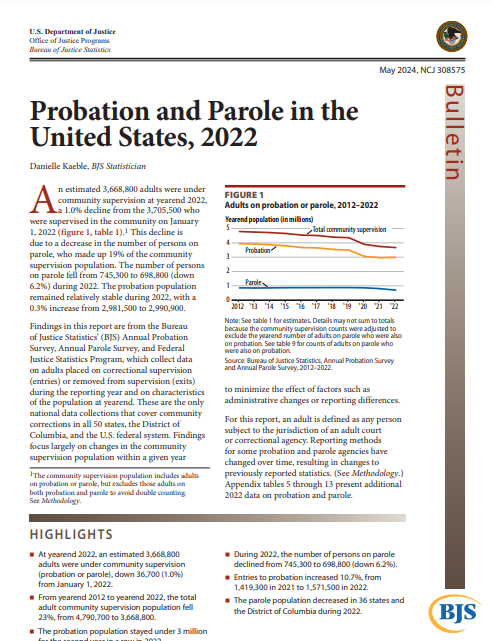
Probation and Parole in the United States, 2022

  By Danielle Kaeble  

This report is the 31st in a series that began in 1981 and features data on adult U.S. residents under correctional supervision in the community. It includes characteristics of this population such as sex, race or ethnicity, and most serious offenses. The report details how people move onto and off community supervision, such as completing their term of supervision, being incarcerated, absconding, or other unsatisfactory outcomes while in the community.

Highlights:

  • At yearend 2022, an estimated 3,668,800 adults were under community supervision (probation or parole), down 36,700 (1.0%) from January 1, 2022.

  • From yearend 2012 to yearend 2022, the total adult community supervision population fell 23%, from 4,790,700 to 3,668,800.

  • The probation population stayed under 3 million for the second year in a row in 2022.

  • During 2022, the number of persons on parole declined from 745,300 to 698,800 (down 6.2%).

Washington, DC: U.S.  Department of Justice Office of Justice Programs Bureau of Justice Statistics, 2024. 35p.

Download
Read-Me.Org
Experiences of Public Law Care Proceedings: A briefing on interviews with parents and special guardians

By Gillian Hunter, Monica Thomas, Nicola Campbell

Summary of findings • Findings are based on 21 in-depth interviews with parents (16 women and 5 men) involved in public law care proceedings between late 2019 and 2023. Three were involved in proceedings to become a special guardian. • Collectively, parents had experiences of various aspects of public law, including in relation to care, placement, special guardianship and emergency protection orders. • They described wider circumstances associated with the family court proceedings, including experiences of domestic violence, substance misuse and mental health. Over a third reported contact with social services and the care system as a child. • Unsurprisingly, contact with social services prior to court proceedings was generally fractious. Parents reported complying with requests for reports, assessments and tests but distrusted and often disputed how findings were subsequently presented by the local authority to the court. • Parents perceived themselves to be outsiders or by-standers at court proceedings. They sat at the back of the courtroom when attending in person and were muted in virtual hearings. They had few opportunities to speak unless providing formal evidence to the court and they understood little of what was being discussed by the judge and legal professionals. • Experiences of legal representation were mixed and while a minority reported being well-supported by their lawyer, with regular updates or post-hearing explanations of proceedings, most felt their lawyer did not adequately represent their lives or views, or challenge aspects of evidence that they considered to be wrong or unfair. 

• The judge’s conduct played a significant part in shaping parents’ reported family court experiences. Judicial kindness or a lack of attention, and informal and more formal comments made by the judge – both positive and negative – were remembered well after the hearing was over. For example, judicial ‘instruction’ about what parents needed to do to have children returned to their care was described as giving hope for the future. • Time was a recurring theme in interviews, with some aspects of the process felt to move too slowly and others too fast. This includes perceptions of the process moving too quickly towards court proceedings and the ‘backwards and forwards’ of court hearings. Participants also talked about being rushed into making what were essentially life-changing decisions about both temporary and permanent care arrangements of their children. • The harmful impact of processes of racialisation, institutional racism and cultural stigma was also raised by Black and Black Mixed Race parents, as well as caregivers to children racialised as Black Mixed Race. However, participants were sometimes hesitant to raise such concerns out of fear of being seen to be pulling ‘the race card’. • Voluntary sector services were the main providers of assistance, including counselling, especially after children had been removed and parents felt largely abandoned by the statutory system. Parents reported initial feelings of anger, shock, confusion and longterm grief at the removal of their children. Six parents referred to feeing suicidal and self-harming either during or following the conclusion of their proceedings. The importance of peer-based support through community groups and social media was also noted as important for coping with the aftermath of the family court. 

London: Revolving Doors, et al., 2024. 24p.

Download
Read-Me.Org