Open Access Publisher and Free Library
HUMAN RIGHTS.jpeg

HUMAN RIGHTS

Human Rights-Migration-Trafficking-Slavery-History-Memoirs-Philosophy

Posts tagged Excessive Use of Force
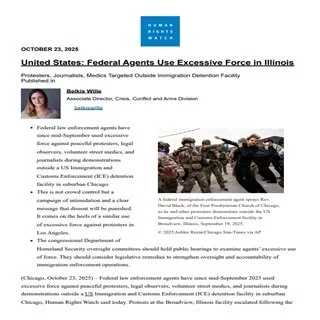
United States: Federal Agents Use Excessive Force in Illinois: Protesters, Journalists, Medics Targeted Outside Immigration Detention Facility

By Belkis Wille

Federal law enforcement agents have since mid-September 2025 used excessive force against peaceful protesters, legal observers, volunteer street medics, and journalists during demonstrations outside a US Immigration and Customs Enforcement (ICE) detention facility in suburban Chicago, Human Rights Watch said today. Protests at the Broadview, Illinois facility escalated following the start of ICE’s “Operation Midway Blitz” on September 8 and an increase in immigration raids and seizures throughout the Chicago area. 

Based on accounts by witnesses and videos that Human Rights Watch analyzed, Department of Homeland Security (DHS) agents—sometimes in the presence of state and local police, and other federal agents—repeatedly used excessive force against small groups of protesters who appeared to pose no threat to the agents or to public security, and against clearly identifiable journalists, legal observers, and volunteer street medics. They detained dozens of protesters, and at least one journalist and one volunteer street medic. The violent response comes on the heels of law enforcement’s use of excessive force against protesters opposing immigration raids in June in Los Angeles.

“This is not crowd control, but a campaign of intimidation,” said Belkis Wille, associate crisis and conflict director at Human Rights Watch. “Federal agents are using chemical irritants and firing projectiles at peaceful protesters, volunteer street medics, and journalists in broad daylight. The message is clear that dissent will be punished.”

Human Rights Watch interviewed 18 people who were present during the Broadview protests: 7 protesters, 4 journalists, 1 volunteer street medic, 2 immigration rights advocates, and a religious leader. Researchers also analyzed 17 videos recorded during the protests that were posted to social media or provided to researchers. On October 17, Human Rights Watch sent a letter to Homeland Security Secretary Kristi Noem summarizing these findings, posing questions, and offering the opportunity to comment, but has not received a response.

Witnesses and video confirm that DHS agents used tear gas and fired projectiles directly into groups of protesters, including from the detention facility roof, often without warning, and without protesters appearing to pose any risk to agents. Witnesses and verified footage show there were sometimes as few as 10 protesters and never more than 250. 

New York: Human Rights Watch, 2025.
download
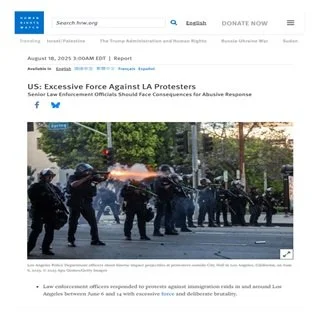
US: Excessive Force Against LA Protesters: Senior Law Enforcement Officials Should Face Consequences for Abusive Response

By Human Rights Watch

Law enforcement officers responded to protests against immigration raids in and around Los Angeles, California, between June 6 and 14, 2025, with excessive force and deliberate brutality, Human Rights Watch said today. 

Officers fired tear gas, pepper balls, hard foam rounds, and flash-bang grenades directly at protesters, journalists, and other observers, often at close range and often without sufficient warning or provocation. Scores of people suffered injuries, ranging from severe bruising and lacerations to broken bones, concussions, an amputated finger, and severe eye damage.

“Sweeping immigration raids have terrorized communities across Los Angeles and driven thousands of people to the streets in protest,” said Ida Sawyer, crisis, conflict and arms director at Human Rights Watch. “Local, state, and federal law enforcement’s aggressive response to these protests violently oppressed the public’s right to express outrage and the media’s right to report safely.” 

The protests were sparked by a dramatic escalation of immigration raids across Los Angeles and the surrounding area, following the Trump administration’s orders to the Immigration and Customs Enforcement (ICE) agency to increase daily arrests of undocumented immigrants. Heavily armed federal agents have stormed stores, warehouses, hotels, restaurants, farms, car washes, taco stands, and other workplaces and detained those they suspect of being undocumented with the aim of deporting them.

Human Rights Watch observed protests and visited locations of ICE raids in and around Los Angeles from June 10 to 14, and interviewed 39 people, including protesters, journalists, legal observers, volunteer street medics, immigration rights advocates and organizers, and others affected by the raids. Researchers analyzed lawsuits, documentation by the Los Angeles Press Club, media reports, and photos and videos recorded during the protests and posted on social media or shared directly with researchers. 

Human Rights Watch documented 65 cases in which law enforcement officers from various local, state, and federal agencies injured protesters, journalists, and other observers. The actual number is most likely much higher. In the three weeks following June 6, more than 280 people contacted the American Civil Liberties Union (ACLU) of Southern California, most reporting that they had been personally injured by law enforcement agents while engaged in protest activity.

New York: Human Rights Watch; 2025.

download
Excessive Use of Force and Migrant Death and Disappearance in Southern Arizona

By Robin C. Reineke and Daniel E. Martinez

In this article, we present a qualitative analysis of the events surrounding death or disappearance in autopsy and missing person reports from the Pima County Office of the Medical Examiner (PCOME) in Arizona to highlight how interactions between border enforcement personnel and migrants can be deadly. We reviewed PCOME records of undocumented border crosser deaths between 2000 and 2023 and observed three main types of deadly U.S. Border Patrol (USBP) practices: reckless motor vehicle pursuits, aggressive strategies used to detain individuals who are on foot, and the use of lethal force. Our findings reveal that these tactics, which we argue constitute forms of “excessive use of force,” represent significant yet overlooked factors contributing to migrant death and disappearance in southern Arizona. We make the following policy recommendations:

1. Immediate measures to prevent the loss of life

(A). The Department of Homeland Security (DHS) should mandate a ban on border enforcement methods that provoke fear, panic, or confusion.

(B). DHS should take measures to substantially reduce the use of high-speed motor vehicle pursuits by USBP and other immigration enforcement officials.

(C). DHS should ensure that USBP officers are compliant with Department of Justice (DOJ) standards on use of deadly force, in particular the policy that “Deadly force may not be used solely to prevent the escape of a fleeing suspect.”

2. Investigate Border Fatalities Involving Border Enforcement Officers

(A). We call on the Government Accountability Office (GAO) to conduct an official review of all medical examiner and coroner records along the U.S.-Mexico border for fatality cases in which border enforcement personnel were involved in any way in the circumstances surrounding death.

(B). We encourage the formation of civilian review boards in border regions to review medical examiner and coroner records of migrant fatalities involving immigration officials as well as immigration officials’ apprehension strategies immediately preceding fatal encounters with migrants.

Journal on Migration and Human SecurityVolume 12, Issue 3, September 2024, Pages 243-256

download