
Open Access Publisher and Free Library
HUMAN RIGHTS.jpeg

HUMAN RIGHTS

Human Rights-Migration-Trafficking-Slavery-History-Memoirs-Philosophy

Posts tagged international relations
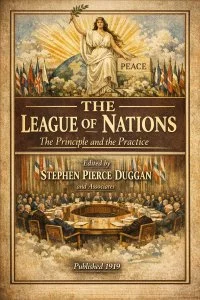
THE LEAGUE OF NATIONS: The Principle and the Practice

Edited by Stephen Pierce Duggan. Introduction by Graeme R. Newman

A Landmark Vision of International Order at the Dawn of the Modern World

Published in 1919 at the very moment when the post–First World War settlement was taking shape, The League of Nations: The Principle and the Practice, edited by Stephen Pierce Duggan, is one of the most authoritative and illuminating contemporary statements of the ideas that sought to prevent another global catastrophe. Written as the Covenant of the League of Nations moved toward ratification, this volume captures the urgency, optimism, and hard-headed realism of thinkers grappling with the central political question of the twentieth century: how can peace be made durable in a world of sovereign states?

Bringing together leading scholars, jurists, historians, and policy practitioners, the book moves beyond slogans to examine how an international organization must actually function. It explains not only the moral and historical foundations of the League idea, but also its practical machinery—arbitration, sanctions, international administration, and continuous cooperation across borders. Readers are guided through the institutional logic of collective security, the limits of national sovereignty, and the challenges posed by armaments, small nations, and postwar reconstruction.

Distinctive for its clarity and documentary richness, the volume includes key historical texts and the full Covenant of the League itself, allowing readers to engage directly with the constitutional framework of early international governance. Written in accessible but rigorous prose, it was intended for educated citizens as well as specialists—an informed guide for public debate at a decisive historical moment.

Today, The League of Nations: The Principle and the Practice stands as an indispensable primary source for understanding the intellectual foundations of modern global governance. It reveals how the ambitions and anxieties of 1919 shaped later institutions, including the United Nations, and it remains strikingly relevant in an era once again marked by questions of collective security, international law, and global cooperation. For historians, political scientists, legal scholars, and readers interested in the origins of the contemporary international order, this book is both a historical document and a continuing challenge to think seriously about how peace is organized.

The Atlantic Monthly Press. BOSTON. 1919. Read-Me.Org Inc. New York-Philadelphia-Australia. 2025. p.253.

Islamists and the Global Order: Between Resistance and Recognition

By Hanna Pfeifer

This book presents a thought-provoking challenge to the commonly held belief that Islamists uniformly reject the Western-dominated world order. In the wake of George W. Bush's declaration of a "global war on terror" in 2001, Islamists have often been associated with violence, opposition to liberal values, and the disruption of order. However, a closer examination reveals that only a fraction of the groups categorised as "Islamist" genuinely combat the global order. Through an in-depth analysis of the discourses of Tunisian Ennahda and Lebanese Hezbollah, this book demonstrates that Islamist stances toward the world order involve a delicate balance between resistance to certain aspects of the Western-dominated order and recognition of others.

Edinburgh Edinburgh University Press, 2024, 354p.

Ethnicity and Nation-Building : Comparative, International, and Historical Perspectives

Edited by Wender Bell and Walter E. Freeman

This book is the result of the twelfth annual convention of the International Studies Association which was held March 17-20, 1970, in San Juan, Puerto Rico. Although we have subsequently asked a few additional people to contribute, most of the chapters were prepared for and presented at several sessions of the ISA convention, the participants having been invited and the panels organized by William J. Foltz and Leo Kuper, in addition to the editors.

Our theme was “Ethnicity in Nation-Building, Regional Integration, and International Conflict,” and our discussions turned out to be among those happy intellectual occasions when a deep, common interest in a given subject matter washes away disciplinary distinctions. This was especially important because we are an interdisciplinary group composed of political scientists, sociologists, historians, community developers, anthropologists, and planners.

We were also gladdened by the sun, sand, and sea of the Caribbean and we all owe much for the pleasant surroundings, both physical and intellectual, to theProgram Officers—Basil A. Ince, Fred W. Riggs, and Luis Vega. After the conference, the idea of bringing these papers together in a published volume was encouraged by Norman D. Palmer, Richard C. Snyder, and John E. Turner.

We wish to thank Lorraine Estra, of Yale University, and Kay McClellan Richard Gold, and Carol Gold, all of Pennsylvania State University, for editorial assistance. The first editor also wishes to thank the National Science Foundation for a grant (GS-2637) under which he was able to take the time to work on this volume.

AGE PUBLICATIONS LTD, 1974, 381p.