By Abigail Hean
The termination of parental rights refers to the permanent, legal severance of any rights, relationship, or privileges between a parent and child. In the age of mass incarceration in the United States, more and more parents are seeing their rights involuntarily terminated as a result of their incarceration, making it one of the gravest and yet simultaneously least-discussed collateral consequence that comes with a criminal conviction and sentence to imprisonment. For example, national data revealed that 32,000 incarcerated parents had their parental rights involuntarily terminated from 2006 to 2016, many of whom had no allegations of unfitness prior to incarceration. In fact, a parent who was incarcerated but had never been accused of child abuse or neglect was more likely to have their parental rights terminated than one who had physically or sexually abused their children.
Because of the undeniable racial and socioeconomic disparities that exist in our criminal justice system, the link between incarceration and termination of parental rights is especially concerning. On their face, child welfare laws purport to balance the interests of parents and children. However, these procedures fail to adequately protect incarcerated parents. The child welfare system disproportionately affects poor parents of color, threatening the long-term lives of their children and the stability of communities of color, while perpetuating racist and classist prejudices. To correct this problem, scholars have suggested both practical solutions and legal reforms, such as heightening the burden of proof and repealing federal legislation. However, rather than rewrite the laws, this article suggests that advocates work to reframe the idea of a child's best interests to more seriously consider the importance of family unity, especially for families of color and those of low socio-economic status.
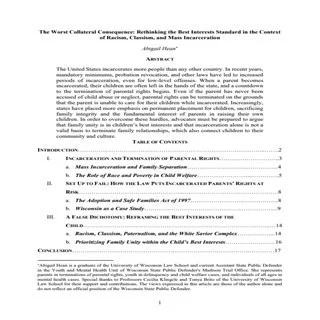
Part I of this article will discuss the high rates of termination of parental rights among incarcerated parents and the role of race and poverty in these cases. Part II will review the laws which currently set incarcerated parents up for failure, including the Adoption and Safe Families Act of 1997 and, using Wisconsin as a case study, the state statutes which are often used against incarcerated parents. Finally, Part III will examine the false dichotomy of family unity and the child's best interest, which has been created to perpetuate racism, classism, and paternalism in our legal system, despite evidence that family unity and a child's best interests are actually interrelated. This article will then recommend a few ways for advocates and judges to reframe the idea of the child's best interests to better preserve family unity.
45 Children's Legal Rights Journal 1 (2024)