
Open Access Free Library
JUVENILE JUSTICE.jpeg

JUVENILE JUSTICE

JUVENILE JUSTICE-DELINQUENCY-GANGS-DETENTION

Posts tagged criminal careers
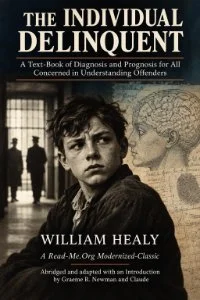
The Individual Delinquent: A Text-Book of Diagnosis and Prognosis for All Concerned in Understanding Offenders

William Healy’s The Individual Delinquent, first published in 1915, is a landmark in the development of modern criminology, juvenile justice, and the scientific study of offenders. Based on five years of intensive research with more than a thousand young repeat offenders at Chicago’s Juvenile Psychopathic Institute, Healy challenged the prevailing search for a single explanation of criminal behavior. Instead, he argued that delinquency could be understood only by examining the individual offender and the complex interaction of psychological, physical, developmental, family, and environmental factors.

Healy’s central question remains strikingly contemporary: not simply what crime was committed, but why did this particular person commit it? His approach combined family and developmental histories, medical examinations, psychological testing, investigation of home and social environments, and extensive personal interviews. He emphasized diagnosis, prognosis, treatment, and follow-up rather than reliance upon punishment or abstract theories of criminality.

This Read-Me.Org Modernized-Classic makes Healy’s massive original work accessible to contemporary readers. The original volume of more than 800 pages has been abridged to approximately one-quarter of its length while retaining Healy’s organization and central arguments. The text has been rendered in modern English, representative case histories have been condensed, and editorial notes identify obsolete terminology and historically limited assumptions. Review and discussion questions make the volume particularly suitable for students and classroom use.

Both a historical document and a surprisingly modern argument for individualized justice, The Individual Delinquent illuminates the emergence of psychological and clinical approaches to crime and demonstrates why understanding the person behind the offense became a fundamental concern of twentieth-century criminology. Download the original book here.

Read-Me.Org Inc. New York-Philadelphia-Australia. 2026. p.114.

Transitions from Juvenile Delinquency to Adult Crime : Criminal Careers, Justice Policy, and Prevention

Edited by Rolf Loeber and David P. Farrington

What makes a juvenile delinquent develop into an adult criminal? What defines-cognitively, developmentally, legally-the transition from juvenile to adult and what determines whether patterns of criminal behavior persist? In most US states and Western nations, legal adulthood begins at age 18. This volume focuses on the period surrounding that abrupt transition (roughly ages 15-29) and addresses what happens to offending careers during it. Edited by two leading authorities in the fields of psychology and criminology, Transitions from Juvenile Delinquency to Adult Crime examines why the period of transition is important and how it can be better understood and addressed both inside and outside of the justice system. Bringing together over thirty leading scholars from multiple disciplines in both North America and Europe, this volume asks critical questions about criminal careers and causation, and whether current legal definitions of adulthood accurately reflect actual maturation and development. The volume also addresses the current efficacy of the justice system in addressing juvenile crime and recidivism, why and how juveniles ought to be treated differently from adults, if special legal provisions should be established for young adults, and the effectiveness of crime prevention programs implemented during early childhood and adolescence. With serious scholarly analysis and practical policy proposals, Transitions from Juvenile Delinquency to Adult Crime addresses what can be done to ensure that today's juvenile delinquents do not become tomorrow's adult criminals.

Oxford, UK: New York: Oxford University Press, 2012. 416p.