Open Access Publisher and Free Library
PUNISHMENT.jpeg

PUNISHMENT

PUNISHMENT-PRISON-HISTORY-CORPORAL-PUNISHMENT-PAROLE-ALTERNATIVES. MORE in the Toch Library Collection

Posts tagged pay-to-stay fees
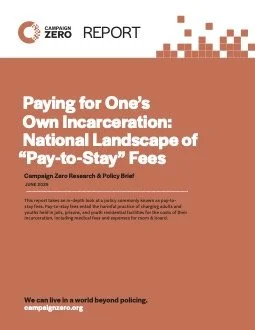
Paying for One’s Own Incarceration: National Landscape of Pay-to-Stay Fees

By Byun, W., Stevenson, K., & Loyo, M.

Pay-to-stay fees, also referred to as costs of incarceration, cost of care, cost of support, or room and board, are the costs charged to individuals for their incarceration. They may be automatically deducted from an individual’s wages or prison account, but often accumulate or are collected as debt after the conclusion of their sentence. Using an in-depth literature review, discussions with researchers, and interviews with people impacted by pay-to-stay fees, this report examines the imposition of room and board and medical fees at the state level during a period of incarceration. The authors conclude that pay-to-stay fees impose excessive financial burdens on individuals and their families, are a barrier to accessing basic goods and services, hinder successful reentry, and are ineffective fiscal policy. The authors urge state and local governments to ban the imposition of these fees.

Key findings:

48 states and Washington D.C. allow for the imposition of at least one category of pay-to-stay fees (adult room & board, adult medical, youth room & board, and youth medical).

California and Illinois have repealed fees for all categories.

26 states allow for both room & board and medical fees for both adults and youth who are incarcerated.

Among states that allow medical co-pays, the fee ranges from $.50 to $13.55 per visit.

15 states prohibit the denial of medical service for adults for lack of ability to pay.

A number of states allow for the direct garnishing of an individual’s resources to pay pay-to-stay fees.

12 states authorize the use of criminal prosecution for accured or unpaid fees for at least one category.

New York: Campaign Zero, 2025. 33p.

download
Paying for One’s Own Incarceration: National Landscape of “Pay-to-Stay” Fees

By Campaign Zero

This report examines the practice of pay-to-stay fees, which involves charging individuals—both adults and youths—in correctional facilities for costs relating to their incarceration. Pay-to-stay fees not only affect individuals during their time of incarceration but can also result in post-release debt. While the report considers the overarching issues with pay-to-stay fees broadly, it looks more specifically at the imposition of room and board and medical fees at the state level for incarcerated adults and youths serving a sentence. Based on an in-depth literature review, discussions with other researchers, and interviews with people directly impacted by pay-to-stay fees, we argue that these fees are highly problematic for several reasons. Specifically, pay-to-stay fees: Impose excessive financial burdens on incarcerated individuals and their families, many of whom are already economically strained before and during incarceration; Serve as significant barriers to accessing basic goods and services during incarceration, such as medical care; Hinder successful reentry after a person has served their sentence; and Are ineffective fiscal policies that fail to generate significant revenue or meaningfully impact states’ budgets. Despite the lasting harms that pay-to-stay fees pose, these policies are pervasive across the country. Based on our analysis of qualitatively coded state statutes and corrections department policies related to pay-to-stay fees between June 2022 and December 2023, we found that 48 states allow for the imposition of at least one category of pay-to-stay fees 26 states explicitly allow for both room & board and medical fees for both adults and youths who are incarcerated Only the states of California and Illinois have repealed fees for all categories in state correctional facilities Given the widespread prevalence of pay-to-stay fees, we conclude the report by urging correctional systems and state & local governments across the country to explicitly ban the imposition of these fees and work towards dismantling the broader web of legal fines and fees that trap individuals in cycles of incarceration and debt.

Campaign Zero, 2025, 33p.

download