Open Access Free Library
PUNISHMENT.jpeg

PUNISHMENT

PUNISHMENT-PRISON-HISTORY-CORPORAL-PUNISHMENT-PAROLE-ALTERNATIVES. MORE in the Toch Library Collection

Posts tagged transportation
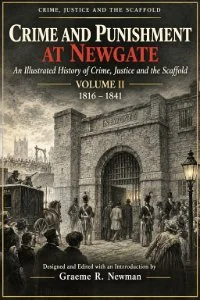
Crime And Punishment At Newgate.: An Illustrated History of Crime, Justice and the Scaffold. Volume II.

By Graeme R. Newman

Murderers and highwaymen, pirates and forgers, thieves and traitors, duelists and rebels—the men and women who passed through the British criminal justice system between 1700 and 1816 inhabited a world in which punishment was intended not merely to penalize the offender, but to be seen.

Crime and Punishment at Newgate brings that world vividly back to life through nearly 190 illustrated cases drawn from Camden Pelham’s celebrated nineteenth-century Chronicles of Crime; or, The New Newgate Calendar. Each case has been newly designed and presented as a compact illustrated narrative, combining the story of the crime with arrest, trial, conviction and, above all, punishment.

The punishments could be extraordinary. Men and women were hanged for offences that today might result in imprisonment. Others were whipped, branded, transported, imprisoned, mutilated or exposed to public humiliation. Bodies might be dissected after execution or displayed in chains. Yet the system was not uniformly merciless: pardons, reprieves, escapes, reduced verdicts and differences of wealth, gender and social rank produced striking variations in who was punished—and how.

Among these pages are murder, piracy, robbery, treason, duelling, forgery, riot, domestic killing and political crime. But this is more than a collection of sensational criminal stories. It is an illustrated history of the changing meaning of punishment itself.

In a substantial new Introduction, criminologist Graeme R. Newman asks questions that remain surprisingly modern: Did the punishment fit the crime? Who deserved punishment? Was justice applied equally to rich and poor? How fair were criminal trials? Why did governments make punishment a public spectacle? And how different are modern societies, which have moved punishment behind prison walls while turning crime and criminal trials into mass entertainment?

The scaffold, the prison, the courtroom and the crowd become parts of the same history. As Newman observes, the eighteenth-century spectator travelled to the punishment; today the spectacle travels to the spectator.

Richly illustrated throughout and supplemented by a Thematic Guide to Crime and Punishment and a Selected Bibliography, this first volume transforms the traditional Newgate Calendar into a modern visual history of crime, justice and society.

For readers interested in criminal justice, criminology, the history of punishment, capital punishment, Newgate Prison, British social history, true crime, and the darker side of eighteenth- and early nineteenth-century life.

Read-Me.Org Inc. New York-Philadelphia-Australia. 2026. p.204.
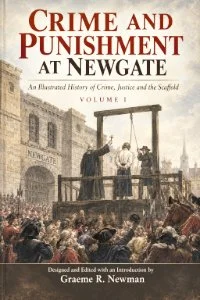
Crime And Punishment At Newgate.: An Illustrated History of Crime, Justice and the Scaffold. Volume I.

By Graeme R. Newman

Murderers and highwaymen, pirates and forgers, thieves and traitors, duelists and rebels—the men and women who passed through the British criminal justice system between 1700 and 1816 inhabited a world in which punishment was intended not merely to penalize the offender, but to be seen.

Crime and Punishment at Newgate brings that world vividly back to life through nearly 190 illustrated cases drawn from Camden Pelham’s celebrated nineteenth-century Chronicles of Crime; or, The New Newgate Calendar. Each case has been newly designed and presented as a compact illustrated narrative, combining the story of the crime with arrest, trial, conviction and, above all, punishment.

The punishments could be extraordinary. Men and women were hanged for offences that today might result in imprisonment. Others were whipped, branded, transported, imprisoned, mutilated or exposed to public humiliation. Bodies might be dissected after execution or displayed in chains. Yet the system was not uniformly merciless: pardons, reprieves, escapes, reduced verdicts and differences of wealth, gender and social rank produced striking variations in who was punished—and how.

Among these pages are murder, piracy, robbery, treason, duelling, forgery, riot, domestic killing and political crime. But this is more than a collection of sensational criminal stories. It is an illustrated history of the changing meaning of punishment itself.

In a substantial new Introduction, criminologist Graeme R. Newman asks questions that remain surprisingly modern: Did the punishment fit the crime? Who deserved punishment? Was justice applied equally to rich and poor? How fair were criminal trials? Why did governments make punishment a public spectacle? And how different are modern societies, which have moved punishment behind prison walls while turning crime and criminal trials into mass entertainment?

The scaffold, the prison, the courtroom and the crowd become parts of the same history. As Newman observes, the eighteenth-century spectator travelled to the punishment; today the spectacle travels to the spectator.

Richly illustrated throughout and supplemented by a Thematic Guide to Crime and Punishment and a Selected Bibliography, this first volume transforms the traditional Newgate Calendar into a modern visual history of crime, justice and society.

For readers interested in criminal justice, criminology, the history of punishment, capital punishment, Newgate Prison, British social history, true crime, and the darker side of eighteenth- and early nineteenth-century life.

Read-Me.Org Inc. New York-Philadelphia-Australia. 2026. p.206.

The Fatal Shore

By Robert Hughes

(Mr Hughes) has felt his way back into the past with passion and insight, mined an enormous mass of material and welded the results of his researches into a commanding narrative... Already widely known as an art critic, he now reveals his formidable gifts as a social htstonan "           —The New York Times

'Although The Fatal Shore is both lengthy and scholarly, it is alio fun to read One of Hughes's greatest gifts as a joumalist has always been his ability to express senous themes in accessible language. In his marvelous new history, he brings convict Australia to life both in his own words and those of its inhabitants……The idiosyncratic voices of the individual convicts he quotes imbue the narrative with the spark and savor of real life in all its chaotic, intimate detail. This kind of history is as exciting and entertaining as a good novel.” — Chicago Sun-Times

NY. Vintage. 1988. 743p.

Jeremy Bentham and Australia: Convicts, utility and empire

Edited by Tim Causer, Margot Finn, and Philip Schofield

Jeremy Bentham and Australia is a collection of scholarship inspired by Bentham’s writings on Australia. These writings are available for the first time in authoritative form in Panopticon versus New South Wales and other writings on Australia, a volume in The Collected Works of Jeremy Bentham published by UCL Press.

In the present collection, a distinguished group of authors reflect on Bentham’s Australian writings, making original contributions to existing debates and setting agendas for future ones. In the first part of the collection, the works are placed in their historical contexts, while the second part provides a critical assessment of the historical accuracy and plausibility of Bentham’s arguments against transportation from the British Isles. In the third part, attention turns to Bentham’s claim that New South Wales had been illegally founded and to the imperial and colonial constitutional ramifications of that claim. Here, authors also discuss Bentham’s work of 1831 in which he supports the establishment of a free colony on the southern coast of Australia. In the final part, authors shed light on the history of Bentham’s panopticon penitentiary scheme, his views on the punishment and reform of criminals and what role, if any, religion had to play in that regard, and discuss apparently panopticon-inspired institutions built in the Australian colonies.

This collection will appeal to readers interested in Bentham’s life and thought, the history of transportation from the British Isles, and of British penal policy more generally, colonial and imperial history, Indigenous history, legal and constitutional history, and religious history.

London: UCL Press, 2022. 425p.