
Open Access Publisher and Free Library
PUNISHMENT.jpeg

PUNISHMENT

PUNISHMENT-PRISON-HISTORY-CORPORAL-PUNISHMENT-PAROLE-ALTERNATIVES. MORE in the Toch Library Collection

Posts in Social Sciences
The Growth of Incarceration in the United States: Exploring Causes and Consequences

National Research Council.

After decades of stability from the 1920s to the early 1970s, the rate of imprisonment in the United States more than quadrupled during the last four decades. The U.S. penal population of 2.2 million adults is by far the largest in the world. Just under one-quarter of the world's prisoners are held in American prisons. The U.S. rate of incarceration, with nearly 1 out of every 100 adults in prison or jail, is 5 to 10 times higher than the rates in Western Europe and other democracies. The U.S. prison population is largely drawn from the most disadvantaged part of the nation's population: mostly men under age 40, disproportionately minority, and poorly educated. Prisoners often carry additional deficits of drug and alcohol addictions, mental and physical illnesses, and lack of work preparation or experience. The growth of incarceration in the United States during four decades has prompted numerous critiques and a growing body of scientific knowledge about what prompted the rise and what its consequences have been for the people imprisoned, their families and communities, and for U.S. society.

The Growth of Incarceration in the United States examines research and analysis of the dramatic rise of incarceration rates and its affects. This study makes the case that the United States has gone far past the point where the numbers of people in prison can be justified by social benefits and has reached a level where these high rates of incarceration themselves constitute a source of injustice and social harm.

The Growth of Incarceration in the United States recommends changes in sentencing policy, prison policy, and social policy to reduce the nation's reliance on incarceration. The report also identifies important research questions that must be answered to provide a firmer basis for policy. The study assesses the evidence and its implications for public policy to inform an extensive and thoughtful public debate about and reconsideration of policies.

Washington, DC: The National Academies Press. 2014. 464p.

download
Re-Offending by Released Terrorist Prisoners: Separating Hype from Reality

By Andrew Silke and John Morrison

Recent cases of attacks by released terrorist prisoners highlight issues around the risk of re-offending posed by former terrorist prisoners. What are the appropriate processes and systems for managing and risk assessing such individuals, and to what extent is rehabilitation possible in the context of terrorist offending? This Policy Brief will explore these and related issues to help inform wider discussion and debates on appropriate policy in this area.

In this Policy Brief, the authors critically analyse the definition of ‘recidivism’, and demonstrate the need for a concrete operational definition before one is able to truly analyse recidivist activity. Following this, the authors discuss terrorist recidivism in a range of international contexts, ranging from Northern Ireland to Sri Lanka, the United States to Israel. By taking this broader perspective it allows the reader to gain a greater understanding of what factors related to recidivism rates may be context-specific, and which are universal.

The Hague: International Centre for Counter-Terrorism (ICCT), 2020. 13p.

download
Alternative Representations of Imprisonment

Edited by Michael Fiddler.

“Contemporary representations of imprisonment, be they cinematic or literary, tend to be remarkably consistent. There are a series of recurrent characters and tropes that one can reliably expect to see. To give a decidedly partial list, there is the naïf, the kindly old-timer, the threat of (often sexual) violence or the dank darkness of ‘the hole’. A useful exercise in this regard is to look at the ways in which a remake of a particular prison film reuses these visual themes. The 1974 film The Longest Yard (dir. R. Aldrich) starring Burt Reynolds as a disgraced and subsequently imprisoned American football player was remade in 2001 (dir. B.Skolnick) and 2005 (dir. P.Segal) as vehicles for Vinnie Jones and Adam Sandler respectively. The UK version, renamed Mean Machine to match the original UK release title of the 1974 film, owes much to key British television and film where prisons and imprisonment play key roles.”

Prison Service Journal. Issue 199. January 2012. 64p.

download
The Prison and the Factory: Origins of the Penitentiary System

By Dario Melossi.

An examination and interpretation of the development of modern prisons in England and Europe from 1550 to 1850, a study of Italian prison development, and of American prisons from colonial times to 1930. 

New York: Macmillan, 1981. 243p.

download
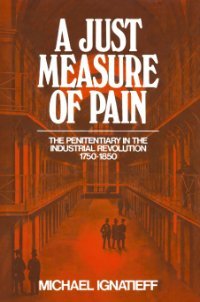
A Just Measure of Pain: The penitentiary in the industrial revolution, 1750-1850

By Michael Ignatieff.

"A Just Measure of Pain" describes the moment in 18th century England when the modern penitentiary and its ambiguous legacy were born. In depicting how the whip, the brand and the gallows - public punishments once meant to cow the unruly poor into passivity - came to be replaced by the "moral management" of the prison and the notion that the criminal poor should be involved in their own rehabilitation. Michael Ignatieff documents the rise of a new conception of class relations and with it a new philosophy of punishment, one directed not at the body but at the mind. "A Just Measure of Pain" is a highly atmospheric and compellingly written work of social history, which has already become a classic study of its subject.

New York: Pantheon Books, 1978. 257p.

read
English Prisons: An Architectural History

By Allan Brodie, Jane Croom, James O. Davies.

For most of us, the prison is an unfamiliar institution and life 'inside' is beyond our experience. However, more than 60,000 people now live in England's jails, some serving their sentences in buildings with Victorian or more ancient origins, others in prisons dating from the last twenty years. English Prisons: An Architectural History is the result of the first systematic written and photographic survey of prisons since the 20th century. It traces the history of the purpose-built prison and its development over the past 200 years. Over 130 establishments that make up the current prison estate and over 100 former sites that have surviving buildings or extensive documentation have been investigated, institutions ranging from medieval castles and military camps to country houses that have been taken over and adapted for penal use.

The Prison Service granted the project team unprecedented access to all its establishments, allowing the compilation of an archive of more than 5,000 images and 250 research files. The team was allowed to go anywhere, and to photograph almost anything (except where this could compromise security) and to speak to any inmate. A selection of the images from the archive illustrates this book.

Swindon, UK: English Heritage 2001, 297p,

download
Improving Interagency Collaboration, Innovation and Learning in Criminal Justice Systems

Edited by Sarah Hean, Berit Johnsen, Anu Kajamaa and Laure Kloetzer.

Supporting Offender Rehabilitation. This Open Access edited collection seeks to improve collaboration between criminal justice and welfare services in order to help prepare offenders for life after serving a prison sentence. It examines the potential tensions between criminal justice agencies and other organisations which are involved in the rehabilitation and reintegration of offenders, most notably those engaged in mental health care or third sector organisations. It then suggests a variety of different methods and approaches to help to overcome such tensions and promote inter-agency collaboration and co-working, drawing on emerging research and models, with a focus on the practice in European and Scandinavian countries. For academics and practitioners working in prisons and the penal system, this collection will be invaluable.

Cham: Palgrave Macmillan, 2021. 475p.

download
Harnessing the Power of the Criminal Corpse

By Sarah Tarlow and Emma Battell.

This open access book is the culmination of many years of research on what happened to the bodies of executed criminals in the past. Focusing on the eighteenth and nineteenth centuries, it looks at the consequences of the 1752 Murder Act. These criminal bodies had a crucial role in the history of medicine, and the history of crime, and great symbolic resonance in literature and popular culture. Starting with a consideration of the criminal corpse in the medieval and early modern periods, chapters go on to review the histories of criminal justice, of medical history and of gibbeting under the Murder Act, and ends with some discussion of the afterlives of the corpse, in literature, folklore and in contemporary medical ethics. Using sophisticated insights from cultural history, archaeology, literature, philosophy and ethics as well as medical and crime history, this book is a uniquely interdisciplinary take on a fascinating historical phenomenon.

Lowman. Palgrave (2018) 277 pages.

download
Remembering and Disremembering the Dead

By Floris Tomasini.

Posthumous Punishment, Harm and Redemption over Time. “In the main, this book is a cross-fertilisation of history and philosophy in the broadest possible sense. Ideas of death, posthumous harm, punishment and redemption germinate in both the conceptual ground of philosophical analysis and the empirical ground of historical case study.”

Palgrave (2017) 106p.

download
Deprivation Of Liberty In The Shadows Of The Institution

By Lucy Series.

“The community is a complicated place, easier to define by what it is not (a hospital) than what it is. Successive waves of post-carceral policy have deposited different care structures and settings on its shores. There are the first-wave quasi-institutions, which still predominate in the care of older people: residential care homes and nursing homes. Then there are second wave quasi-domestic services, aspiring to break free of our institutional heritage: ‘supported living’, ‘independent living’, sheltered housing, and other kinds of ‘housing with support.”

Bristol University Press (2022) 318p.

download
Auburn, N.Y.

By D. Morris Kurtz

Its Facilities and Resources. For reasons of their own, the publishers have been pleased to omit the sketches relating to the large axle manufactories of Sheldon & Co., in the Auburn Prison and on Sheldon Avenue ; the shoe manufactories of Dunn, Barber & Co., in the Auburn Prison and on Garden street ; the hollow ware manufactory of Jones & Merritt, Auburn Prison ; the hame manufactory of Hayden & Boyd, Auburn Prison, and several smaller concerns (manufacturing and mercantile), for which I can only express sorrow.

Kurtz publishing (1884) 159p.

download
The Prison Question

By Charles H. Reeve.

A theoretical and philosophical review of some matters relating to crime, punishment, prisons, and reformation of convicts. With a glance at mental, social and political conditions; and some suggestions about and the prevention of crime and the production of causes, and the prevention of crime and the production of criminals.

Knight and Leonard (1890) 206 pages.

download
Wards of the State

By Tighe Hopkins

An Unofficial View Of Prison And The Prisoner. “Imprisonment, its effects upon the prisoner (in prison and after prison) and the prejudice it creates agamst him in the pubHc mind these are my chief topics. With imperfections of which I am extremely conscious, the book represents a study of some years' duration, a study rendered difficult for the onlooker by this fact above others, that he does not view the life of prison from within.”

Boston. Little Brown (1913) 345 pages.

download
The Great West Ukrainian Prison Massacre of 1941

Edited by Ksenya Kiebuzinski and Alexander Motyl.

A Sourcebook. After Germany invaded the Soviet Union in 1941, the Soviet secret police, the NKVD, executed a staggering number of political prisoners in Western Ukraine-somewhere between 10,000 and 40,000-in the space of eight days, in one of the greatest atrocities perpetrated by the Soviet state. Yet the Great West Ukrainian Prison Massacre of 1941 is largely unknown. This sourcebook aims to change that, offering detailed scholarly analysis, eyewitness testimonies and profiles of known victims, and a selection of fiction, memoirs, and poetry that testifies to the lasting impact of the massacre in the collective memory of Ukrainians.

Amsterdam University Press. (217) 433 pages.

download
In the Shadow of the Wall

By Harriette B. Gunn.

Were John Howard alive to-day, he would rejoice over the development of the prison reforms he inaugurated . He would be surprised at the Prisoner’sAid Societies, the Parole Boards, the Hope Halls, the International Prison Congress meeting annually to discuss prison problems, , and the many changes of the new system of prison management. Praise God for the humanity that now exists..

Christopher publishing (1922) 301 pages.

download
Pathways To Recovery And Desistance

by David Best.

The Role of the Social Contagion of Hope. This is the first book that uses the latest research evidence to build guidance on community-based rehabilitation with the aim of challenging stigma and marginalisation. The case studies discussed, and a strengths-based approach, emphasize the importance of long-term recovery and the role that communities and peers play in the process. Best examines effective methods for community growth, offers sustainable ways of promoting social inclusion and puts forward a new drug strategy and a new reform policy for prisons.

Policy Press (2019) 234 pages.

download
A Global History of Convicts and Penal Colonies

Edited by Clare Anderson.

Between 1415, when the Portuguese first used convicts for colonization purposes in the North African enclave of Ceuta, to the 1960s and the dissolution of Stalin’s gulags, global powers including the Spanish, Dutch, Portuguese, British, Russians, Chinese and Japanese transported millions of convicts to forts, penal settlements and penal colonies all over the world. A Global History of Convicts and Penal Colonies builds on specific regional archives and literatures to write the first global history of penal transportation. The essays explore the idea of penal transportation as an engine of global change, in which political repression and forced labour combined to produce long-term impacts on economy, society and identity. They investigate the varied and interconnected routes convicts took to penal sites across the world, and the relationship of these convict flows to other forms of punishment, unfree labour, military service and indigenous incarceration. They also explore the lived worlds of convicts, including work, culture, religion and intimacy, and convict experience and agency.

Bloomsbury Academic (2018) 406 pages.

download