Open Access Publisher and Free Library
PUNISHMENT.jpeg

PUNISHMENT

PUNISHMENT-PRISON-HISTORY-CORPORAL-PUNISHMENT-PAROLE-ALTERNATIVES. MORE in the Toch Library Collection

Posts in Social Sciences
Mentoring After Prison: Recognition As A Tool For Reflection

By Sarah Hean, Siv Elin Nord Sæbjørnsen, Trude Fløystad Eines & Cecilie Katrine Utheim Grønvik

Abstract Many organisations offer mentoring schemes to support people leaving prison and resettle back into the community. Mentorship relationships are complex but despite this, there remains limited theoretical and/or research informed tools to guide mentorship practices and hereby the success of ex-prisoner mentorship. The aim of the paper is to contribute to this shortfall by presenting a theoretically informed framework to assist reflection on mentorship practices and the mentorship relationship: the Recognition Reflection Framework (RRF). The framework has potential to provide mentors with a tool to reflect on ex-prisoners´ need for recognition of worth if they are to desist from crime. The paper describes the theoretical development and preliminary validation of this reflection framework, underpinned by a strengths-based mentoring approach, and developed through the merger of concepts from recognition theory, person centred care and therapeutic alliances. We present this framework as a means through which mentors can reflect on how they may specifically contribute to secondary and tertiary desistance, as well as reflect on ways they can personally develop a constructive mentor-client relationship.

British Journal of Community Justice. 26/07/2023.

download
Juvenile Probation Structure, Policy, and Practice in the United States: Subtitle A Full Analysis of Variation within and across States

By Lily Robin, Arielle Jackson, and Erica Henderson

This report summarizes findings from the Urban Institute’s national scan of juvenile probation policies and practices which involved a scan of literature and nationwide surveys of state and local juvenile probation agencies. The goal of the scan was to understand and document variation in probation policy and practice within and across states and to offer recommendations and considerations for key stakeholders in juvenile probation policy and practice.

The findings span different parts of juvenile probation, including the purpose of juvenile probation, diversion, disposition, supervision, fines and fees and restitution, data collection and sharing, partnerships, and impacts of the COVID-19 pandemic. The findings indicate much variation in juvenile probation policies and practices across states, within regions, and within states. There also seems to be disagreement between state and local juvenile probation agencies regarding how much oversight states have of different juvenile probation policies.

Our findings suggest that delays implementing policies and pilot programs and resource constraints at the state and local levels could be driving variation and disagreement within states. This variation limits understanding of local policies and practices at the state level. This inhibits wide use of evidence-informed policies and practices in juvenile probation; it also inhibits states’ ability to implement and oversee policies at the local level and to provide localities the resources they need. Based on these findings, we offer considerations for federal, state, and local stakeholders seeking to improve juvenile probation policy and practice.

Washington, DC: Urban Institute, Justice Policy Center, 2023. 63p.

download
Transitional Housing Support for People on Probation in Pima County, Arizona

By Rochisha Shukla, Ammar Khalid and Arielle Jackson

Through its participation in the John D. and Catherine T. MacArthur Foundation’s Safety and Justice Challenge, Pima County, Arizona, strengthened its transitional housing program as part of a multifaceted approach to address housing instability among people with histories of criminal legal system involvement, including people serving probation. As part of this program, Pima County’s Adult Probation Department provided referrals and financial assistance to people on probation in need of immediate housing. In this study, the Urban Institute assessed the effects of receiving transitional housing support on people serving probation, especially in terms of jail incarceration.

WHY THIS MATTERS

Housing instability, especially chronic homelessness, has been found to have strong links to jail incarceration. Not only are people with histories of criminal legal system involvement at higher risk of facing homelessness, but homelessness can be a major cause of further system involvement. This is particularly true for people serving probation, whose probation conditions require them to report and maintain a valid address, a violation of which can result in jail incarceration.

WHAT WE FOUND

Our main takeaways include the following:

The Adult Probation Department prioritized people with higher risk and needs when making decisions about funding for transitional housing. Accordingly, people who received financial support from the department to access transitional housing were more likely to have been charged with a felony at the time of original sentencing, more likely to be classified as higher risk based on criminogenic risk scores, generally had more formal violation petitions filed against them, were more likely to be on the Intensive Probation Supervision caseload than the Standard Probation Supervision caseload, and were more likely to have sentences entailing incarceration and probation terms.

The odds of a probation termination to jail were not significantly different for people who received APD funding for transitional housing and those who did not. These null effects, however, could owe to the program being in its early stages, which translated to small number of people served and limited data available on people who received transitional housing support.

Although we did not observe that transitional housing support had any effects on the odds of being incarcerated in jail, interviewed stakeholders perceived this support for people on probation to be a crucial stabilizing force and extremely meaningful to their well-being.

Washington, DC: Urban Institute, Justice Policy Center, 2022. 18p.

download
An Assessment of Community Supervision Incarceration Responses in Nebraska and Utah

By Robin Olsen, Ammar Khalid, Ashlin Oglesby-Neal, Tessa Upin

Many states have enacted comprehensive justice system reforms to reduce the use of incarceration and community supervision with the aim of focusing resources on people at higher risk of reoffending and investing in strategies to achieve better outcomes for people and communities. In 2015, Nebraska and Utah passed legislation to create a structured approach for responding to supervision violations. This included the use of time-limited incarceration stays that are shorter than full revocations of supervision. We conducted interviews with stakeholders and analyzed administrative data in both states to examine the implementation and effects of the reform to community supervision incarceration responses. Our analysis found that violation responses have changed in both states, moving from revocations or other prereform incarceration sanctions toward structured, short jail stays or incarceration caps. Additionally, while overall incarceration stays associated with supervision violations increased in both states after the reforms, the number of full revocations from felony probation decreased in Nebraska and the proportion of violations that received an incarceration response decreased in Utah. The analysis also showed that successful completions for both states’ supervision systems either increased immediately after reforms were implemented or increased after a brief decrease. However, the analysis found that the use of time-limited incarceration responses did not make successful supervision completion more likely for particular cases in Nebraska, and in Utah, cases that received time-limited incarceration responses had higher recidivism rates than similar cases that did not. This brief offers recommendations that Nebraska, Utah, and other jurisdictions considering similar policies can consider to build on these pieces of legislation, including closely tracking both system-level and individual outcome metrics, establishing policies and practices that meet the goals of their approaches to supervision violation responses, and limiting the overall use of incarceration because of its potential criminogenic impact.

Washington, DC: Urban Institute, 2022. 53p.

download
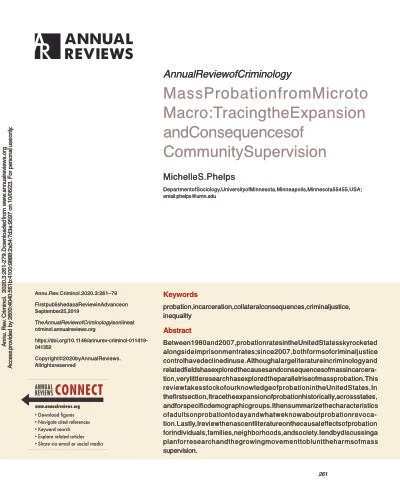
Mass Probation from Micro to Macro: Tracing the Expansion and Consequences of Community Supervision

By Michelle S. Phelps

Between 1980 and 2007, probation rates in the United States skyrocketed alongside imprisonment rates; since 2007, both forms of criminal justice control have declined in use. Although a large literature in criminology and related fields has explored the causes and consequences of mass incarceration, very little research has explored the parallel rise of mass probation. This review takes stock of our knowledge of probation in the United States. In the first section, I trace the expansion of probation historically, across states, and for specific demographic groups. I then summarize the characteristics of adults on probation today and what we know about probation revocation. Lastly, I review the nascent literature on the causal effects of probation for individuals, families, neighborhoods, and society. I end by discussing a plan for research and the growing movement to blunt the harms of mass supervision.

Annual Review of Criminology, Annu. Rev. Criminol. 2020. 3:261–79

download
Levers of Change in Parole Release and Revocation

By Edward E. Rhine, Kelly Lyn Mitchell, and Kevin R. Reitz

Paroling authorities play an important, if often unrecognized role, in American prison policies. Discretionary parole processes decide the actual release dates for most individuals subject to confinement in 34 states. Additional leverage over time served is exercised through parole boards’ revocation and re-release authority. The degree of discretion these back-end officials exert over the dosage of incarceration is vast, sometimes more than that held by sentencing courts.

Any comprehensive program to change American prison policy must focus to a significant degree on prison-release discretion, where it exists, and its relationship to time served. During the buildup to mass incarceration, many parole boards became increasingly reluctant to grant release to eligible prisoners. Today, if it were possible to reverse this upward driver of prison populations, parole boards could be important contributors to a new evidence-based status quo of lower prison rates in many states. Reasonable objectives of reform include policy-driven increases in the likelihood of parole release, and more rational decision making overall about time served.

This report describes twelve “levers of change,” each associated with potential reforms in the realm of discretionary parole release. The reforms are called “change levers” because, once a lever is pulled, it is designed to impact prison populations by altering parole grant rates and durations of time served. The report identifies 12 areas of innovation that, to some degree, have already been tried by a number of states. In most cases, from a distance, it is impossible to evaluate the quality of each state’s implementation of one or more change levers, or the results that have been achieved. But the fact that states have begun to experiment in specific areas shows that there is an appetite for reform. In addition, actual experimentation indicates that some of the groundwork has been laid for evaluation, improvement, and dissemination of promising ideas to many additional states.

Some levers have become embedded in the decision protocols of parole boards over the past 20 years and more, while others have emerged only recently. One of the goals of this report is to demonstrate how combining the levers is key to reform. This report maps the terrain of the 12 identified change levers, to the degree permitted by available information. The map shows a huge amount of state-by-state variation, even without hands-on study of each system. The report further classifies individual levers based on the number of jurisdictions in which they have been identified, and their potential impact on states’ prison populations.

St. Paul, MN: Robina Institute of Criminal Law and Criminal Justice, 2022. 36p.

download
Understanding Probation Violations and Disrupting the Revocation Pathway in Ramsey County, Minnesota

By Kelly Lyn Mitchell, Lily Hanrath, Erin Harbinson

Ramsey County Community Corrections (RCCC) and the Robina Institute of Criminal Law and Criminal Justice partnered to participate in the Reducing Revocations Challenge, a national initiative of Arnold Ventures and the CUNY Institute for State and Local Governance dedicated to understanding the drivers of probation revocations and identifying ways to reduce them when appropriate. The study involved two broad questions. First, what is the pathway to revocation for people on probation in Ramsey County? Second, what are the drivers of revocations in Ramsey County? Drawing from three sources of information—a legal and policy review, data regarding a cohort starting probation in 2016, and interviews with criminal justice system stakeholders—the primary goals were to identify the factors driving revocations and to collaborate with other stakeholders and members of the community to identify changes in policy and practice that can reduce probation revocations and lead to better outcomes for individuals on probation while protecting public safety

St. Paul, MN: Robina Institute of Criminal Law and Criminal Justice,

Minneapolis, MN2022. 70p.

download
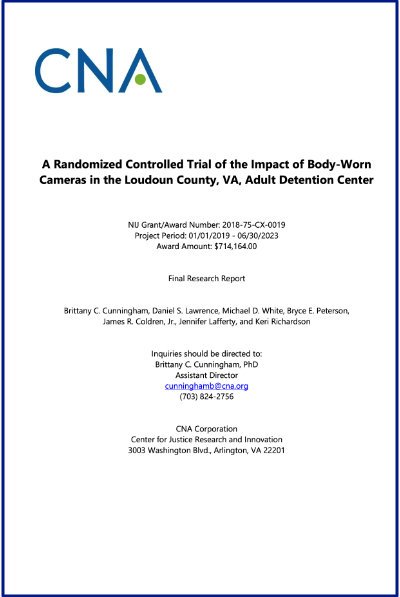
A Randomized Controlled Trial of the Impact of Body-Worn Cameras in the Loudoun County, VA, Adult Detention Center

By Brittany C. Cunningham; Daniel S. Lawrence; Michael D. White; Bryce E. Peterson; James R. Coldren, Jr.; Jennifer Lafferty; Keri Richardson

his final research report presents an evaluation of body-worn cameras (BWCs) in the Loudoun County, Virginia, Adult Detention Center. The goal of this study was to conduct a rigorous process and impact evaluation of BWCs in a correctional setting to inform researchers and practitioners about the implementation and potential impacts of BWCs on critical correctional outcomes. To achieve this goal, the study team implemented a 12-month, clustered, randomized controlled trial, and collected data using a mixed-method design. Primary data sources included the following: surveys of deputies; interviews of jail leaders, deputies, and external jail stakeholders; a focus group with deputies who serve on the Special Weapons and Tactics team; observations of jail operations and BWC trainings; review and analysis of jail administrative data, including response to resistance (RTR) events and resident injuries; and review and analysis of data collected from stationary cameras and BWC footage. Research findings suggested that BWCs have potential for improving the safety and security of correctional facilities by reducing RTR events and preventing injuries to incarcerated residents. However, findings from deputy surveys raised questions about the potential impact of BWCs on deputy-resident relations. The study also addressed one of the primary points of contention about implementing BWCs in correctional environments: that they are superfluous to the existing network of stationary cameras. This study found limitations with both types of cameras, as well as areas where they can complement one another to help overcome those limitations. The study team made several recommendations for policy and disseminated the research through both academic and practitioner conferences and publications.

Alexandria, VA: CNA Analysis & Solutions, 2023. 26p

download
Torture, Inhumanity and Degradation under Article 3 of the ECHR: Absolute Rights and Absolute Wrongs

By Natasa Mavronicola

This open access book theorises and concretises the idea of ‘absolute rights’ in human rights law with a focus on Article 3 of the European Convention on Human Rights (ECHR). It unpacks how we might understand what an ‘absolute right’ in human rights law is and draws out how such a right’s delimitation may remain faithful to its absolute character. From these starting points, it considers how, as a matter of principle, the right not to be subjected to torture or inhuman or degrading treatment or punishment enshrined in Article 3 ECHR is, and ought, to be substantively delimited by the European Court of Human Rights (ECtHR). Focusing on the wrongs at issue, this analysis touches both on the core of the right and on what some might consider to lie at the right’s ‘fringes’: from the aggravated wrong of torture to the severity assessment delineating inhumanity and degradation; the justified use of force and its implications for absoluteness; the delimitation of positive obligations to protect from ill-treatment; and the duty not to expel persons to places where they face a real risk of torture, inhumanity or degradation. Few legal standards carry the simultaneous significance and contestation surrounding this right. This book seeks to contribute fruitfully to efforts to counter a proliferation of attempts to dispute, circumvent or dilute the absolute character of the right not to be subjected to torture or inhuman or degrading treatment or punishment, and to offer the groundwork for transparently and coherently (re)interpreting the right’s contours in line with its absolute character. Winner of the 2022 SLS Peter Birks Prize for Outstanding Legal Scholarship.

London: Bloomsbury/Hart, 2022. 221p.

download
Process Evaluation of the Drug Recovery Prison at HMP Holme House

By Tammy Ayres, Ruth Hatcher and Emma Palmer

The Drug Recovery Prison (DRP) at HMP Holme House began in 2017 as a three-year pilot, jointly funded by NHS England (NHSE) and MOJ/HMPPS. The DRP aimed to address the supply of and demand for alcohol and illegal substances, improve treatment outcomes, and support ongoing recovery. The DRP process evaluation, jointly commissioned by MOJ and NHSE, aimed to understand how the pilot had been implemented, providing evidence on the roll out and capturing the perceptions and experiences of staff and prisoners.

Ministry of Justice Analytical Series, 2023. London: Ministry of Justice, 2023. 107p.

download
Alcohol and Drug Monitoring for Community Supervision\

By Criminal Justice Testing and Evaluation Consortium

This technology brief is the third document in a four-part series (Figure 1) on technologies to support the monitoring and supervision of individuals on pretrial release, probation, and parole (i.e., community supervision). The goal of this series is to offer foundational insights from use cases, examine the challenges of community supervision, highlight example products, and discuss the future of select technologies and their implications for community supervision. This brief highlights technologies and solutions used to monitor alcohol and drug use for persons on community supervision.

CJTEC Retrieved October, 2023.

download
Deaths in prison: Examining causes, responses, and prevention

By Penal Reform International and the University of Nottingham

Mortality rates are up to 50% higher in prison than in the community, linked to a wide range of causes and contributing factors which raise serious concerns for human rights, public health, and prison management. Yet, information on who is dying in prison and why, including disaggregated data, remains a key problem in understanding and reducing deaths in prisons.

This briefing is a call to action for the international community and national actors to strengthen their approach to deaths in prisons, to take pro-active measures to prevent loss of life and, when deaths do occur, to respond appropriately and conduct robust investigations in line with international human rights standards to identify any systemic concerns and prevent future harm.

Published in partnership with the University of Nottingham, it is based on research conducted as part of the prisonDEATH initiative and survey responses to a call for input from PRI from a variety of stakeholders in 25 countries covering all regions, as well as 19 prison administrations facilitated by EuroPris. Aimed to inspire action, it includes some recommendations to guide human rights-based responses to prevent premature or avoidable deaths in prison.

London: PRI, 2022. 16p.

download
Investing Deaths in Prison: A guide to a human rights-based approach

By Prison Reform International and the University of Nottingham

nvestigating deaths in prisons is an essential part of a state’s human rights responsibilities, including the obligation to guarantee the right to life and the prohibition of torture and other cruel, inhuman or degrading treatment or punishment. Investigations of deaths in prisons provide crucial evidence to find out what went wrong, provide redress to families, improve prison management and ultimately prevent future deaths.

This guide by PRI and the University of Nottingham provides prison authorities, policy makers, law enforcement officials, and families of persons deprived of liberty guidance and analysis on the basic features of human rights-based investigations into deaths in prison. It sets out key international and regional jurisprudence and includes recommendations to assist in designing and implementing an effective investigation system, as well as promising practices to inspire authorities to develop and implement reforms.

London: PRI, 2023. 26p.

download
Race-Specific Risk Factors for All-Cause, Natural, and Unnatural Deaths Among Individuals Released from State Prison

By Susan McNeeley, Valerie Clark and Grant Duwe

Individuals released from prison have an elevated risk of premature death, especially during the first few weeks after release. Furthermore, these consequences of incarceration may be exacerbated by racial and ethnic disparities. This study examined three types of post-release mortality – all-cause mortality, natural deaths, and unnatural deaths which include accidents, suicides, and homicides – among individuals released from Minnesota state prisons in order to identify characteristics and experiences that place individuals at risk. In addition, we conducted race-specific models examining these types of mortality among White, Black, and Native American releasees. The results of Cox regression models showed, first, that several personal characteristics were related to risk of death. Black, Asian, and Latino people had lower risk of mortality than White people, while Native American people had higher risk. Those affiliated with security threat groups (STG) had higher risk of death, as did those with more mental and physical health diagnoses and those with higher body mass index (BMI). Second, several aspects of criminal history and incarceration were related to post-release mortality. Sex offenders had lower risk of death, while those incarcerated for driving while intoxicated (DWI) had higher risk. Prison visitation reduced the risk of mortality. Risk of death was higher among those with more prior prison admissions, those incarcerated for supervised release revocations, and those with more discipline convictions – but was lower when individuals were incarcerated for longer periods of time. Third, the circumstances of release were related to risk of death. Individuals released to the Twin Cities Metropolitan area had higher risk of mortality, while those released to community programs had lower risk. Finally, the results also showed that, while many risk or protective factors appeared to be universal, some race-specific risk factors do exist.

St. Paul, Minnesota Department of Corrections, 2023. 43p.

download
Comparing Risk Factors for Prison Victimization Between Foreign-Born and Native-Born Incarcerated People

By Susan McNeeley and Doyun Koo

Prior research on violent victimization in prison suggests noncitizens may be less likely to experience violence while incarcerated. In an attempt to better understand this relationship, this study examined whether citizenship status predicts risk among a subsample of foreign-born incarcerated people. In addition, we modeled violent victimization separately for foreign-born and native-born individuals to identify any differences in risk factors between groups. We tested these relationships using a sample of 7,326 individuals incarcerated in Minnesota state prisons. The results of Cox regression models showed foreign-born citizens and foreign-born noncitizens had similar risk for violent prison victimization. We also found that some risk factors for victimization (age, physical health, MnSTARR 2.0 risk level, and idle status) differed across native-born and foreign-born incarcerated people.

St. Paul: Minnesota Department of Corrections, 2023. 27p.

download
Considering the Process of Debt Collection in Community Corrections: The Case of the Monetary Compliance Unit

By Nathan W. Link, Kathleen Powell, Jordan M. Hyatt, and Ebony L. Ruhland

Monetary sanctions levied on individuals on probation and parole may dramatically influence their ability to reintegrate into the community and to complete their community supervision. Yet very little work has empirically assessed how agencies respond to these obligations. This is critical, given that individuals under community supervision occupy a liminal space: free in the community yet often at risk of violation, rearrest, additional fines, or re-incarceration. In this article, we introduce an approach to the collection and management of monetary sanctions by an adult probation and parole agency in one Pennsylvania county. This specialized department focuses solely on repayment of fines, fees, and costs for a subset of probationers and parolees who have completed all other supervision requirements. We complement the conceptual overview by presenting administrative data on this caseload (N = 5,811) to describe the population under supervision and assess the factors associated with debt amount, having difficulty with repayment, and being the subject of an enforcement action for non-payment. We conclude with a discussion of the advantages and disadvantages of this model compared with historical and other existing models of debt enforcement during community supervision.

Journal of Contemporary Criminal Justice, Volume 37, Issue 1, February 2021, Pages 128-147

download
Debt, Incarceration, and Re-entry: a Scoping Review

By Annie Harper, Callie Ginapp, Tommaso Bardelli, Alyssa Grimshaw & Marissa Justen & Alaa Mohamedali & Isaiah Thomas & Lisa Puglisi

People involved with the criminal justice system in the United States are disproportionately low-income and indebted. The experience of incarceration intensifies financial hardship, including through worsening debt. Little is known about how people who are incarcerated and their families are impacted by debt and how it affects their reentry experience. We conducted a scoping review to identify what is known about the debt burden on those who have been incarcerated and their families and how this impacts their lives. We searched 14 databases from 1990 to 2019 for all original research addressing financial debt held by those incarcerated in the United States, and screened articles for relevance and extracted data from pertinent studies. These 31 studies selected for inclusion showed that this population is heavily burdened by debt that was accumulated in three general categories: debt directly from criminal justice involvement such as LFOs, pre-existing debt that compounded during incarceration, and debts accrued during reentry for everyday survival. Debt was generally shown to have a negative effect on financial well-being, reentry, family structure, and mental health. Debts from LFOs and child support are very common among the justice-involved population and are largely unpayable. Other forms of debt likely to burden this population remain largely understudied. Extensive reform is necessary to lessen the burden of debt on the criminal justice population in order to improve reentry outcomes and quality of life.

American Journal of Criminal Justice (2021) 46:250–278

download
Substantiated Incidents of Sexual Victimization Reported by Adult Correctional Authorities, 2016-2018

By Emily D. Buehler

This report describes substantiated incidents of inmate sexual victimization by another inmate or by staff. It presents data on the incidents of sexual victimization, such as location and time of day. It also provides characteristics of the victims and perpetrators of the victimization. The report details services provided to the victim and consequences for the perpetrator. In part, it fulfills BJS’s mandates under the Prison Rape Elimination Act of 2003 (PREA; P.L. 108–79).

Highlights

  • During 2016–18:

  • Half of both inmate-on-inmate and staff-on-inmate sexual victimization incidents occurred in an area not under video surveillance.

  • There were 2,886 victims of inmate-on-inmate sexual victimization and 2,496 victims of staff-on-inmate sexual victimization in adult correctional facilities.

  • About 25% of victims of inmate-on-inmate nonconsensual sexual acts and 43% of victims of abusive sexual contact were female.

  • The victim was given a medical examination in 61% of inmate-on-inmate nonconsensual sexual act incidents and in 36% of abusive sexual contact incidents

Washington, DC: U.S. Department of Justice, Office of Justice Programs, Bureau of Justice Statistics. 2023. 36p.

download
The impact of IPP sentences on prisoners’ wellbeing

By The Independent Monitoring Boards

Independent Monitoring Boards (IMBs) monitor and report on the conditions and treatment of those detained in every prison in England and Wales. The government recently rejected the Justice Select Committee’s recommendation for a resentencing exercise to take place for anyone serving an IPP sentence. IMBs submitted current findings on the impact of this decision, and the sentence itself, on IPP prisoners’ wellbeing. This briefing summarises findings from 24 IMBs submitted between 17 February and 9 March 2023 and references two 2021-22 annual reports from IMBs at HMPs Hewell and Moorland, which conducted surveys with IPP prisoners. Key findings The findings indicated: • Serious safety implications were heightened by the recent announcement, with assessment, care in custody and teamwork (ACCT) documents being opened for several IPP prisoners. Three apparently self-inflicted deaths of IPP prisoners occurred in three prisons in the four weeks following the announcement. • IPP prisoners had increased feelings of hopelessness and frustration following the announcement, which IMBs noted could act as a catalyst for poor mental health, violence and disruptive behaviour. • Variable and often inadequate staff engagement both pre- and post-announcement, with some prisoners only learning of the decision through a letter. • Progression pathways were poor and unclear to prisoners, which meant many prisoners questioned whether they would ever be released following the announcement. Some prisoners were being held in inappropriate establishments, often without access to required courses. The increasing difficulty of transferring to open conditions has left some prisoners ‘institutionalised’. • Insufficient preparation for parole hearings and for release, with reports of inadequate care plans and ‘through the gate’ provision. This lack of provision contributed to recall: for example, some prisoners were recalled only because of issues arising from the loss of accommodation.

London: Independent Monitoring Boards, 2023. 6p.

download
Impulsive and premeditated aggression in male offenders with antisocial personality disorder

By Jacinto AzevedoI, Maria Vieira-Coelho, Miguel Castelo-Branco, Rui Coelho, Margarida Figueiredo-Braga

Introduction: Aggression is a clinical symptom of various psychiatric disorders that can be conceptualised as a physical act towards another person with the intent to cause harm. In antisocial personality disorder (ASPD), aggression is a frequent manifestation that differently compromise therapeutic and prognostic goals according to its impulsive or premeditated categorisation. ASPD is characterised by high levels of impulsivity, psychopathic traits, and a high prevalence of co-morbid substance use disorders (SUDs). Aggression in ASPD patients may determine long and recurrent imprisonment thus representing a challenge clinicians and legal experts face. Objectives: Our aims were to characterise impulsive and premeditated aggression in male ASPD offenders as well as to determine the potential role of SUDs, impulsivity, and psychopathic traits as predictors. Materials and methods In this cross-sectional study we evaluated a sample of ASPD offenders with a battery of clinical and psychometric, standardised instruments: the Psychopathy Checklist-Revised (PCL-R), the European Version of the Addiction Severity Index (EuropASI), the Barratt Impulsivity Scale Version 11 (BIS-11), and the Impulsive/Premeditated Aggression Scale (IPAS). Results: We used a total sample of 134 offenders, all of whom were male. ASPD patients (n = 96) had a 71.9% prevalence of impulsive aggression and a 28.1% prevalence of premeditated aggression. ASPD patients with impulsive aggression had significantly lower scores of total PCL-R (p<0.01) factor 1 and interpersonal facet 1 (p<0.05), compared with ASPD patients with premeditated aggression. ASPD patients with impulsive aggression and ASPD patients with premeditated aggression had comparable BIS-11 mean scores, and exhibited an equal prevalence of SUDs. The interpersonal facet 1of the PCL-R predicted the aggression type (p<0.05) in ASPD patients, and the exponential beta value for facet 1 was 1.42 (CI = 1.03; 1.95). Conclusions The aggression type that is associated withASPD is mainly impulsive in nature. ASPD patients who have higher scores of psychopathic traits have a lower probability of exhibiting impulsive aggression and a higher probability of exhibiting premeditated aggression.Although ASPD patients have high levels of impulsivity and a high frequency ofSUDs, these two variables were not predictors of the aggression type.

PLoS ONE 15(3): 2020. e0229876.

download