Open Access Publisher and Free Library
PUNISHMENT.jpeg

PUNISHMENT

PUNISHMENT-PRISON-HISTORY-CORPORAL-PUNISHMENT-PAROLE-ALTERNATIVES. MORE in the Toch Library Collection

Posts in justice
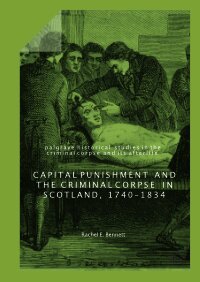
Capital Punishment and the Criminal Corpse in Scotland, 1740–1834

By Rachel E. Bennett.

Capital punishment has a long and storied global history. Within the annals of this penal narrative, the eighteenth and nineteenth centuries have offered a sustained attraction to historians of Western Europe. However, studies of the Scottish capital punishment experience have remained limited by comparison. This book seeks to redress this scholarly lacuna. Based upon an extensive gathering and analysis of previously untapped resources, it takes the reader on a journey from the courtrooms of Scotland to the theatre of the gallows. It introduces them to several of the malefactors who faced the hangman’s noose and explores the traditional hallmarks of the spectacle of the scaffold. The study demonstrates that the period between 1740 and 1834 was one of discussion, debate and fundamental change in the use of the death sentence and how it was staged in practice. In addition, it contextualises the use of capital punishment against the backdrop of key events in Scottish history in this period including Anglo-Scottish relations in the wake of the 1707 Act of Union, the aftermath of the 1745 Jacobite Rebellion and the rapid industrialisation and urbanisation witnessed by the country. In doing so, the current study goes beyond redressing a scholarly gap and instead demonstrates that an exploration of Scotland’s unique capital punishment history enhances the current feld in some areas but provides a crucial caveat to the broader narrative in others. Finally, this study writes the post-mortem punishment of the criminal corpse into Scotland’s capital punishment history. In demonstrating that the journey of several capitally convicted offenders, predominantly murderers, did not end upon the scaffolds of Scotland, it takes the reader from the theatre of the gallows to the dissection tables of Scotland’s main universities and to the foot of the gibbets from which criminal bodies were displayed. In doing so it identifes an intermediate stage in the long-term disappearance of public bodily punishment.

Basingstoke, UK: Springer Nature, 2018. 243p.

download
The Prison and the Factory: Origins of the Penitentiary System

By Dario Melossi.

An examination and interpretation of the development of modern prisons in England and Europe from 1550 to 1850, a study of Italian prison development, and of American prisons from colonial times to 1930. 

New York: Macmillan, 1981. 243p.

download
Improving Interagency Collaboration, Innovation and Learning in Criminal Justice Systems

Edited by Sarah Hean, Berit Johnsen, Anu Kajamaa and Laure Kloetzer.

Supporting Offender Rehabilitation. This Open Access edited collection seeks to improve collaboration between criminal justice and welfare services in order to help prepare offenders for life after serving a prison sentence. It examines the potential tensions between criminal justice agencies and other organisations which are involved in the rehabilitation and reintegration of offenders, most notably those engaged in mental health care or third sector organisations. It then suggests a variety of different methods and approaches to help to overcome such tensions and promote inter-agency collaboration and co-working, drawing on emerging research and models, with a focus on the practice in European and Scandinavian countries. For academics and practitioners working in prisons and the penal system, this collection will be invaluable.

Cham: Palgrave Macmillan, 2021. 475p.

download
Harnessing the Power of the Criminal Corpse

By Sarah Tarlow and Emma Battell.

This open access book is the culmination of many years of research on what happened to the bodies of executed criminals in the past. Focusing on the eighteenth and nineteenth centuries, it looks at the consequences of the 1752 Murder Act. These criminal bodies had a crucial role in the history of medicine, and the history of crime, and great symbolic resonance in literature and popular culture. Starting with a consideration of the criminal corpse in the medieval and early modern periods, chapters go on to review the histories of criminal justice, of medical history and of gibbeting under the Murder Act, and ends with some discussion of the afterlives of the corpse, in literature, folklore and in contemporary medical ethics. Using sophisticated insights from cultural history, archaeology, literature, philosophy and ethics as well as medical and crime history, this book is a uniquely interdisciplinary take on a fascinating historical phenomenon.

Lowman. Palgrave (2018) 277 pages.

download
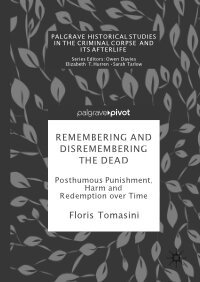
Remembering and Disremembering the Dead

By Floris Tomasini.

Posthumous Punishment, Harm and Redemption over Time. “In the main, this book is a cross-fertilisation of history and philosophy in the broadest possible sense. Ideas of death, posthumous harm, punishment and redemption germinate in both the conceptual ground of philosophical analysis and the empirical ground of historical case study.”

Palgrave (2017) 106p.

download
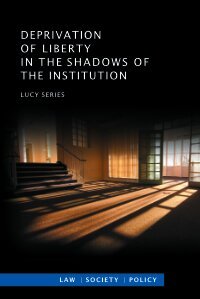
Deprivation Of Liberty In The Shadows Of The Institution

By Lucy Series.

“The community is a complicated place, easier to define by what it is not (a hospital) than what it is. Successive waves of post-carceral policy have deposited different care structures and settings on its shores. There are the first-wave quasi-institutions, which still predominate in the care of older people: residential care homes and nursing homes. Then there are second wave quasi-domestic services, aspiring to break free of our institutional heritage: ‘supported living’, ‘independent living’, sheltered housing, and other kinds of ‘housing with support.”

Bristol University Press (2022) 318p.

download
Auburn, N.Y.

By D. Morris Kurtz

Its Facilities and Resources. For reasons of their own, the publishers have been pleased to omit the sketches relating to the large axle manufactories of Sheldon & Co., in the Auburn Prison and on Sheldon Avenue ; the shoe manufactories of Dunn, Barber & Co., in the Auburn Prison and on Garden street ; the hollow ware manufactory of Jones & Merritt, Auburn Prison ; the hame manufactory of Hayden & Boyd, Auburn Prison, and several smaller concerns (manufacturing and mercantile), for which I can only express sorrow.

Kurtz publishing (1884) 159p.

download
The Prison Question

By Charles H. Reeve.

A theoretical and philosophical review of some matters relating to crime, punishment, prisons, and reformation of convicts. With a glance at mental, social and political conditions; and some suggestions about and the prevention of crime and the production of causes, and the prevention of crime and the production of criminals.

Knight and Leonard (1890) 206 pages.

download
Wards of the State

By Tighe Hopkins

An Unofficial View Of Prison And The Prisoner. “Imprisonment, its effects upon the prisoner (in prison and after prison) and the prejudice it creates agamst him in the pubHc mind these are my chief topics. With imperfections of which I am extremely conscious, the book represents a study of some years' duration, a study rendered difficult for the onlooker by this fact above others, that he does not view the life of prison from within.”

Boston. Little Brown (1913) 345 pages.

download
The Great West Ukrainian Prison Massacre of 1941

Edited by Ksenya Kiebuzinski and Alexander Motyl.

A Sourcebook. After Germany invaded the Soviet Union in 1941, the Soviet secret police, the NKVD, executed a staggering number of political prisoners in Western Ukraine-somewhere between 10,000 and 40,000-in the space of eight days, in one of the greatest atrocities perpetrated by the Soviet state. Yet the Great West Ukrainian Prison Massacre of 1941 is largely unknown. This sourcebook aims to change that, offering detailed scholarly analysis, eyewitness testimonies and profiles of known victims, and a selection of fiction, memoirs, and poetry that testifies to the lasting impact of the massacre in the collective memory of Ukrainians.

Amsterdam University Press. (217) 433 pages.

download
In the Shadow of the Wall

By Harriette B. Gunn.

Were John Howard alive to-day, he would rejoice over the development of the prison reforms he inaugurated . He would be surprised at the Prisoner’sAid Societies, the Parole Boards, the Hope Halls, the International Prison Congress meeting annually to discuss prison problems, , and the many changes of the new system of prison management. Praise God for the humanity that now exists..

Christopher publishing (1922) 301 pages.

download
Pathways To Recovery And Desistance

by David Best.

The Role of the Social Contagion of Hope. This is the first book that uses the latest research evidence to build guidance on community-based rehabilitation with the aim of challenging stigma and marginalisation. The case studies discussed, and a strengths-based approach, emphasize the importance of long-term recovery and the role that communities and peers play in the process. Best examines effective methods for community growth, offers sustainable ways of promoting social inclusion and puts forward a new drug strategy and a new reform policy for prisons.

Policy Press (2019) 234 pages.

download
A Global History of Convicts and Penal Colonies

Edited by Clare Anderson.

Between 1415, when the Portuguese first used convicts for colonization purposes in the North African enclave of Ceuta, to the 1960s and the dissolution of Stalin’s gulags, global powers including the Spanish, Dutch, Portuguese, British, Russians, Chinese and Japanese transported millions of convicts to forts, penal settlements and penal colonies all over the world. A Global History of Convicts and Penal Colonies builds on specific regional archives and literatures to write the first global history of penal transportation. The essays explore the idea of penal transportation as an engine of global change, in which political repression and forced labour combined to produce long-term impacts on economy, society and identity. They investigate the varied and interconnected routes convicts took to penal sites across the world, and the relationship of these convict flows to other forms of punishment, unfree labour, military service and indigenous incarceration. They also explore the lived worlds of convicts, including work, culture, religion and intimacy, and convict experience and agency.

Bloomsbury Academic (2018) 406 pages.

download
The Golden and Ghoulish Age of the Gibbet in Britain

By Sarah Tarlow.

”The story of Tom Otter, a murderer who was executed and gibbeted in 1806, has many striking features. Not least, this form of brutal and bodily post-mortem punishment seems rather anachronistic during a period often described in terms of increasing gentility and humanity. It took place within the legal context of the Murder Act (1752), which specified that the bodies of murderers had to be either dissected or hung in chains. Other aggravated death penalties were applied to those convicted of treason and suicide. A number of common misconceptions about the gibbet need to be corrected.” Palgrave (2017) 163p.

download
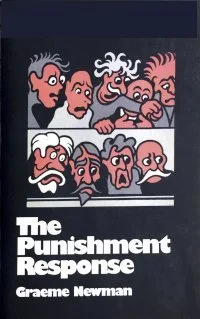
The Punishment Response: First Edition

By Graeme R. Newman.

This is a classic reprint of the original edition of The Punishment Response, originally published in 1976. An acclaimed treatise on the history,  philosophy and psychology of punishment. "...read with enormous appreciation for its erudition and method of analysis..." -- Michel Foucault.

Harrow and Heston Classic Reprint. 1985.312p.

download
Remarks on Prisons and Prison Discipline in the United States

By Dorothea Lynde Dix.

“ Society, during the last hundred years, has been alternately perplexed and encouraged, defeated and successful, respecting the two great questions— how shall the criminal and pauper be disposed of, in order to reduce crime and reform the criminal on the one hand, and, on the other, to diminish pauperism and restore the pauper to useful citizenship 1 Though progress has been made, through the efforts of energetic and enlightened persons, directed to the attainment of these ends, all know that society is very far from realizing their accomplishment. We accord earnest and grateful praise to those who have procured the benefits at present possessed ; and, with careful zeal, we would endeavor to advance a work, which succeeding generations must toil to perfect and complete. Moralists and philosophers, with pietists and philanthropists, have urged upon "communities the truer course of employing early preventive measures, rather than expend the energies, at a late period, in futile attempts to govern and lead by correct and virtuous habits, the long-time criminal, and the life-long indolent and ignorant

Boston : Printed by Munroe & Francis, 1845. 108p.

download
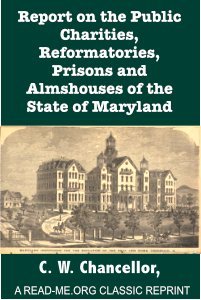
Report on the Public Charities, Reformatories, Prisons and Almshouses of the State of Maryland

By C. W. Chancellor.

Excerpt from Report on the Public Charities, Reformatories, Prisons and Almshouses of the State of Maryland, by C. W. Chancellor, M.D., Secretary of the State Board of Health, Made to His Excellency, John Lee Carroll, Governor, July, 1877, by C.W. Williams, and the Maryland State Board of Health.

Frederick, MD: Baughman Brothers, 1877. 208p.

download