
Open Access Publisher and Free Library
PUNISHMENT.jpeg

PUNISHMENT

PUNISHMENT-PRISON-HISTORY-CORPORAL-PUNISHMENT-PAROLE-ALTERNATIVES. MORE in the Toch Library Collection

Posts in justice
The Walls Are Closing In On Me: Suicide and Self-Harm in New York State’s Solitary Confinement Units, 2015-2019

By The # HaltSolitary Campaign

In the U.S. criminal legal system, individuals sentenced to prison are required to relinquish their liberty as redress for the crimes for which they have been convicted. They are not supposed to also give up their humanity, their physical and mental health, or their lives. Yet in New York’s state prisons, these are the terrible prices many incarcerated people end up paying. Some of the incidents of suicide and self-harm in the state’s prisons may be beyond the control of the New York State Department of Corrections and Community Supervision (DOCCS). But there can be no doubt that prison conditions profoundly affect the level of suffering and despair felt by incarcerated people, and that inhumane conditions often lead to desperate responses. This report provides hard evidence, drawn from data provided by DOCCS and other state agencies, that the rate of suicides in New York’s prisons far exceeds the national prison average. It also establishes an undeniable link between the use of solitary confinement and higher rates of suicide, suicide attempts, and self-inflicted injury. Taken together, these numbers demand immediate and drastic change in DOCCS policies and practices in relation to solitary confinement. They demand that New York’s lawmakers put an end to preventable suffering, self-harm, and death in our prisons by enacting the HALT Solitary Confinement Act, A.2500/S.1623.1 Preventing self-injury and suicide by enacting HALT is even more imperative now, as COVID-19 increases the levels of anxiety, fear, and risk of self-harm for people in solitary during the pandemic.

New York: The New York Campaign for Alternatives to Isolated Confinement (CAIC) , 2020. 22p.

download
Trans Women Deprived of Liberty: Invisible Stories Behind Bars

By Teresa García Castro

As Latin American countries continue to grapple with worsening prison conditions, overcrowding, and the potentially devastating impact of COVID-19 in such prisons, a new report found an alarming absence of standards and public policies to protect an often-overlooked population: trans women deprived of liberty. The report—the first-ever regional study of its kind—underscores the urgent need to release as many people behind bars as possible before COVID-19 enters the region’s crumbling prison infrastructure. Drawing on a participatory research process led by formerly incarcerated trans women, the study, Trans Women Deprived of Liberty: Invisible Stories Behind Bars, is the result of a collaboration between nine human rights and advocacy organizations: Almas Cautivas, Casa de las Muñecas Tiresias, Casa Hogar Paola Buenrostro, the Corpora en Libertad Network, Dejusticia, Equis: Justice for Women, the International Drug Policy Consortium (IDPC), the Prison Ombudsman’s National Office in Argentina, and the Washington Office on Latin America (WOLA). The report describes the failures of Latin American governments to implement basic measures to protect trans women deprived of liberty from violence and abuse. As a result, trans women are subjected to discrimination, stigmatization, and criminalization at every stage of interaction with the criminal justice system, the report found. As Latin American countries continue to grapple with worsening prison conditions, overcrowding, and the potentially devastating impact of COVID-19 in such prisons, a new report found an alarming absence of standards and public policies to protect an often-overlooked population: trans women deprived of liberty. The report—the first-ever regional study of its kind—underscores the urgent need to release as many people behind bars as possible before COVID-19 enters the region’s crumbling prison infrastructure.

  • Drawing on a participatory research process led by formerly incarcerated trans women, the study, Trans Women Deprived of Liberty: Invisible Stories Behind Bars, is the result of a collaboration between nine human rights and advocacy organizations: Almas Cautivas, Casa de las Muñecas Tiresias, Casa Hogar Paola Buenrostro, the Corpora en Libertad Network, Dejusticia, Equis: Justice for Women, the International Drug Policy Consortium (IDPC), the Prison Ombudsman’s National Office in Argentina, and the Washington Office on Latin America (WOLA). The report describes the failures of Latin American governments to implement basic measures to protect trans women deprived of liberty from violence and abuse. As a result, trans women are subjected to discrimination, stigmatization, and criminalization at every stage of interaction with the criminal justice system, the report found.

Washington, DC: Washington Office on Latin America (WOLA), 2020. 26p.

download
Imprisoned at Home: Women under House Arrest in Latin America

By Teresa García Castro

COVID-19 has shed light on the need for governments across the Americas to take steps to address prison overcrowding, given the high risk of deadly outbreaks in places of detention where social distancing and other sanitary measures are difficult to achieve. In this context, some governments have promoted decarceration measures and alternatives to incarceration including house arrest—that is, court-ordered detention of a person in their place of residence—as a way to reduce overcrowding. When implemented effectively, house arrest is meant to be a less restrictive form of confinement and to help those deprived of liberty reintegrate back into their communities and avoid landing back in prison. But as detailed in a new report, Imprisoned at Home: Women under House Arrest in Latin America, imposing strict house arrest without guaranteeing fundamental human rights, particularly for people in low-income situations, can make house arrest just as punitive as incarceration. House arrest should not simply replace one form of incarceration for another. Governments across the Americas should guarantee that people subjected to this measure have their rights protected. If you’re placed under house arrest but aren’t given the option to remain employed or seek emergency medical help when you need it, those are unacceptable conditions. Authorities must ensure that those under house arrest receive the support they need to provide for their families and reintegrate into their communities.

Washington, DC: Washington Office on Latin America (WOLA), 2020. 20p.

download
Women Behind Bars for Drug Offenses in Latin America: What the Numbers Make Clear

By Coletta A. Youngers, Teresa García Castro, and Maria (Kiki) Manzur

Women’s incarceration in Latin America has increased dramatically over the last two decades. Not only have the sheer numbers increased, but the percentage of females in the overall prison population has also risen, and the rate of the ongoing increase in the size of the female prison population is alarming. Moreover, the number of women being put behind bars is growing much faster than the number of men. These trends cannot be explained by growth of the overall female population, or simply by the increase in the total number of prisoners. Rather, the driving force behind the data is the adoption of punitive drug laws that disproportionately affect women. In the majority of Latin American countries, drug-related crimes are the main cause of female incarceration. For instance, available data shows that in Argentina, Bolivia, Brazil, Chile, Colombia, Costa Rica, Ecuador, Mexico, Panama, Paraguay, Peru, and Venezuela, drug-related offenses are the most common offense for female prisoners. In sheer numbers, more men than women are incarcerated for drug-related offenses in Latin American countries. But the percentage of women imprisoned for that offense is almost always higher than the percentage of men. Data compiled by WOLA shows that in Brazil, Chile, Costa Rica, Panama and Peru, the proportion of women prisoners who are incarcerated for drug offenses is at least 30% higher than in the case of men imprisoned in those countries. The excessive use of pretrial detention is a primary factor contributing to the over-incarceration of women for drug offenses in Latin America. Research shows that more women than men are in pretrial detention for drug offenses in almost all of the countries studied.

  • The incarceration of these women does nothing to disrupt drug markets or thwart the drug trade, as they are primarily engaged in high-risk but low-ranking jobs and are easily replaced, while those running criminal enterprises rarely end up behind bars. Yet the consequences of incarceration for these women, their families and their communities can be devastating. The COVID-19 pandemic—and its disproportionate impact on people in prison—gives even greater urgency to implementing reforms to dramatically reduce the number of women behind bars. The report concludes with a plea to adopt recommendations for developing and implementing gender-sensitive drug and prison-related policies rooted in human rights and public health—policies that also take into account the intersectionalities and multiple vulnerabilities of women in situations of poverty or extreme poverty; those who are LGBTI+, Afro-descendent, foreign women, or indigenous; and women who are pregnant and/or have children.

Washington, DC: Washington Office on Latin America (WOLA), 2020. 33p.

download
Review of the Federal Bureau of Prisons’ Management of Its Female Inmate Population

By The U.S. Office of the Inspector General

As of September 2016, the Federal Bureau of Prisons (BOP) incarcerated 10,567 sentenced female inmates, representing 7 percent of the total BOP sentenced inmate population of 146,084. Though female inmates compose a small percentage of the nationwide incarcerated population, correctional officials have recognized that in some areas female and male inmates have different needs and BOP has adopted genderresponsive programs and policies that account for these needs. As a continuation of prior U.S. Department of Justice Office of the Inspector General (OIG) reviews examining BOP’s management of certain subpopulations of inmates, including aging inmates and inmates with mental illness in restrictive housing, OIG initiated this review of BOP’s management of female inmates, specifically BOP’s efforts and capacity to ensure that BOP-wide policies, programs, and decisions adequately address the distinctive needs of women. Our decision to initiate this review was also informed by members of Congress and public interest groups recently raising concerns about what they consider to be deficiencies in BOP’s current management of female inmates.

Washington, DC: U.S. Office of the Inspector General, 2018. 60p.

download
Women in Prison: Seeking Justice Behind Bars

By The U.S. Civil Rights Commission

This report examines the state of federal civil rights protections for incarcerated women to explore women’s experiences while incarcerated. It covers a range of issues incarcerated women face, including access to healthcare, prevention of sexual assault, discipline and segregated housing, parental rights, and availability of programming. The report provides examples of prison administrations seeking to address these issues and it evaluates the response of the federal government. The Commission’s research includes examination of high rates of a history of trauma reported by incarcerated women, as well as policies responsive to this trauma. The report also offers recommendations to Congress and the executive branch.

Washington, DC: The Commission, 2020. 292p.

download
In the Extreme: Women Serving Life Without Parole and Death Sentences in the United States

By Ashley Nellis

Nationwide one of every 15 women in prison — over 6,600 women — are serving a sentence of life with parole, life without parole, or a virtual life sentence of 50 years or more. The nearly 2,000 women serving life-without-parole sentences can expect to die in prison. Death sentences are permitted by 27 states and the federal government, and currently 52 women sit on death row. This report presents new data on the prevalence of both of these extreme sentences imposed on women.

Washington, DC: The Sentencing Project, 2021. 17p.

download
rule of law, justiceRead-Me.Org
Incarcerated Women and Girls

By The Sentencing Project

Over the past quarter century, there has been a profound change in the involvement of women within the criminal justice system. This is the result of more expansive law enforcement efforts, stiffer drug sentencing laws, and post-conviction barriers to reentry that uniquely affect women. The female incarcerated population stands nearly five times higher than in 1980. Over half (58%) of imprisoned women in state prisons have a child under the age of 18.1 Between 1980 and 2020, the number of incarcerated women increased by more than 475%, rising from a total of 26,326 in 1980 to 152,854 in 2020. The total count in 2020 represents a 30% reduction from the prior year—a substantial but insufficient downsizing in response to the COVID-19 pandemic, which some states began to reverse in 2021.

Washington, DC: The Sentencing Project, 2022. 6p.

download
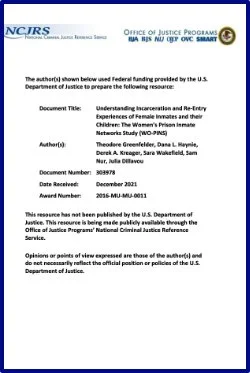
Understanding Incarceration and Re-Entry Experiences of Female Inmates and their Children: The Women's Prison Inmate Networks Study (WO-PINS)

By Theodore Greenfelder; Dana L. Haynie ; Derek A. Kreager; Sara Wakefield; Sam Nur; Julia Dillavou

This study extends a previous study, the Prison Inmate Networks Study (PINS), which focused on the social organization within a men’s prison unit. These two studies enable gender comparisons that reveal potential differences and similarities in prison social structure and health in men’s and women’s prisons. The current project involving women’s prisons was conducted in three phases. Phase 1 involved the design and implementation of a network and health survey administered to residents in three women’s units in a minimum-security prison and a maximum-security prison. This was done to determine the informal social structures within the prison units and prisoners’ positions within those structures. Phase 2 identified and recruited Phase 1 participants who were release-eligible within 1 year of the baseline survey. These women were administered semi-structured interviews prior to release to determine their future concerns and expectations regarding reentry, with a focus on mothers’ plans and expectations for child reunification. Phase 3 interviewed paroled prisoners and their children 1 year after release to determine the status of their family reunification and well-being. Thus far, this study’s findings reveal the complexity of women’s prison social systems, with implications for correctional policy. There was a more fluid social system in the women’s prisons than in the men’s prisons, which requires daily attention from correctional staff and prisoners. Prison pseudo-families were present to provide support and caring behaviors. Although analyses of pre-release and post-release interviews are ongoing, important lessons are reported on the data-collection process.

Washington, DC: U.S. National Institute of Justice, 2021. 55p.

download
Double Jeopardy: The economic and social costs of keeping women behind bars

By The Committee for Economic Development of Australia

This collaborative paper has been produced with contributions from experts, stakeholders and CEDA members. CEDA’s objective in publishing this paper is to encourage constructive debate and discussion on a matter of national economic importance. Justice is a critical institution underpinning economic and social development. Providing access to world-class justice and rehabilitation can help both the victims and perpetrators of crime, while minimising its associated economic and fiscal costs. This paper provides a foundational framework outlining the clear need to reform the imprisonment of women in Australia. It seeks to highlight the key issues and emphasise the urgent need to reduce rates of female imprisonment through a nationally consistent approach. This will help to improve workforce participation and life outcomes, while also reducing wasteful government spending at a time of urgent budget repair. This report does not seek to detail all the complexities of the issue of the incarceration of women.

Melbourne VIC ; Committee for Economic Development of Australia, 2022. 52p.

download
Incarcerated Parents and Their Children: Trends 1991-2007

By Sarah Schirmer, Ashley Nellis and Marc Mauer

Mass incarceration has had significant and long-lasting impacts on American society, and particularly on communities of color. There is now a growing awareness that parents who go to prison do not suffer the consequences alone; the children of incarcerated parents often lose contact with their parent and visits are sometimes rare. Children of incarcerated parents are more likely to drop out of school, engage in delinquency, and subsequently be incarcerated themselves.1 In 2007 there were 1.7 million children in America with a parent in prison, more than 70% of whom were children of color. Children of incarcerated parents live in a variety of circumstances. Some were previously in homes of two-parent families, where the non-incarcerated parent can assume primary responsibility for the children. Many children, especially in cases of women’s incarceration, were in single-parent homes and are then cared for by a grandparent or other relative, if not in foster care. And in some cases, due to substance abuse and other factors, incarcerated parents had either not lived with their children or not provided a secure environment for them. Following release from prison both parents and children face challenges in reuniting their families. Parents have to cope with the difficulty of finding employment and stable housing while also reestablishing a relationship with their children.

Washington, DC: The Sentencing Project, 2009. 14p.

download
Focus on Children of Incarcerated Parents: An Overview of the Research Literature

By Creasie Finney Hairston

What is it like to grow up with a parent in prison? What are the immediate and long-term effects of parental incarceration on children? How can we best serve the needs of these children and ensure that they receive the support they need to thrive under challenging circumstances? These are questions that still need to be answered. Research that focuses on children whose parents are incarcerated has been quite limited, despite the growing numbers of children who are affected by the imprisonment of their mother or father. Over 1.5 million children in the United States have a parent who is in prison. Several million more have grown up with a parent in prison during some part of their formative years. The children of incarcerated parents have long been an almost invisible population, but in recent years, they have begun to receive attention from public policymakers, traditional social service providers and academic researchers. Some, concerned about the rapidly growing correctional population of more than two million people, fear that these children are at a higher risk to become incarcerated themselves as adults. Others are motivated by a desire to better understand and promote the well-being of children living in challenging life circumstances. This overview is based primarily on research published during the last 20 years, though some earlier works are included. It also draws on several years of consultation on programs and research involving prisoners and their families.

Baltimore: Annie E. Casey Foundation, 2007. 44p.

download
Sick Justice: Inside the American Gulag

By Ivan G. Goldman

In America, 2.3 million people—a population about the size of Houston’s, the country’s fourth-largest city—live behind bars. Sick Justice explores the economic, social, and political forces that hijacked the criminal justice system to create this bizarre situation. Presenting frightening true stories of (sometimes wrongfully) incarcerated individuals, Ivan G. Goldman exposes the inept bureaucracies of America’s prisons and shows the real reasons that disproportionate numbers of minorities, the poor, and the mentally ill end up there. Goldman dissects the widespread phenomenon of jailing for profit, the outsized power of prison guards’ unions, California’s exceptionally rigid three-strikes law, the ineffective and never-ending war on drugs, the closing of mental health institutions across the country, and other blunders and avaricious practices that have brought us to this point. Sick Justice tells a big, gripping story that’s long overdue. By illuminating the system’s brutality and greed and the prisoners’ gratuitous suffering, the book aims to be a catalyst for reform, complementing the work of the Innocence Project and mirroring the effects of Michael Harrington’s The Other America: Poverty in the United States (1962), which became the driving force behind the war on poverty.

Washington, DC: Potomac Books, 2013. 256p.

download
American Gulag: Inside U.S. Immigration Prisons

By Mark Dow

American Gulag takes us inside prisons such as the Krome North Service Processing Center in Miami, the Corrections Corporation of Americas Houston Processing Center, and county jails around the country that profit from contracts to hold INS prisoners. It contains disturbing in-depth profiles of detainees, including Emmy Kutesa, a defector from the Ugandan army who was tortured and then escaped to the United States, where he was imprisoned in Queens, and then undertook a hunger strike in protest. To provide a framework for understanding stories like these, Dow gives a brief history of immigration laws and practices in the United States—including the repercussions of September 11 and present-day policies. His book reveals that current immigration detentions are best understood not as a well-intentioned response to terrorism but rather as part of the larger context of INS secrecy and excessive authority.

Berkeley and Los Angeles: University of California Press, 2004. 429p.

download
Race, Gender and the School-to-Prison Pipeline: Expanding Our Discussion to Include Black Girls

By Monique W. Morris

The school-to-prison pipeline refers to the policies, practices, and conditions that facilitate both the criminalization of educational environments and the processes by which this criminalization results in the incarceration of youth and young adults. This Report discusses the literature on the “schoolto- prison pipeline” and explores why the “pipeline” analogy may not accurately capture the education system pathways to confinement for Black girls.

New York: African American Policy Forum, 2012. 23p.

download
Fatherhood Arrested: Parenting from Within the Juvenile Justice System

By Ann M. Nurse

Crime and young fatherhood have generally been viewed as separate social problems. Increasingly, researchers are finding that these problems are closely related and highly concentrated in low-income communities. Fatherhood Arrested is an in-depth study of these issues and the difficulties of parenting while in prison and on parole. By taking us inside the prison system, Nurse shows how its structure actively shapes an inmate's relationship with his children. For example, visitation is sometimes restricted to blood relatives and wives. Because relationships between unmarried men and the mothers of their children are often strained, some mothers are unwilling to allow their children to go to the prison with the inmate's family. Or the father may be allowed to receive visits from only one "girlfriend," which forces a man with multiple relationships, or with children by different women, to make impossible choices. Special attention is paid to the gendered nature of prison, its patriarchal and punitive structure, and its high-stress environment. The book then follows newly paroled men as they are released and return to their children. The author spent four years doing research at the California Youth Authority, during which time she surveyed 258 paroled fathers. The group included young white, black, and Latino men, ages sixteen to twenty-five. She conducted in-depth interviews with men selected from this group, participated in forty parenting class sessions, and observed visiting hours at three different institutions. The data provide fascinating information about the characteristics of the men, their attitudes toward fatherhood, and the ways they are involved with their children. The diversity of the fathers allows for an analysis of racial and ethnic variation in their attitudes and involvement. The study concludes with a series of policy suggestions, especially important in light of the large number of fathers now living under the care and control of the juvenile justice system.

Nashville, TN: Vanderbilt University Press, 2002. 176p.

download
Lockdown America: Police and Prisons in the Age of Crisis

By Christian Parenti

The first section of the book deals with the recent history of American poUt- ical economy and the origins of the current criminal justice buildup. The second explores some important forms of policing, like New York—style zero tolerance, SWAT teams, and the Immigration and Naturalization Service (INS) war on immigrants. The third deals with prison: the politics of life inside (gangs, rape, and brutality) and incarceration's role in reproducing the US economic and social order. This book is written with a linear, broadly historical narrative, but readers should feel free to digest the chapters in any order they wish

VERSO. London. New York. 1999. 312p.

download
International Handbook of Penology and Criminal Justice

Edited by Shlomo Giora Shoham, Ori Beck and Martin Kett

The first comparative study of this increasingly integral social subject, International Handbook of Penology and Criminal Justice provides a comprehensive and balanced review of the philosophy and practicality of punishment. Drawn from the expertise of scholars and researchers from around the world, this book covers the theory, practice, history, and empirical evidence surrounding crime prevention, identification, retribution, and incarceration. It analyzes the efficacy of both traditional methods and thinking as well as novel concepts and approaches. The book evaluates arguments regarding the world-wide abolition of capitol punishment from moral, utilitarian, and practical positions. It examines non-incarcerative and alternative punishments such as financial restoration and restrictions of liberty, as well as the positive effects of Victim Offender Mediation. It also considers several methods aimed at achieving measurable crime prevention including identifying at-risk juveniles and minimizing crimes of opportunity, as well as the pros and cons of employing the coercive power of police. Further essays consider subjects such as international policing, the roles of prosecution and defense attorneys, current discretionary sentencing practices, and the role and treatment of victims. The volume concludes with two chapters of case studies that provide a "hands-on" feel for the interplay of the concepts discussed.

Boca Raton, FL: CRC Press, 2008. 802p.

download
Islam in American Prisons: Black Muslims' Challenge to American Penology

By Hamid Reza Kusha

The growth of Islam both worldwide and particularly in the United States is especially notable among African-American inmates incarcerated in American state and federal penitentiaries. This growth poses a powerful challenge to American penal philosophy, structured on the ideal of rehabilitating offenders through penance and appropriate penal measures. "Islam in American Prisons" argues that prisoners converting to Islam seek an alternative form of redemption, one that poses a powerful epistemological as well as ideological challenge to American penology. Meanwhile, following the events of 9/11, some prison inmates have converted to radical anti-Western Islam and have become sympathetic to the goals and tactics of the Al-Qa'ida organization. This new study examines this multifaceted phenomenon and makes a powerful argument for the objective examination of the rehabilitative potentials of faith-based organizations in prisons, including the faith of those who convert to Islam.

Farnham, Surrey, UK: Ashgate: 2009. 231p.

download
American Penology: A History of Control

By Karol Lucken and Thomas G. Blomberg

The purpose of American Penology is to provide a story of punishment's past, present, and likely future. The story begins in the 1600s, in the setting of colonial America, and ends in the present As the story evolves through various historical and contemporary settings, America's efforts to understand and control crime unfold. The context, ideas, practices, and consequences of various punishment reforms are described and examined. Though the book's broader scope and purpose can be distinguished from prior efforts, it necessarily incorporates many contributions from this rich literature. These many contributions are explicitly discussed in the book, and their relationship to the story of American penology is self-evident (e.g., the rise of prisons, reformatories, probation, parole, and juvenile courts, the origins and functions of prison subcultures, the needs of special inmate populations, the effectiveness of community-based alternatives to incarceration). It is important to acknowledge that while this book incorporates selected descriptions of historical contingencies in relation to particular eras and punishment ideas and practices, it does not provide individual "histories" of these eras. Rather than doing history, this book uses history to frame and help explain particular punishment ideas and practices in relation to the period and context from which they evolved. The authors focus upon selected demographic, economic, political, religious, and intellectual con-tingencies that are associated with particular historical and contemporary eras to suggest how these contingencies shaped America's punishment ideas and practices. The purpose is to inform the reader about American penology's story as it evolved over several centuries. The focus is purposely narrowed to major punishment reform eras and selected historical influences. In offering a new understanding of received notions of crime control, Blomberg and Lucken not only provide insights into its future, but also show how the larger culture of control extends beyond the field of criminology to have an impact on declining levels of democracy, freedom, and privacy.

New York: Aldine de Gruyter, 2000. 400p.

download