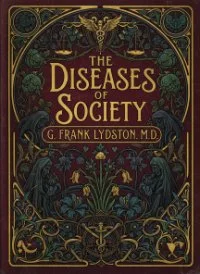
By George Frank Lydston. Introduction by Graeme R. Newman
In Diseases of Society (1903), George Frank Lydston—Chicago physician, professor, and one of the Progressive Era’s most provocative thinkers—delivers a bold diagnosis of the forces undermining modern civilization. With the precision of a clinician and the urgency of a social critic, Lydston argues that vice, crime, poverty, political corruption, and widespread sexual ignorance are not isolated failings but symptoms of a deeper “social pathology.”
From the hidden toll of alcohol abuse and venereal disease to the pressures of urban life and the roots of criminal behavior, Lydston dissects the moral and physical maladies of American society at the dawn of the twentieth century. His prescriptions—public health measures, honest governance, education, and pragmatic regulation—anticipate many of today’s harm-reduction and evidence-based approaches.
Both unsettling and strikingly forward-looking, Diseases of Society stands as a landmark work in early social medicine and criminology. It captures the anxieties of its age while illuminating challenges that remain uncannily familiar. For scholars of public health, social reform, criminology, and American urban history, Lydston’s analysis invites a fresh reconsideration of how societies fall ill—and how they might heal.The Vice and Crime Problem..
From the preface by the author: “Twenty-five years ago I witnessed a legal murder, — the hanging of two unfortunate youths condemned for an illegal murder. Neither was over twenty-one years of age. The assassination was unprovoked, unpremeditated and committed by stabbing….’They after better off dead,’ the law said.”
This modern version has been edited by Colin Heston, retaining some of the quaint spellings, but leaving most of the older medical terms as is. The footnotes have been removed to make the book more easy to read without distractions.
Lippincott (1904). Read-Me.Org Inc. New York-Philadelphia-Australia. 2025. p.442.