

Open Access Free Library
CRIME+CRIMINOLOGY.jpeg

CRIME

Violent-Non-Violent-Cyber-Global-Organized-Environmental-Policing-Crime Prevention-Victimization

Posts in Financial Regulation
Highway Robbery? A financial analysis of Design Build Finance and Operate in roads in the UK

Jean Shaoul, Anne Stafford and Pamela Stapleton

This paper examines empirically the financial outcomes of using private finance in roads under the UK government’s Private Finance Initiative (PFI) known as Design Build Finance and Operate (DBFO).

It refutes the government’s claim that private finance would lever in additional finance that it could not afford since in the three years for which information was available, the Highways Agency paid out more than the £590m construction cost of the projects.

It questions the claims of greater VFM over the life of the contracts than conventional procurement because: (i) the payment mechanism, based on the volume of traffic which has been rising, introduces additional costs for the public sector; (ii) DBFO seems to have been more costly than expected, thereby eroding the expected and very marginal cost advantage of DBFO; and (iii) the high cost of risk transfer.

Unpublished.
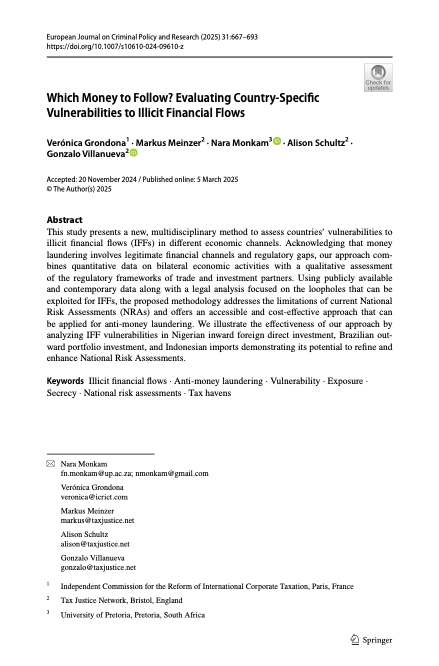
Which Money to Follow? Evaluating Country-Specific Vulnerabilities to Illicit Financial Flows 

By Verónica Grondona, Markus Meinzer, Nara Monkam, Alison Schultz, Gonzalo Villanueva

This study presents a new, multidisciplinary method to assess countries’ vulnerabilities to illicit financial flows (IFFs) in different economic channels. Acknowledging that money laundering involves legitimate financial channels and regulatory gaps, our approach combines quantitative data on bilateral economic activities with a qualitative assessment of the regulatory frameworks of trade and investment partners. Using publicly available and contemporary data along with a legal analysis focused on the loopholes that can be exploited for IFFs, the proposed methodology addresses the limitations of current National Risk Assessments (NRAs) and offers an accessible and cost-effective approach that can be applied for anti-money laundering. We illustrate the effectiveness of our approach by analyzing IFF vulnerabilities in Nigerian inward foreign direct investment, Brazilian outward portfolio investment, and Indonesian imports demonstrating its potential to refine and enhance National Risk Assessments