

By Annelieke Mooij
This open access book examines regulating an environment that has no jurisdiction, is fully anonymous and infinitely vast? Welcome to the Metaverse, an online virtual reality that is expected to add billions to the global economy. The Metaverse offers a new type of virtual economy with practically endless business opportunities. The question is how to prevent these opportunities from being abused to commit money laundering and finance terrorism (MLFT).
This book explores the current European Union legislation designed to prevent MLFT in connection with the Metaverse. It analyses the legislation in relation to the three traditional stages of MLFT: placement, layering and integration. Furthermore, some additional risks specific to the Metaverse are discussed, such as Non-Fungible Tokens (NFTs) and the high level of anonymity. The book concludes that the current legislation is not suitable for facing the new challenges of the Metaverse.
In turn, the book puts forward a novel approach to regulating and enforcing MLFT legislation: using a system of smart assets equipped with AI to prevent and detect MLFT. In addition, it makes recommendations on how to improve the legal framework with regard to the new challenges arising from the Metaverse. Particular attention is given to creating a legal framework that incorporates the use of smart assets and the Internet of Things, in order to provide a safe environment for potential users and society.
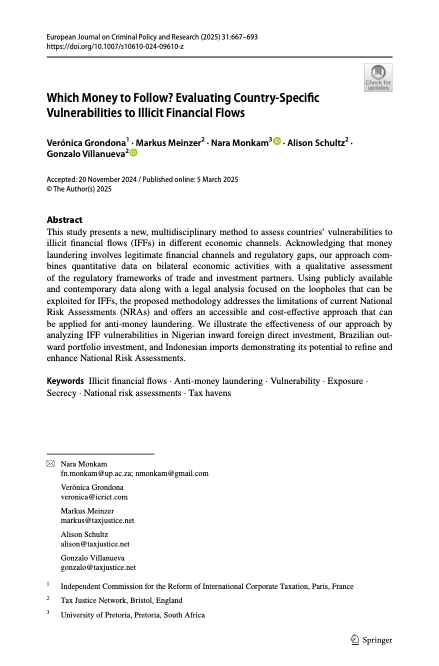
By Verónica Grondona, Markus Meinzer, Nara Monkam, Alison Schultz, Gonzalo Villanueva
This study presents a new, multidisciplinary method to assess countries’ vulnerabilities to illicit financial flows (IFFs) in different economic channels. Acknowledging that money laundering involves legitimate financial channels and regulatory gaps, our approach combines quantitative data on bilateral economic activities with a qualitative assessment of the regulatory frameworks of trade and investment partners. Using publicly available and contemporary data along with a legal analysis focused on the loopholes that can be exploited for IFFs, the proposed methodology addresses the limitations of current National Risk Assessments (NRAs) and offers an accessible and cost-effective approach that can be applied for anti-money laundering. We illustrate the effectiveness of our approach by analyzing IFF vulnerabilities in Nigerian inward foreign direct investment, Brazilian outward portfolio investment, and Indonesian imports demonstrating its potential to refine and enhance National Risk Assessments
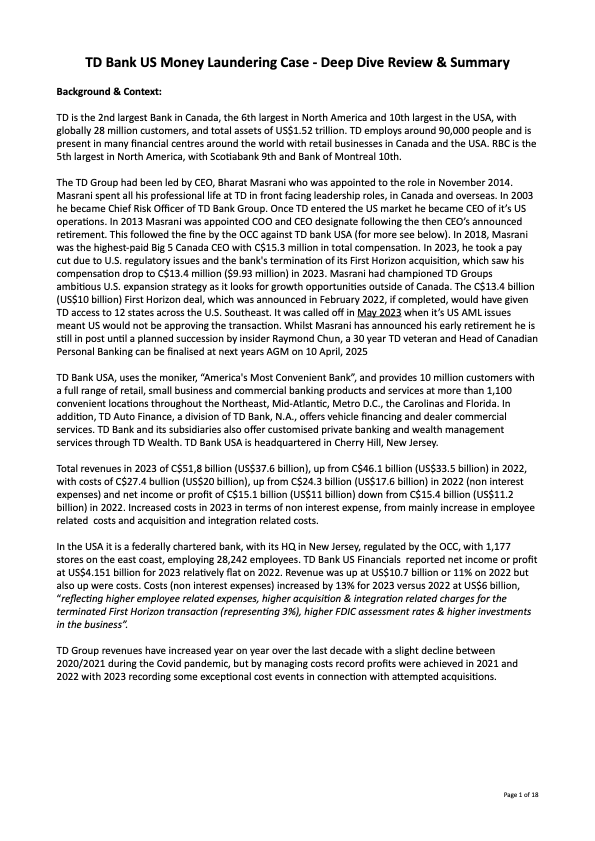
By Financial Crime News
Background & Context: TD is the 2nd largest Bank in Canada, the 6th largest in North America and 10th largest in the USA, with globally 28 million customers, and total assets of US$1.52 trillion. TD employs around 90,000 people and is present in many financial centres around the world with retail businesses in Canada and the USA. RBC is the 5th largest in North America, with Scotiabank 9th and Bank of Montreal 10th. The TD Group had been led by CEO, Bharat Masrani who was appointed to the role in November 2014. Masrani spent all his professional life at TD in front facing leadership roles, in Canada and overseas. In 2003 he became Chief Risk Officer of TD Bank Group. Once TD entered the US market he became CEO of it’s US operations. In 2013 Masrani was appointed COO and CEO designate following the then CEO’s announced retirement. This followed the fine by the OCC against TD bank USA (for more see below). In 2018, Masrani was the highest-paid Big 5 Canada CEO with C$15.3 million in total compensation. In 2023, he took a pay cut due to U.S. regulatory issues and the bank's termination of its First Horizon acquisition, which saw his compensation drop to C$13.4 million ($9.93 million) in 2023. Masrani had championed TD Groups ambitious U.S. expansion strategy as it looks for growth opportunities outside of Canada. The C$13.4 billion (US$10 billion) First Horizon deal, which was announced in February 2022, if completed, would have given TD access to 12 states across the U.S. Southeast. It was called off in May 2023 when it’s US AML issues meant US would not be approving the transaction. Whilst Masrani has announced his early retirement he is still in post until a planned succession by insider Raymond Chun, a 30 year TD veteran and Head of Canadian Personal Banking can be finalised at next years AGM on 10 April, 2025 TD Bank USA, uses the moniker, “America's Most Convenient Bank”, and provides 10 million customers with a full range of retail, small business and commercial banking products and services at more than 1,100 convenient locations throughout the Northeast, Mid-Atlantic, Metro D.C., the Carolinas and Florida. In addition, TD Auto Finance, a division of TD Bank, N.A., offers vehicle financing and dealer commercial services. TD Bank and its subsidiaries also offer customised private banking and wealth management services through TD Wealth. TD Bank USA is headquartered in Cherry Hill, New Jersey. Total revenues in 2023 of C$51,8 billion (US$37.6 billion), up from C$46.1 billion (US$33.5 billion) in 2022, with costs of C$27.4 bullion (US$20 billion), up from C$24.3 billion (US$17.6 billion) in 2022 (non interest expenses) and net income or profit of C$15.1 billion (US$11 billion) down from C$15.4 billion (US$11.2 billion) in 2022. Increased costs in 2023 in terms of non intere
By Kathryn Westmore and Georgia Jones
To answer this question, the Centre for Finance and Security at RUSI convened a virtual roundtable in September 2025 to discuss how football clubs, players and agents are vulnerable to money laundering and the benefit of any potential regulatory response. Participants were drawn from the public sector, the private sector, academia and civil society and included those with first-hand experience of issues relating to money laundering, financial crime and compliance within professional sports.
By Michael E. Clements, Triana McNeil et al
What GAO Found Mexican transnational criminal organizations are a major supplier of the top two illicit synthetic drugs involved in overdose deaths in the U.S.—fentanyl and methamphetamine. To supply these drugs to U.S. users, these organizations • source and purchase precursor chemicals primarily from China, using payment methods such as electronic funds transfers and virtual currency; • produce or oversee the production of fentanyl and methamphetamine in clandestine labs in Mexico; and • smuggle the drugs across the U.S.-Mexico border and supply them to U.S.- based drug trafficking groups. Local drug trafficking groups sell these drugs to users through e-commerce platforms, online marketplaces, mobile applications, and social media using payment methods such as cash, peer-to-peer payment applications, and virtual currency, according to Financial Crimes Enforcement Network (FinCEN) and Drug Enforcement Administration (DEA) reports. Transnational criminal organizations launder the illicit proceeds from synthetic drug sales using methods such as • bulk cash smuggling (moving physical currency across international borders), • funnel accounts (bank accounts that collect deposits from members of the criminal network in multiple locations), • trade-based money laundering (using goods in trade transactions to disguise the movement of illicit funds), • virtual currency (exchanging bulk cash for virtual currency), and • Chinese money laundering networks. Chinese money laundering networks are largely decentralized and use both underground-banking mechanisms (which bypass formal banking channels) and other laundering methods within banking systems to convert, move, and obscure illicit proceeds for a fee. Mexican transnational criminal organizations are increasingly using these networks in part because their laundering schemes have lower costs than other organizations, according to law enforcement officials. To combat drug trafficking and related money laundering, federal agencies coordinate and share information with each other and with state, local, and international partners through task forces, working and advisory groups, colocation, and other information-sharing channels. These mechanisms help agencies share resources and expertise, prevent overlapping investigations, and combine unique authorities. In addition, starting on January 20, 2025, the administration began instituting a variety of new policies, including some aimed at combating the flow of synthetic drugs into the U.S. For example, ExecutiveOrder 14159 requires the Departments of Justice and Homeland Security to jointly establish Homeland Security Task Forces in all 50 states to end the presence of cartels and transnational criminal organizations in the U.S. Agencies reported that it is too early to assess the full impact of these policies.
Washington, DC: United States Government Accountability Office; 67pp; 2025. 67p.