Open Access Free Library
CRIME+CRIMINOLOGY.jpeg

CRIME

Violent-Non-Violent-Cyber-Global-Organized-Environmental-Policing-Crime Prevention-Victimization

Posts in Violence Prevention
Do females known for online child sexual exploitation differ from males? Group characteristics and recidivism

By Erika Fortunato, Reneta Slikboer, Marie Henshaw, Denny Meyer and James RP Oglof

Abstract | Despite increasing research on online child sexual exploitation, limited research compares female and male perpetrators. This study examined 116 females and 116 age-matched males known to police for online child sexual exploitation on group characteristics and risk of reoffending. Some differences emerged, with females co-offending and experiencing violent victimisation more often thanmales. However, several similarities were also apparent, including that females and males had similar risk of recidivism. These findings have implications for policy and highlight several important avenues for future research.

The relationship between pornography use and sexual violence in Australian men

By Christopher Dowling and Laura Doherty

The production and availability of pornography has increased dramatically over the past few decades. Concerns have been raised regarding pornography’s influence on sexual violence, particularly among men, who constitute the majority of its audience. While a vast body of research has examined the association between pornography use and sexual violence, questions remain regarding the strength of this association, including among Australian men, and its underlying mechanisms.

Drawing on the survey responses of almost 2,000 Australian heterosexual cisgender men, the current study examined the association of intentional pornography viewing across the life course and self-reported sexual violence perpetration in the 12 months preceding survey completion. It also examined the extent to which this association is mediated by pornography’s effect on respondents’ attitudes towards sex and women. Findings show that more frequent intentional viewing of violent pornography is associated with a small but statistically significant increase in the probability of having perpetrated sexual violence. Meanwhile, the probability of perpetrating sexual violence does not significantly change with an increase in the intentional viewing of any (ie violent or non-violent) pornography. Furthermore, a portion of the relationship between the frequency of intentional violent pornography viewing and sexual violence perpetration is mediated by the degree to which respondents exhibit a promiscuous, emotionally detached orientation towards sex and hostile attitudes towards women. However, the importance of these mediators varies between respondents. This study provides valuable information to inform measures to prevent and counteract any potential negative impacts of violent pornography on sexual behaviour.


The impacts of CCTV on victim-survivors of domestic and family violence

By Diarmaid Harkin, Mary Iliadis, Jessica Woolley, Marilyn McMahon and Karen Bentley

Victim-survivors of domestic and family violence (DFV) are increasingly using closed-circuit television (CCTV) systems. To date, the impacts of CCTV systems on victim survivors have been unclear. This paper presents the findings from a world-first study into how victim survivors of DFV experience the use of CCTV systems. It draws on a national survey of 125 DFV support practitioners and 28 in-depth interviews (including with 9 victim-survivors). The findings demonstrate that CCTV can have beneficial impacts on the wellbeing of victim-survivors by providing a sense of safety and security but also carries risks, including that victim-survivors will become hypervigilant.victim-survivors of domestic and family violence (DFV) are increasingly using closed-circuit television (CCTV) systems. To date, the impacts of CCTV systems on victim survivors have been unclear. This paper presents the findings from a world-first study into how victim survivors of DFV experience the use of CCTV systems. It draws on a national survey of 125 DFV support practitioners and 28 in-depth interviews (including with 9 victim-survivors). The findings demonstrate that CCTV can have beneficial impacts on the wellbeing of victim-survivors by providing a sense of safety and security but also carries risks, including that victim-survivors will become hypervigilant.

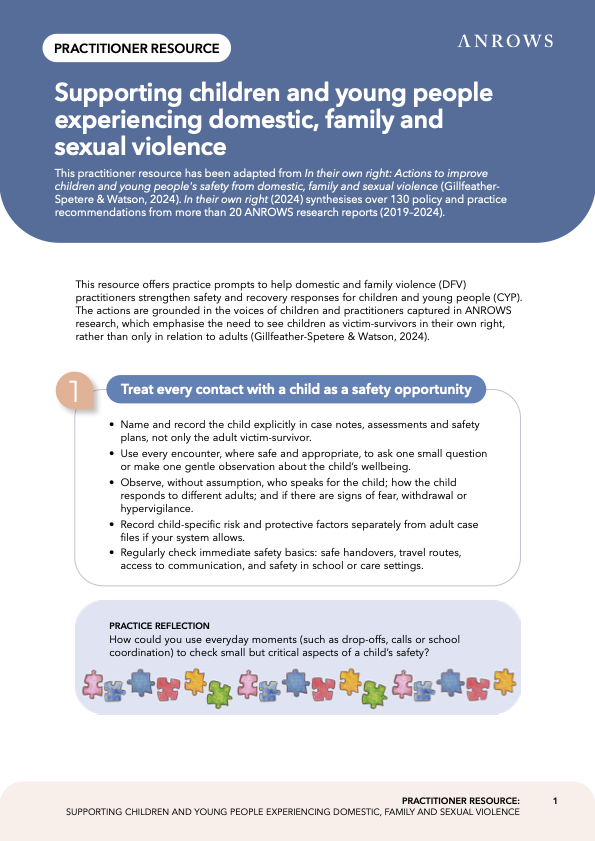
Supporting children and young people experiencing domestic, family and sexual violence

By The Australian National Research Organisation for Women's Safety ( ANROWS)

This resource supports frontline workers to strengthen safety and recovery responses for children and young people experiencing domestic, family and sexual violence. Focused on translating evidence into everyday practice, the resource is particularly relevant for practitioners working in regional and rural contexts, where service gaps, confidentiality risks and workforce pressures shape how support is delivered.