


By Diarmaid Harkin, Mary Iliadis, Jessica Woolley, Marilyn McMahon and Karen Bentley
Victim-survivors of domestic and family violence (DFV) are increasingly using closed-circuit television (CCTV) systems. To date, the impacts of CCTV systems on victim survivors have been unclear. This paper presents the findings from a world-first study into how victim survivors of DFV experience the use of CCTV systems. It draws on a national survey of 125 DFV support practitioners and 28 in-depth interviews (including with 9 victim-survivors). The findings demonstrate that CCTV can have beneficial impacts on the wellbeing of victim-survivors by providing a sense of safety and security but also carries risks, including that victim-survivors will become hypervigilant.victim-survivors of domestic and family violence (DFV) are increasingly using closed-circuit television (CCTV) systems. To date, the impacts of CCTV systems on victim survivors have been unclear. This paper presents the findings from a world-first study into how victim survivors of DFV experience the use of CCTV systems. It draws on a national survey of 125 DFV support practitioners and 28 in-depth interviews (including with 9 victim-survivors). The findings demonstrate that CCTV can have beneficial impacts on the wellbeing of victim-survivors by providing a sense of safety and security but also carries risks, including that victim-survivors will become hypervigilant.
By Katrina Scurrah, Swen Kuh, Mulu Woldegiorgis, Catherine Andersson, Sean Martin
Using data from Wave 1 (2013–14) and Wave 4 (2022) of Ten to Men: The Australian Longitudinal Study on
Male Health, we found: Higher-risk alcohol use was associated with men starting to use intimate partner violence (IPV) over time. Men with hazardous drinking at Wave 1 were 27% more likely to initiate IPV by Wave 4 than low-risk drinkers; men with harmful use or possible dependence were 57% more likely. The relationship between alcohol use and IPV was similar across the different forms of IPV measured (emotional-type abuse, physical violence and sexual abuse) and was strongest for the use of physical IPV. Men with harmful use/possible dependence had around double the risk (119%) of initiating physical IPV than low-risk drinkers.
How much men drank in a typical session mattered more than how often they drank. Men who typically drank 10+ standard drinks were 55% more likely to initiate IPV than non-drinkers; drinking frequency and age at first drink were not linked to later IPV initiation.
Overall scores for conformity to masculine norms were not associated with IPV initiation but some specific norms were. Higher scores on the measure, used in Wave 1, for the domains of playboy, violence and risk taking were associated with starting to use IPV. In contrast, patterns combining emotional openness, self-reliance and primacy of work were associated with a lower likelihood of starting to use IPV. Another masculinity-related scale that assessed gender-role identity was used in Wave 4 and there was no clear association with the use of IPV. There was little evidence that self-reported masculinities changed the strength of the relationship between alcohol use and IPV initiation. Higher-risk drinking was linked to IPV regardless of the strength between alcohol use and IPV initiation. Higher-risk drinking was linked to IPV regardless of the strength of conformity to these masculine norms. The combined highest-risk group (harmful/probable alcohol dependence plus high scores on the masculine norms measure used at Wave 1) showed at most a modest additional increase in risk of IPV use compared with either high alcohol risk or stronger conformity to specific masculine norms alone.
These findings suggest the following could enhance policy and practice to support IPV prevention efforts: Use alcohol harm reduction as a practical lever for IPV prevention. Strengthen routine alcohol screening and brief intervention/referral pathways in settings that see large numbers of men (primary care, mental health and community services), with clear, safe escalation pathways where IPV risk is identified. Prioritise indicators of heavier drinking in risk identification for IPV initiation. Policies and practice guidance should focus on current severity/patterns rather than drinking frequency alone for men, as these were the measures most predictive of later use of IPV. Target the specific masculine norms associated with IPV use. While this report found little evidence that these norms change the strength of the alcohol–IPV association, the highest observed risks tended to be among men with both higher-risk drinking and higher-risk masculine norm profiles. This suggests prevention and behaviour-change approaches may be particularly valuable when targeted to men already identified as higher risk (e.g. through alcohol-related risk) and should address norms related to violence acceptance, risk taking, sexual entitlement and status/power, and build skills such as emotion regulation and non-violent conflict management – integrated with alcohol-focused interventions where relevant. Taken together, these findings point to the potential value of coordinated alcohol and other drugs–family and domestic violence (AOD–FDV) pathways, rather than separate, parallel responses. This includes alcohol interventions that incorporate safe identification of family violence risk and enable appropriate referral, as well as specialist programs that address both alcohol-related harm and relevant attitudes and behaviours as part of a tailored response.

by Graeme Newman (Author), Sheldon Glueck (Author)
When a court asks whether a defendant was too mentally ill to be responsible, whose knowledge should decide it: the judge's, the jury's, or the doctor's? A reader's guide to the 1925 book that first mapped the whole problem.
In 1925, a young Harvard scholar named Sheldon Glueck published Mental Disorder and the Criminal Law, a study of nearly seven hundred pages on how American courts handle the mentally ill accused. It appeared while the country was arguing over Leopold and Loeb, over rising murder rates, and over Chief Justice Taft's charge that criminal justice was a disgrace to civilization. Glueck asked how courts find out that a defendant is mentally ill, how the legal tests of insanity were made, what psychiatry actually says about the main mental disorders, and what becomes of defendants who are acquitted. His answer was that the law had cut the mind into separate compartments of knowing, feeling and willing, and that reform had to begin with the unity of the mind.
The book is long, technical and dense with footnotes. This Reader's Guide makes it accessible without replacing it. It explains the argument in plain language, supplies the legal and medical background a modern reader may lack, and shows where the reasoning is strong and where it is open to question.
INSIDE THIS GUIDE
A reading plan and a chapter-by-chapter map of the original
The pretrial-examination law of Massachusetts and what its first 113 examinations found
How the tests of insanity were made, from Hale and the "wild beast" to M'Naghten and the American courts
The argument that mental processes are a unity, and why it undercuts the old tests
A table of the main mental disorders of 1925 and what each meant for criminal responsibility
What happens to defendants acquitted by reason of insanity, and the fight over release
Glueck's program: neutral experts, a new jury charge, a verdict of partial responsibility, and a commission to decide treatment after conviction
A worked example that applies his 1925 jury charge to three imaginary defendants
What has changed since 1925, from Durham to the Insanity Defense Reform Act, and the eugenics assumptions the book shared with its time
Five common misreadings, a primer of legal terms, a glossary, an annotated reading list, an FAQ, 26 discussion questions and classroom activities
WHO IT'S FOR
Students of law, criminology, psychology, psychiatry and history; teachers and reading groups; and general readers who want to know how the insanity defense came to be the way it is.
PLEASE NOTE
This is an independent guide, not an abridgment or edition of Glueck's book. It does not reproduce the original's text and is not endorsed by the author's heirs or the original publisher. It is meant to be read alongside the original. Download the original book.
Written by Graeme R. Newman with the assistance of Claude, an AI model made by Anthropic. The AI-generated content is disclosed in accordance with Read-Me.Org policy.
Read-Me.Org Inc. New York-Philadelphia-Australia. 2026. p.64.

by Graeme Newman (Author), Sheldon Glueck (Author)
If a man kills because he is certain his victim is plotting against him, and he knows killing is against the law, is he responsible?
In 1962, Sheldon Glueck of the Harvard Law School gave four lectures at Tulane University on one of the hardest questions in criminal law: where to draw the line between the wicked and the ill. Law and Psychiatry: Cold War or Entente Cordiale? reviews the tests of legal insanity, says what is wrong with each, proposes a new one, and argues that lawyers and psychiatrists are quarreling over too small a prize.
This Reader's Guide explains his arguments in plain language, supplies the legal background, and shows what has changed since. Inside are a lecture map, a worked example applying six tests to three imaginary defendants, common misreadings, and discussion questions.
A companion to the original, for students, teachers and curious readers. Download the original book.
Read-Me.Org Inc. New York-Philadelphia-Australia. 2026. p.64.
By The Australian Human Rights Commission
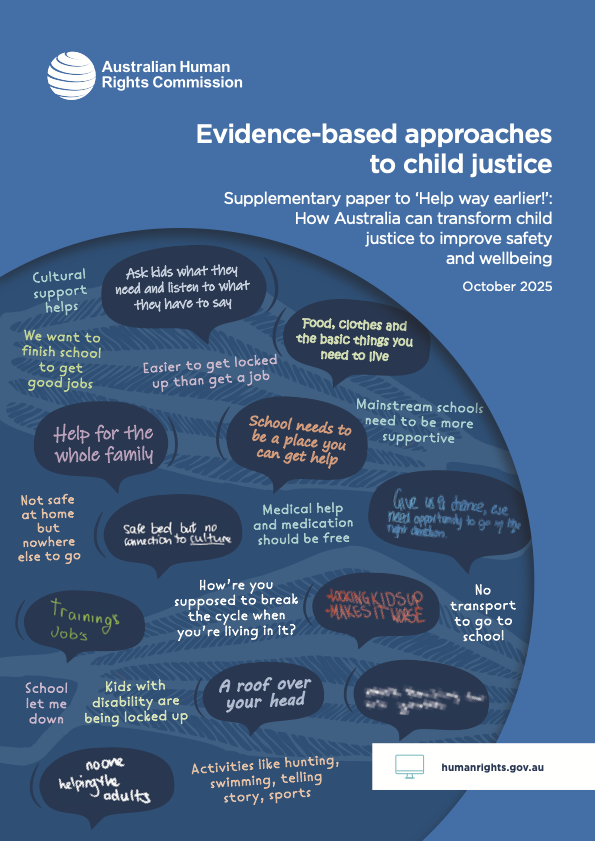
This report contains six case studies from Australia and around the world that are examples of evidence-based approaches to reforming child justice systems. It shows how primary prevention, early intervention, integrated services and therapeutic community-based approaches that emphasise family and cultural connections can transform outcomes for children.

By North Carolina Criminal Justice Analysis Center
This report examines patterns of firearm violence across North Carolina over the most recent five-year period, with attention to variation across rural, urban, and suburban communities. The analysis identifies clear temporal trends and significant demographic and geographic disparities that can inform targeted prevention and policy responses.
Firearm homicide increased sharply beginning in 2019, rising 72 percent statewide and peaking in 2021. Since that peak, firearm homicides have declined by 29 percent through mid-2025. Non-fatal shootings followed a similar trajectory, indicating a broader surge and subsequent reduction in interpersonal firearm violence.
In contrast, firearm suicide represents a larger and growing share of firearm-related deaths. From 2019 to 2023, firearm suicides exceeded homicides statewide, with consistent annual increases since 2014. Risk is concentrated among older adults, particularly men aged 65 and older in rural areas, aligning with broader national trends.
Young adults face the highest risk of interpersonal firearm violence. Individuals aged 20–24 consistently experience the highest rates across homicide, non-fatal shootings, and other firearm-related crimes, with elevated risk also observed among those aged 15–19 and 25–29. This pattern highlights the transition to adulthood as a critical period for intervention.
Substantial racial and ethnic disparities persist. Black, non-Hispanic individuals experience the highest rates of interpersonal firearm violence statewide, with particularly high rates in rural areas. American Indian and Alaska Native individuals also face disproportionately high victimization relative to their population size. Hispanic individuals experience comparatively higher victimization rates in urban counties.
Geographic differences are pronounced. Rural counties exhibit the highest overall rates across multiple forms of firearm violence, including homicide, suicide, non-fatal shootings, and unintentional deaths, particularly following the 2021 spike. While urban counties have similar cumulative firearm homicide totals over the five-year period, they report substantially higher levels of other firearm-related crime and lower rates of firearm suicide. Suburban counties consistently show the lowest rates of interpersonal firearm violence but have higher firearm suicide rates than urban areas.
Overall, the findings underscore the need for differentiated strategies that address both interpersonal firearm violence and suicide, with targeted approaches for high-risk populations and communities.

By Bernard Glueck. Designed and Edited with an Introduction by Graeme R. Newman and Claude.
In 1916, psychiatrist Bernard Glueck made a case that was still radical for its time: that prisons and asylums needed trained psychiatrists on staff, not as outside consultants, but as clinicians embedded in the institution itself. Writing from the criminal department of the Government Hospital for the Insane in Washington, D.C., Glueck laid out five detailed case studies that argued, one patient at a time, for a new way of understanding the criminal mind.
Inside, you'll find:
A clinical study of psychogenic psychosis in prisoners — the theory that mental breakdown behind bars is often a meaningful reaction to arrest, trial, and confinement, not simply organic illness
An extended case-by-case analysis of malingering, and the difficult problem of separating feigned symptoms from genuine mental illness
A study of "litigious paranoia" — the compulsive, self-representing plaintiff who turns the courtroom into an extension of his delusion
A landmark early psychoanalytic case history of kleptomania
Glueck went on to found the first psychiatric clinic ever established inside an American prison, at Sing Sing, and later served as a psychiatric expert in the Leopold and Loeb trial. He was also the elder brother of criminologist Sheldon Glueck — making this book a companion volume to Read-Me.Org's editions of War Criminals and Probation and Criminal Justice.
This new edition includes a substantial original introduction by Graeme R. Newman, assessing Glueck's century-old argument against the present day: what holds up in modern correctional psychiatry, what doesn't, and a hard look at whether American prisons have actually delivered on the promise Glueck was making in 1916 — including current data on the ongoing shortage of psychiatric staffing across U.S. correctional systems.
A Read-Me.Org Classic Reprint. This is a corrected and reformatted edition of the 1916 first edition (Little, Brown, and Company), prepared from a public domain source text under a Creative Commons Attribution 4.0 International License. AI-assisted tools were used in the production of this edition, as disclosed on our website.
Read-Me.Org Inc. New York-Philadelphia-Australia. 2026. p.165.
By Heidi Mathis,
The purpose of this quantitative study was to compare the characteristics of offenders who posted on social media for attention versus those who posted on social media for fame using discriminant factorial analysis (DFA). To date, there has been very little research done on social media usage with regards to mass shootings. The wealth of the research close to the study at hand has to do with not naming the offender and the media contingency effect. The current research helped close some of that gap. Researching social media usage and mass shootings showed how the variables: location, rejection, mental health history, criminal history, how weapons were obtained, how the offender(s) were apprehended, household status, education, and whether the offender killed family members relate to criminality. This was in line with the framework for this study, anomie, and strain theory. Out of 300 cases analyzed, 72 were chosen that contained all the variables being analyzed in this study. The results of this study were not significant. The variables did not significantly differentiate the mass shooting offenders who posted for attention versus those who posted for fame. This study may be used by forensic experts for positive social change by understanding social media statements made by mass shooters.
By Jessica Pandian
Through foregrounding the circumstances of seven deaths in women’s prisons and highlighting issues which have persisted for decades, this report provides further evidence that the women’s prison estate is – and for decades has been – incapable of adequate reform. An analysis of the deaths reveals the key thematic issues, which fall under three categories: 1. not believing prisoners in crisis and at risk, 2. failings in prison processes, and 3. imprisonment as the default to social inequality. Lastly, the report provides a statistical analysis of deaths and self-harm in women’s prison from 2018 - 2024If we do not address the current prison crisis and reflect on its harmful impact, it is inevitable that more people will be exposed to the harms of the prison environment and die. This report is a blunt reminder to the Government to act now by committing to dismantle the women’s estate and halt all prison building.
This report exposes the successive failures of reforms, strategies and frameworks introduced in the policy around women’s prisons in England and Wales since the launch of the Ministry of Justice’s Female Offender Strategy in 2018.1 The strategy’s intended purpose was to improve lived conditions in women’s prisons and reduce the women’s prison population. 2018 also marks the year in which INQUEST published 'Still Dying on the Inside', 2 the third INQUEST publication providing unique insight into deaths in women’s prisons.
By OFFICE OF INSPECTOR GENERAL OF THE NEBRASKA CORRECTIONAL SYSTEM; Doug Koebernick, Inspector General Zach Pluhacek, Assistant Inspector General
This report by the Office of Inspector General of the Nebraska Correctional System (OIG) explores five areas of interest and/or concern related to mental health services within Nebraska Department of Correctional Services (NDCS) facilities. The findings and recommendations in this report resulted from more than a year of examination of the NDCS mental health system. This work began in early 2024, after NDCS moved to consolidate almost all of its inpatient mental health beds for men from across the system into the Reception and Treatment Center (RTC) in Lincoln. The change – which was directed by NDCS administration, not mental health officials – prompted complaints from patients and their advocates about the living conditions and how this disruption had impacted their mental health. Through interactions with more patients and providers, additional matters came to the OIG’s attention. Although not an exhaustive list, the five topics addressed in this report were selected based on 1) how frequently they were mentioned by people in the system, including patients and staff; 2) the significance of their impact on the system; and 3) their relevance to the Legislature, based on existing statutes and past legislative engagements in this area. These five topics are as follows: 1. Staffing. NDCS mental health services are in a longstanding staffing crisis, which appear more significant than the staffing challenges facing the overall behavioral health industry, including other state-run institutions. However, NDCS appears to be making some progress in this area. 2. Living conditions. The OIG fielded a variety of complaints about the living conditions in NDCS mental health units, including the use of custody restraints, limited out-of-cell time, and quality of facilities. Some of these conditions may be improving with new facilities, management changes and better custody/security staffing, but concerns remain. 3. Restrictive housing for seriously mentally ill individuals. State statute prohibits placing seriously mentally ill people in longer-term restrictive housing. However, NDCS’ interpretation and implementation of statute results in many people with serious mental illnesses being placed in these settings, anyway. 4. Discharge review. State statute also requires NDCS to have “evidence-based criteria” for screening people nearing release who are mentally ill and dangerous and may require civil commitment. However, it is unclear whether an evidence-based tool even exists for such a purpose. 5. Programming for high-risk individuals. There is a general lack of structured, clinical treatment programming available for individuals in high-security settings. NDCS terminated its version of the Violence Reduction Program (VRP), intended for those at high risk for violence, in early 2024 and has yet to identify a replacement. More specific findings are included in each section of this report. The report concludes with a summary of these findings, as well as recommendations for NDCS and the Legislature to consider. The OIG appreciates the efforts of NDCS mental health providers, administrators, and others involved in this area of the correctional system. Although this report provides a broad (and, hopefully, instructive) look at NDCS mental health services, it is not intended to serve as a comprehensive review. It is hoped that these findings and recommendations will help further the Department’s own efforts at improving this system as well as the Legislature’s role in assisting and guiding that process through policy.
By Michael Rempel, Krystal Rodriguez, and Kellyann Bock
As New York City works toward its mandate to close Rikers Island, addressing the mental health needs of people detained in the jail system remains a central challenge—and a defining opportunity for reform. Developed by the Data Collaborative for Justice at John Jay College and the Katal Center for Equity, Health, & Justice, this report brings together the latest mental health data for people held at Rikers, lived-experience insights from directly impacted people, and a 15-point plan to create a more effective and humane path forward.
Grounded in evidence, the report aims to:
Present updated data on the nature and scale of mental health needs among people held in the NYC jails.
Give a voice to the people behind the numbers through select first-person accounts that highlight systemic gaps and unmet needs.
Identify a continuum of safe and effective jail diversion strategies that can reduce the jail population while strengthening care, stability, and long-term public safety.
Taken together, this report offers a roadmap to reduce the number of people with serious mental health needs detained at Rikers and to strengthen NYC’s continuum of care.
By Falcon Correctional & Community Services, Inc
The Wisconsin Department of Corrections (WIDOC) Division of Adult Institutions (DAI) has long served the Wisconsin community with its three stated goals: • WIDOC works to protect the public through the constructive management of those placed in its charge. • WIDOC offers education, programming, and treatment to persons in WIDOC’s care that enables them to be successful upon returning to the community. • WIDOC’s mission is to achieve excellence in correctional practices while fostering safety for victims and communities. The WIDOC Executive Leadership Team sought outside assistance to conduct a comprehensive system-wide assessment of correctional, mental health, and physical health operations and practices, with a particular focus on restrictive housing and organizational culture. The project, initiated through discussions with Secretary Jared Hoy and his executive team, was designed to build upon recent reform efforts and respond to persistent staffing and operational challenges. The study used a multi-method approach that included data requests and analyses, staff interviews, workshops with DAI staff and other key stakeholders, site visits, interviews with incarcerated individuals, and policy reviews. The central objectives of the study were to (1) identify areas of strength that could be expanded upon throughout the department, (2) identify areas requiring improvements, and (3) provide actionable, evidence-based, and sustainable recommendations to achieve both short-term and long-term success. This independent assessment was conducted by an interdisciplinary team of Falcon Correctional and Community Services, Inc. (“Falcon, Inc.” or “Falcon”) experts with expertise in the administration of state prison operations, correctional medical and behavioral health practices, the assessment of criminogenic risk, large-scale system studies, and restrictive housing reform. The purpose of this independent evaluation was to serve as a tool to collectively understand, navigate, and prioritize recommendations for system improvements. Falcon would like to thank everyone at WIDOC for their assistance throughout this study. The time commitment was significant, from responding to data requests, organizing and facilitating site visits, and participating in workshops to providing the information necessary to complete this important project. We also thank you for the important work you do for the individuals in your care, your staff, and the Wisconsin community.Inc.
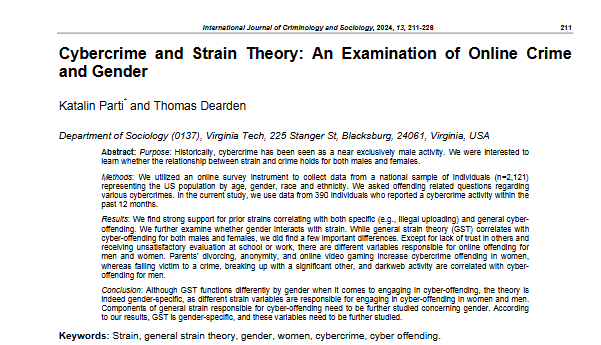
By Katalin Parti, Thomas Dearden
Purpose: Historically, cybercrime has been seen as a near exclusively male activity. We were interested to learn whether the relationship between strain and crime holds for both males and females.
Methods: We utilized an online survey instrument to collect data from a national sample of individuals (n=2,121) representing the US population by age, gender, race and ethnicity. We asked offending related questions regarding various cybercrimes. In the current study, we use data from 390 individuals who reported a cybercrime activity within the past 12 months.
Results: We find strong support for prior strains correlating with both specific (e.g., illegal uploading) and general cyber-offending. We further examine whether gender interacts with strain. While general strain theory (GST) correlates with cyber-offending for both males and females, we did find a few important differences. Except for lack of trust in others and receiving unsatisfactory evaluation at school or work, there are different variables responsible for online offending for men and women. Parents’ divorcing, anonymity, and online video gaming increase cybercrime offending in women, whereas falling victim to a crime, breaking up with a significant other, and darkweb activity are correlated with cyber-offending for men.
Conclusion: Although GST functions differently by gender when it comes to engaging in cyber-offending, the theory is indeed gender-specific, as different strain variables are responsible for engaging in cyber-offending in women and men. Components of general strain responsible for cyber-offending need to be further studied concerning gender. According to our results, GST is gender-specific, and these variables need to be further studied.
International Journal of Criminology and Sociology, 13, 211–226

By Arthur MacDonald.
The narrative in Volume 1 asks many pointed questions: What does it mean to be “abnormal”? Who decides? And how have these judgments shaped modern science, education, and criminal justice?
First published in 1893, Arthur MacDonald’s Abnormal Man is one of the earliest American attempts to systematically study human difference through the emerging tools of psychology, anthropology, and criminology. Drawing on international research—from European criminal anthropology to American child-study movements—MacDonald sought to classify the physical, mental, and moral traits considered “aberrant” in his era. His work reflects the hopes and anxieties of a society confronting rapid industrialization, immigration, social change, and new scientific approaches to crime and mental health.
To the modern reader, Abnormal Man reveals both the ambition and the pitfalls of nineteenth-century science. Its pages contain pioneering observations about child development, deviance, and social responsibility, alongside early theories—now discredited—about heredity, physiognomy, and race. What emerges is a vivid and sometimes unsettling portrait of a culture striving to understand human variation without the benefit of modern psychology or ethical safeguards.
The Read-Me.org edition Volume 1 presents Abnormal Man as both a historical artifact and a gateway to critical reflection. It illustrates how scientific thought evolves, how cultural bias can shape research, and how early debates about abnormality laid the groundwork for contemporary approaches to mental health, special education, criminology, and social policy. To make such work, much of it controversial then as it is today, minimally believable, requires extensive documentation. The voluminous Bibliography of Abnormal Man reproduced here in Volume 2, contains all that Macdnald referred to within his detailed exposition. To some, his arguments may seem unsupported, or lacking in evidence. But he left no stone untuned as this amazing bibliographical documentation of all relative contemporary research
A foundational text at the crossroads of science and society, Abnormal Man invites readers to explore the origins of modern debates about deviance, diversity, and the boundaries of the “normal.”
Read-Me.Org Inc. New York-Philadelphia-Australia. 2025. 240p.

By Arthur MacDonald. Introduction by Graeme R. Newman
What does it mean to be “abnormal”? Who decides? And how have these judgments shaped modern science, education, and criminal justice?
First published in 1893, Arthur MacDonald’s Abnormal Man is one of the earliest American attempts to systematically study human difference through the emerging tools of psychology, anthropology, and criminology. Drawing on international research—from European criminal anthropology to American child-study movements—MacDonald sought to classify the physical, mental, and moral traits considered “aberrant” in his era. His work reflects the hopes and anxieties of a society confronting rapid industrialization, immigration, social change, and new scientific approaches to crime and mental health.
To the modern reader, Abnormal Man reveals both the ambition and the pitfalls of nineteenth-century science. Its pages contain pioneering observations about child development, deviance, and social responsibility, alongside early theories—now discredited—about heredity, physiognomy, and race. What emerges is a vivid and sometimes unsettling portrait of a culture striving to understand human variation without the benefit of modern psychology or ethical safeguards.
This new Read-Me.org edition presents Abnormal Man as both a historical artifact and a gateway to critical reflection. It illustrates how scientific thought evolves, how cultural bias can shape research, and how early debates about abnormality laid the groundwork for contemporary approaches to mental health, special education, criminology, and social policy.
A foundational text at the crossroads of science and society, Abnormal Man invites readers to explore the origins of modern debates about deviance, diversity, and the boundaries of the “normal.”
Read-Me.Org Inc. New York-Philadelphia-Australia. 2025. p.193.

By Matthew Bonn, Chelsea Cox, Marilou Gagnon. et al.
The International Guidelines on Human Rights and Drug Policy recommend that States commit to adopting a balanced, integrated, and human rights-based approach to drug policy through a set of foundational human rights principles, obligations arising from human rights standards, and obligations arising from the human rights of particular groups. Following two years of consultation with stakeholders, including people who use drugs, NGOs, legal and human rights experts, UN technical agencies and Member States, the Guidelines “do not invent new rights. Rather, they apply existing human rights law to the legal and policy context of drug control to maximise human rights protections, including in the interpretation and implementation of the drug control conventions.” In respect of the Guidelines and its obligations under UN human rights treaties, Canada must adopt stronger and more specific commitments for a human rights-based, people centered and public health approach.3 This approach must commit to the removal of criminal penalties for simple possession and a comprehensive health-based approach to drug regulation.
Ottawa, ONT: Royal Society of Canada, 2024. 52p.
By Sally C. Curtin, Betzaida Tejada-Vera, and Brigham A. Bastian
Objectives—This report presents final 2020 data on the 10 leading causes of death in the United States by age, race and Hispanic origin, and sex. Leading causes of infant, neonatal, and post-neonatal death are also presented. This report supplements “Deaths: Final Data for 2020,” the National Center for Health Statistics’ annual report of final mortality statistics. Methods—Data in this report are based on information from all death certificates filed in the 50 states and the District of Columbia in 2020. Causes of death classified by the International Classification of Diseases, 10th Revision (ICD–10) are ranked according to the number of deaths. Cause-of-death statistics are based on the underlying cause of death. Race and Hispanic-origin data are based on the Office of Management and Budget’s 1997 standards for reporting race and Hispanic origin. Results—In 2020, many of the 10 leading causes of death changed rank order due to the emergence of COVID-19 as a leading cause of death in the United States. The 10 leading causes of death in 2020 were, in rank order: Diseases of heart; Malignant neoplasms; COVID-19; Accidents (unintentional injuries); Cerebrovascular diseases; Chronic lower respiratory diseases; Alzheimer disease; Diabetes mellitus; Influenza and pneumonia; and Nephritis, nephrotic syndrome and nephrosis. They accounted for 74.1% of all deaths occurring in the United States. Differences in the rankings are evident by age, race and Hispanic origin, and sex. Leading causes of infant death for 2020 were, in rank order: Congenital malformations, deformations and chromosomal abnormalities; Disorders related to short gestation and low birth weight, not elsewhere classified; Sudden infant death syndrome; Accidents (unintentional injuries); Newborn affected by maternal complications of pregnancy; Newborn affected by complications of placenta, cord and membranes; Bacterial sepsis of newborn; Respiratory distress of newborn; Diseases of the circulatory system; and Neonatal hemorrhage.
Hyattsville, MD: National Vital Statistics Reports; Centers for Disease Control and Prevention. 2023, 115pg