

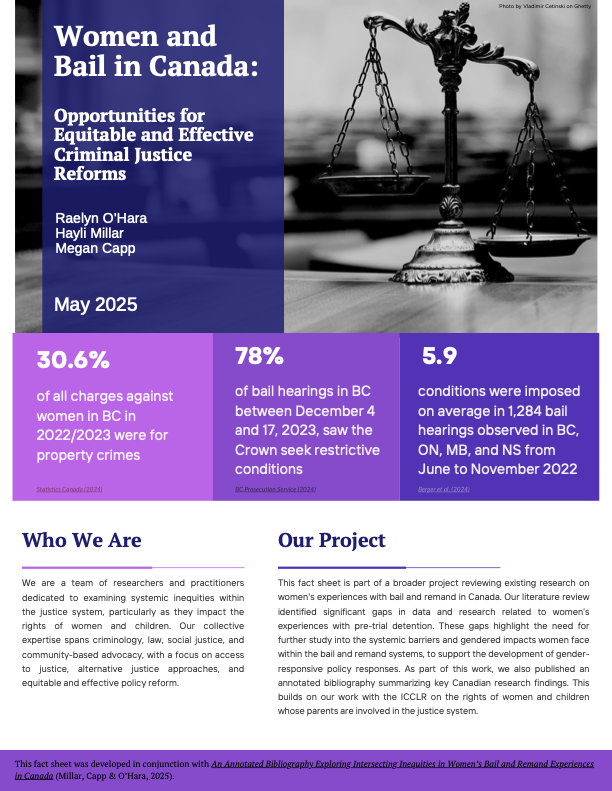
By Raelyn O’Hara, Hayli Millar and Megan Capp
ICCLR's Raelyn O’Hara, Dr. Hayli Millar, and Megan Capp highlight findings on women and bail in Canada in this fact sheet. The broader initiative by the authors focuses attention on the urgent need for primary research on how seemingly neutral bail laws and practices uniquely impact women, especially due to intersecting identities such as race, parenthood, and other social factors.

By Revolving Doors and Newton
The hidden cost of England’s so-called “prolific offenders” the people repeatedly in the headlines for shoplifting and low-level crime – is laid bare in groundbreaking new research by Revolving Doors and
Newton.
The report is the first of its kind, bringing together the insights of people with lived experience of the ‘revolving door’ of reoffending with innovative analysis of real public sector data, including case notes. It reveals new findings about the toll that punishment without rehabilitation and key missed opportunities has on people, public finances and public services.
Revolving Doors is now calling for a joint-departmental Government response across health, justice and housing. They are also requesting a focus on interventions that are known to work to address the root
causes of offending and a joined-up approach that combines shared data, thinking and lived experience.
The joint analysis finds:
● Between 30,000 and 50,000 individuals make up this group, trapped in cycles of repeat offending.
● They are responsible for at least 130,000 crimes a year, from shoplifting and assault to drug offences and criminal damage.
● True costs find that individuals cost more than £100,000 each year, with lifetime costs of over £1.4m.
● They cost the criminal justice system at least £242m annually, with a total socio-economic bill of up to £5.2bn. This figure represents almost a quarter of all reoffending costs and is the first ever measurement of this group’s impact on public services including the NHS, councils and social services.
Those in this group are often referred to as “prolific offenders”. This report identifies them more clearly to show they are in fact the ‘revolving door cohort’: people in crisis who cycle in and out of the justice system because of unmet health and social needs – including mental ill health, addiction, homelessness and histories of trauma.
Crucially, this group is not captured by existing systems like Integrated Offender Management, which was set up to specifically target those identified as most persistently offending.
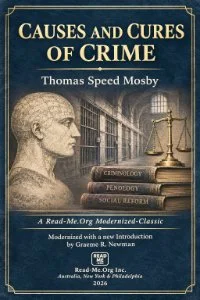
By Thomas Mosby (Author), Graeme Newman (Introduction)
n 1913, Thomas Speed Mosby, who had served as Pardon Attorney to Missouri Governor Joseph W. Folk, set out to explain to the general reader why people commit crimes and what society should do about it. Drawing on years of reviewing convicts’ petitions for clemency, and on the leading criminologists of his day, he organized his answer like a medical textbook. Crime was a disease of the social body, to be understood through its causes, its prevention, and its cure.
Part I, Etiology, examines the “cosmic,” social, and individual factors of crime. These range from climate and season to corrupt prosecutors, sensational newspapers, poverty, alcoholism, and Lombroso’s theory of the born criminal. Part II, Prophylaxis, turns to prevention through eugenics, the sterilization laws then spreading across the states, trade education, and social reform. Part III, Therapeutics, traces the history of punishment and argues forcefully against the death penalty. It includes a remarkable state-by-state survey of American parole laws in 1912 and 1913, and closes with a program for “the new penology.”
Causes and Cures of Crime is a vivid record of American criminal justice reform before the First World War. It shows both the movement’s humane ambitions and its dangerous enthusiasms. Its photographic plates of “criminal types,” supplied by the St. Louis and Kansas City police departments, and its illustrations of anthropometric instruments show how early criminologists hoped to read criminality in the human face and body.
This Read-Me.Org Modernized-Classic edition corrects and modernizes the original text while retaining Mosby’s arguments, statistical tables, all fourteen photographic plates, and the text figures. A new introduction by Colin Heston places the book in historical context, including the later discrediting of eugenics and compulsory sterilization. Review and Discussion Questions for each chapter make the edition well suited to courses in criminology, criminal justice history, and the history of social science.
Read-Me.Org Inc. New York-Philadelphia-Australia. 2026. p.207.

A. E. Winship and Arthur MacDonald. Introduction nad Review Questions, Graeme Newman.
Are people born to crime and poverty, or made by their surroundings? This volume brings together two influential American works from the turn of the twentieth century that tried to answer that question.
In Jukes–Edwards: A Study in Education and Heredity (1900), educator A. E. Winship sets the infamous “Jukes” family against the descendants of the great colonial theologian Jonathan Edwards. The Jukes were the subject of Richard Dugdale’s famous study of crime and pauperism. Edwards’s descendants included college presidents, judges, physicians, senators, and a vice-president of the United States. Winship’s vivid portraits, from Sarah Edwards’s household to the troubled brilliance of Aaron Burr, make a case for the combined power of inheritance, training, and education.
In A Plan for the Study of Man (1902), Arthur MacDonald of the U.S. Bureau of Education urges Congress to establish a national laboratory for the scientific study of “the criminal, pauper, and defective classes.” He wanted it to study ordinary people as well. His wide-ranging survey covers anthropometry, measurements of schoolchildren, instruments for gauging sensitivity to heat, touch, and pain, and hypnotism and suggestion. It also takes in the Mafia and the Camorra, alcoholism, moral education, prison reform, and a detailed case history of a young murderer. His original illustrations of laboratory instruments are reproduced.
The new introduction places both works in historical context. It traces their influence on the eugenics movement, the later criticism of their methods, and their surprising anticipation of modern child development and criminological research. Spelling and wording have been modernized throughout, tables have been summarized in prose, and review and discussion questions are included. The book will interest students and general readers in criminology, sociology, education, and the history of science.
Read-Me.Org Inc. New York-Philadelphia-Australia. 2026. p.196.
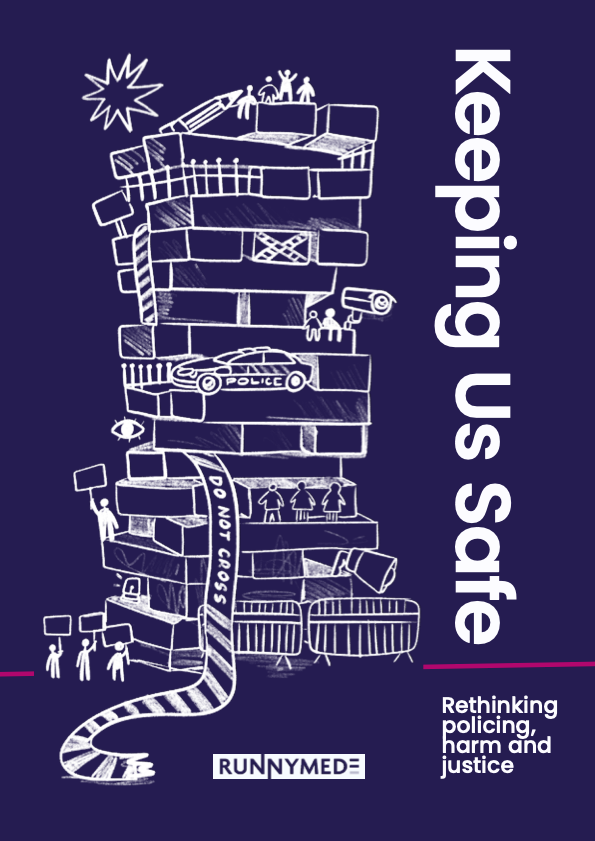
By Runnymede Trust
Keeping Us Safe: Rethinking policing, harm and justice, is a major new report calling for a fundamental shift in how the UK approaches safety, harm prevention and justice.
Drawing on nationally representative polling of 5,405 people in England and Wales, alongside in-depth community-based qualitative research, the report finds strong public support for social investment over punitive enforcement when given nuanced choices.
Key findings from the national polling include:
More than half (52%) think investing in public and social services would do more to prevent crime than increasing police powers (18% disagree, the rest are unsure). Half (50%) of the public believe investing in public and social services would do more to prevent crime than increasing the number of police officers (22% disagree, the rest are unsure). Keeping Us Safe critiques the dominant political and media framing that more police and more policing powers are common-sense solutions to social issues. It argues that binary polling questions obscure these nuances and reinforce a narrow public narrative that equates safety with police presence.
In the report, we trace modern British policing to its colonial origins, finding that contemporary policing continues to reproduce racial injustices through stop and search, punitive practices in educational settings, policing the border, mental health detentions and the overrepresentation of Black and racialised communities in the criminal legal system.
We argue that despite decades of inquiries and reform efforts, including high-profile reviews into institutional racism - from the 1999 Macpherson Report which found ‘institutional racism’ in the Metropolitan Police, to the 2023 Casey Review which identified a culture of racism, misogyny, and homophobia - attempts to reform policing have failed to address systemic issues. Instead, it argues, reform has often individualised racism as a matter of ‘bad apples’, leaving structures which produce inequality intact.
Police spending reached £19.9 billion last year, while youth services, mental health provision, housing support and community infrastructure face chronic underfunding.
Across six key areas (‘serious youth violence’, education, housing and homelessness, border enforcement, gender-based violence and mental health), the research finds that policing often deepens harm and fails to address root causes such as poverty, social exclusion, trauma and racism. It highlights community-led models already in practice, including: transformative justice practices that address harm without reproducing
violence, grounded in care, consent and collective accountability; reparative justice approaches that acknowledge and seek redress for historic and ongoing harms caused by racism, colonialism and slavery
and the inequalities they produced; restorative justice initiatives that empower survivors and create genuine opportunities for people who’ve caused harm to take responsibility and repair relationships; healing justice models that recognise harm as both systemic and interpersonal and treat healing as part of a collective political project.
The report sets out a series of ‘non-reformist reforms’ designed to build safer, more resilient communities. These include investing in teachers and pastoral support; ending school exclusions and the Prevent Duty; overhauling the Mental Health Act to end the use of police in responding to people in crisis; and an end to the No Recourse to Public Funds policy.
Keeping Us Safe concludes that safety does not begin with enforcement but with meeting people’s basic needs. It calls for a redistribution of public resources away from punitive systems and towards harm prevention, collective care and accountability.
Editors: Jaimee Mallion and Erika Gebo
The World Health Organization (2002) classified violence as a leading international public health problem that requires immediate intervention. Violence is a pervasive social problem whose causes and consequences are inextricably linked to individuals, families, institutions, communities, and societies. The negative consequences of violence, and serious violence in particular, reverberate beyond the immediate moment and location of it. By bringing together partners with varied skills, whole-system multi-agency approaches are advocated as the leading means of targeting serious violence. With this context in mind, this Special Issue examines a variety of collaborative, community-based approaches to preventing and reducing serious violence across the global landscape. The contributions from practitioners and researchers focus on the prevention and reduction of serious interpersonal violence in communities. The typologies of serious violence discussed by the collaborators include gang membership, domestic violence, and sexual violence. The contributions address the collaborative nature of serious violence prevention work, recognizing that violence is multi-causal and that solutions are needed across various socio-ecological domains. The contributions describe community-level collaborative approaches to preventing and reducing serious violence. The successes and lessons learned from the approaches are identified, and the applicability of the approaches to other areas are explored.
Edited by Bill McClanahan and Avi Brisman
In the past three decades, a stream of criminological inquiry has emerged which explores, measures, and theorizes crimes and harms to the environment at the micro-, mezzo-, and macro-levels. This “green criminology”, as it has come to be known, has widened the criminological gaze to consider crimes and harms committed against air, land (from forests to wetlands), nonhuman animals, and water in local, regional, national, and international areas or arenas. Accordingly, green criminology has endeavored to understand the causes and consequences of air and water pollution, biodiversity loss, climate change, corporate environmental crime (e.g., illegal waste disposal), food production and distribution, resource extraction and
exploitation, and wildlife trade and trafficking, while also exploring potential responses to these issues. This book seeks to introduce the green criminological perspective to a broader social science audience.
Recognizing that green criminology is not the first social science to explore the phenomena and harms at the intersections of humanity and ecology, this book offers an introduction to some of the unique insights developed over nearly 30 years of green criminological thought and scholarship to students, professors, researchers, and practitioners working in the fields of anthropology, economics, environmental humanities, environmental sociology, geography, history, and political ecology. This book contains contributions from researchers in green criminology from around the world, including early- and mid-career scholars, as well as more established voices in the field—all of whom are dedicated to exposing, understanding, and ultimately hoping to thwart further environmental degradation and despoliation.
Edited by Kirsten Foot,
Elizabeth Shun-Ching Parks,
Marcel Van der Watt
As the crime of human trafficking/modern slavery is multifaceted, collaborating to counter it across sectors, disciplines, regions, and from local to international levels is widely understood to be of utmost importance. However, the processes of organizing and leading robust collaborations are complex and challenging, and to be sustainable, such processes must result in both positive outcomes for the collaborating partners and demonstrable progress toward countering human trafficking. Despite a growing body of published research on anti-trafficking collaboration, many aspects of it remain understudied. This Special Issue of Societies invites researchers and collaboration leaders in the anti-trafficking arena to share research findings and/or evidence-supported practices on how to catalyze and support collaborations to generate and sustain track records of constructive impacts.
Edited by Sylvie Da Lomba
This Special Issue on “Migrants and Human Rights Protections” delves into human rights law’s enduring struggles to extend protections to migrants. The contributions engage with this subject-matter from a wide range of perspectives that bring to the fore both the universal and particular in migrants’ experiences of human rights protection regimes across countries and continents. This Special Issue also reminds of the value of developments in the Global South.
By Jens Rennstam
Sexuality in the Swedish Police is based on the experiences of lesbian, gay, and bisexual police officers and the author’s observations of police work. Written at the intersection of organizational, gender, and police studies, the book analyses how processes of exclusion and inclusion of LGB sexuality coexist in the Swedish police, how these processes are related to the culture and characteristics of police work, and how police management attempts to create an inclusive organization.
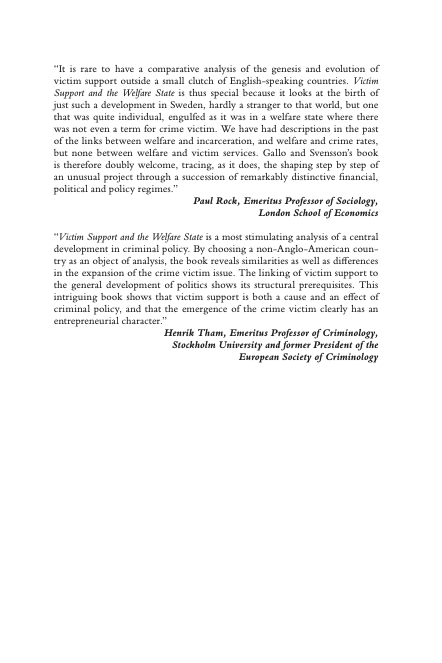
By Carina Gallo, Kerstin Svensson
This book provides a rich analysis of the history of Swedish victim support. With the majority of research on victim support centering on the Anglosphere, this book offers a unique case study for considering the role of the victim in the criminal justice system. While Sweden has enacted many laws to support victims, and victim assistance programs have grown rapidly, welfare policy has become more restrictive and crime policy, to some degree, more punitive.
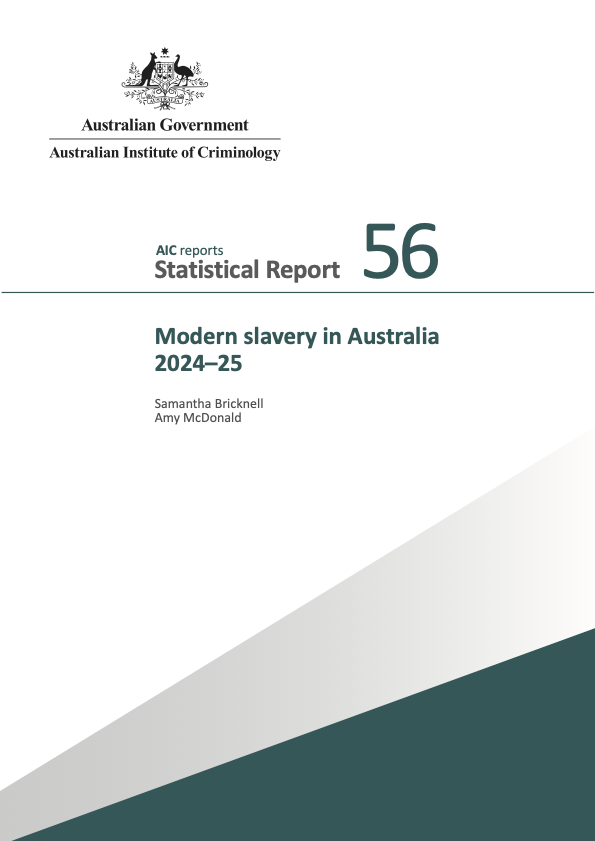
By Samantha Bricknell and Amy McDonald
The Human Trafficking and Modern Slavery National Minimum Dataset is anational data collection on modern slavery events. This study describes modern slavery reports received between July 2024 and June 2025, the characteristics of victim-survivors and perpetrators, the nature of Australia Government-funded support provided to victim-survivors and the outcomes of modern slavery prosecutions.
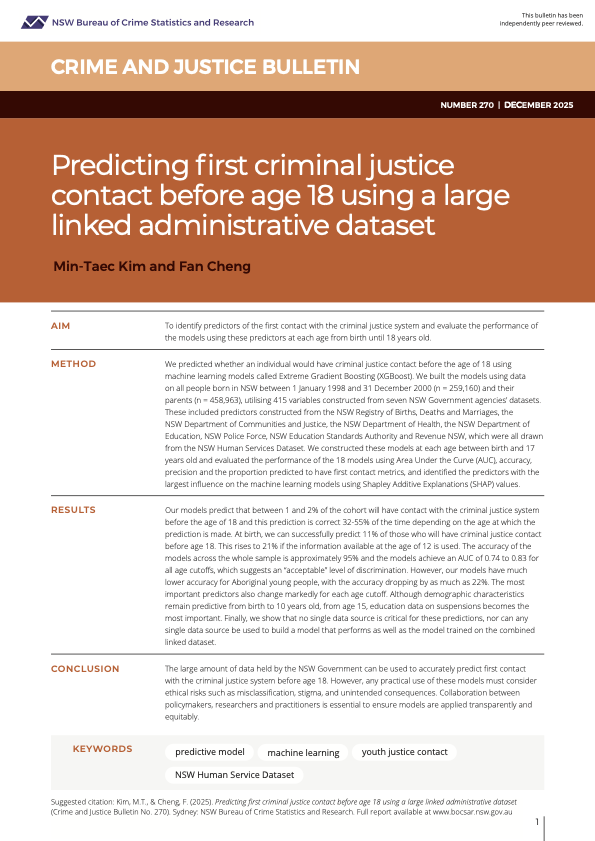
By Min-Taec Kim, Fan Cheng
The Bureau of Crime Statistics and Research (BOCSAR) has released a new study that considered whether linked data from health, education, child protection (and more) can be used to predict which children are likely to offend before turning 18. The study found: Whole-of-population level: Machine learning methods applied to large-linked data can identify future young offenders with reasonable accuracy. Aboriginal young people: The models were far less accurate for Aboriginal young people and could not be reliably used for this group. Offending predictions for Aboriginal young people were more likely to be wrong than for non-Aboriginal young people – a higher rate of false positives. This raises significant ethical concerns about the practical use of such models for Aboriginal people and other sub-populations. Predictive factors over time: The study also identified key predictors of offending and how these change with age. At birth, gender and parental characteristics are most influential. Between ages 5 and 10, child protection reports and disability become important. By age 15, school suspension is the strongest predictor of youth offending.
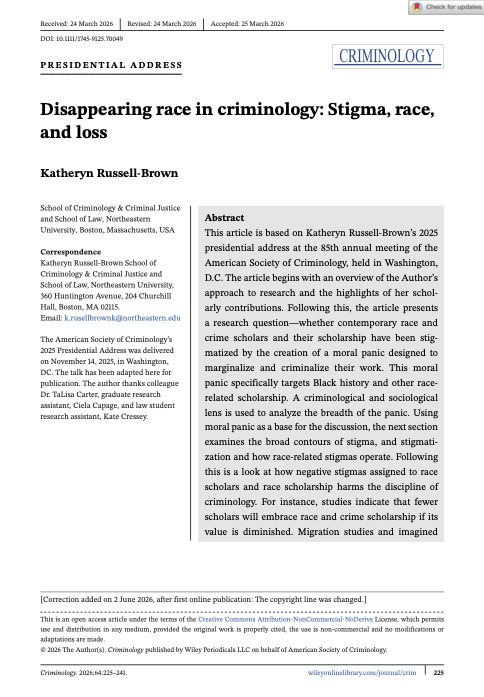
By Katheryn Russell-Brow
This article is based on Katheryn Russell-Brown's 2025 presidential address at the 85th annual meeting of the American Society of Criminology, held in Washington, D.C. The article begins with an overview of the Author's approach to research and the highlights of her scholarly contributions. Following this, the article presents a research question—whether contemporary race and crime scholars and their scholarship have been stigmatized by the creation of a moral panic designed to marginalize and criminalize their work. This moral panic specifically targets Black history and other race-related scholarship. A criminological and sociological lens is used to analyze the breadth of the panic. Using moral panic as a base for the discussion, the next section examines the broad contours of stigma, and stigmatization and how race-related stigmas operate. Following this is a look at how negative stigmas assigned to race scholars and race scholarship harms the discipline of criminology. For instance, studies indicate that fewer scholars will embrace race and crime scholarship if its value is diminished. Migration studies and imagined futures are included in the assessment of how racial stigmas impact race scholarship. Academic disciplines benefit from rigorous engagement regarding their core principles and perspectives. The absence or diminishment of critical research creates a void in the criminology literature. This raises questions about the representativeness, integrity, and comprehensiveness of criminological scholarship. The article concludes with a charge to the discipline to ensure that race and crime scholarship remain a robust part of the criminological canon.
By Carolina Martinelli
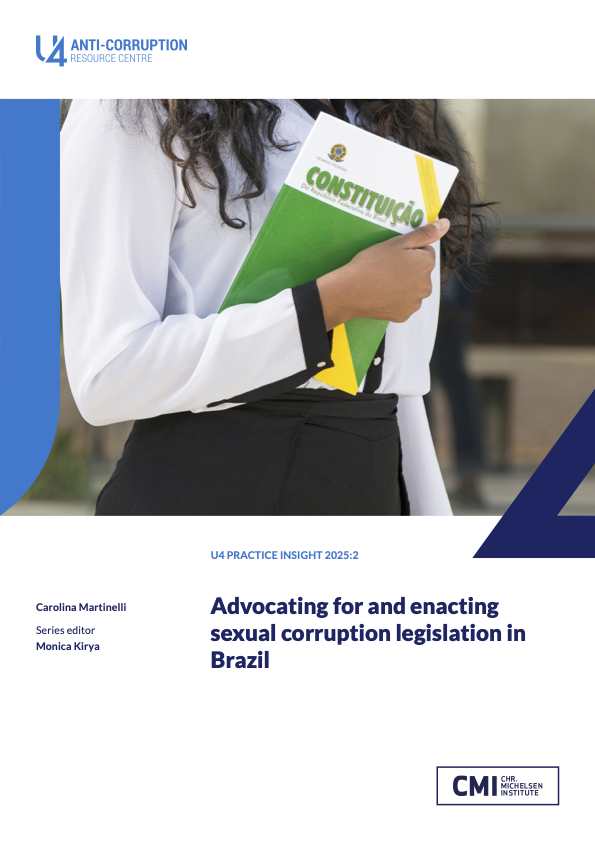
Brazil may join a small but growing number of countries that have already criminalised sexual corruption through specific legal provisions. This legislative effort shows how naming, strategic framing, and cross-sector collaboration can bring invisible gendered abuses into legislative concern. It offers critical lessons on the importance of political sponsorship, data collection, and media visibility for addressing complex, underreported crimes.
By Cassandra Cross · Thomas J. Holt
Using the premise of a genuine relationship, romance fraud ofenders deceive victims for monetary gain. Research on romance fraud has grown, but limited work explores the demographic correlates of victimisation. An assumption exists that older persons are more susceptible to fraud, though this dynamic is not consistently evident in the literature. This article analyses 2686 romance fraud complaints to Scamwatch, an online Australian fraud reporting portal, to identify correlates between being 65 years and older and their risk of victimisation. The fndings illustrate that seniors were not more likely to sufer monetary losses to romance fraud and were less likely to lose personal information compared to victims in other demographic groups. This study afrms the challenge of using demographics to predict romance fraud victimisation and emphasises the need for additional research in this area
Security Journal (2025) 38:46

By Megan M. McNally and Graeme R. Newman
From the cover: There has been a glaring lack of scholarly attention to the crime of identity theft, according to the editors. The chapters in this volume attempt to fill some of this gap by exploring theory and research on identity theft, as well as situational measures to prevent its occurrence.
The editors' introduction outlines several key issues related to the definition, extent and commission of identity theft. The chapter by Graeme Newman applies the opportunity perspective to the study of identity theft. Megan
McNally uses the "script" approach to examine the meaning and mechanics of identity theft in all of its forms. Henry Pontell, Gregory Brown and Anastasia Tosouni present new findings on how identity theft affects victims, based on data collected by the Identity Theft Resource Center. Heith Copes and Lynne Vieraitis describe how a sample of identity theft offenders viewed their crimes. Michael Levi recounts the evolution of identity fraud and its control in the U.K. Russell Smith presents a framework for evaluating preventive measures, particularly document-based systems, biometric technologies and identity cards. Sara Berg considers how information technology can be used within a situational crime prevention framework to fight identity theft. Robert Willison examines the use of situational crime prevention to protect sensitive personal information in the context of information systems security.
Crime Prevention Studies, volume 23. Willan Publishing. Culmcott House, Uffculme, Cullompton Devon EX 15 3AT, U.K. 2008. 195p.

BY Richard Grelling.. Translated By Alexander Gray. Introduction by Colin Heston.
Richard Grelling’s The Crime (Das Verbrechen), translated into English by Alexander Gray and published in London and New York between 1917 and 1919, is conceived as both a moral successor and completion to his earlier pacifist landmark, J’Accuse!, written between August 1915 and November 1916. In creating this extended work, Grelling sought to underscore the causes of World War I and dissect the self-justifying rhetoric that sustained the conflict long after its outbreak. Volumes I and II lay foundational groundwork, tracing the immediate antecedents of the war: imperialist tendencies within Germany and, on the part of the opposing Entente powers, ostensibly defensive motives followed by trait protectionism.
Never before in the annals of humankind has a crime of such sweeping magnitude been committed—and seldom has its perpetration been met with denial so unashamed. Within the very citadels of reason and culture, a proud civilization unleashed catastrophe under the guise of necessity—only to scramble afterward in self-exculpation. It is in this spirit of moral defiance—standing firm against voices of dissent, even from one’s own kin—that The Crime is offered to you. In the trilogy’s third volume, Grelling moves beyond the origins of war into the heart of wartime rationalization, exposing the “war-aims” that enabled aggression to persist under the cloak of purpose. May this work cast a clear light upon the structures of self-deception that allowed the world’s descent, and may it stir an unyielding clarity in us to recognize—and reject—such patterns again.
Read-Me.Org Inc. New York-Philadelphia-Australia. 2025. 261p.

ByThomas D. Akoensi, Justice Tankebe
Using an experimental vignette design, the study inves-tigates the effects of criminal records on the hiring deci-sions of a convenience sample of 221 human resource(HR) managers in Ghana. The HR managers were ran-domly assigned to read one of four vignettes depicting job seekers of different genders and criminal records:male with and without criminal record, female with and without criminal record. The evidence shows that a criminal record reduces employment opportunities for female offenders but not for their male counter-parts. Additionally, HR managers are willing to offer interviews to job applicants, irrespective of their crim-inal records, if they expect other managers to hire ex-convicts. The implications of these findings are dis-cussed.
The Howard Journal of Crime and Justice, online first, May 2024

By Matthew Bonn, Chelsea Cox, Marilou Gagnon. et al.
The International Guidelines on Human Rights and Drug Policy recommend that States commit to adopting a balanced, integrated, and human rights-based approach to drug policy through a set of foundational human rights principles, obligations arising from human rights standards, and obligations arising from the human rights of particular groups. Following two years of consultation with stakeholders, including people who use drugs, NGOs, legal and human rights experts, UN technical agencies and Member States, the Guidelines “do not invent new rights. Rather, they apply existing human rights law to the legal and policy context of drug control to maximise human rights protections, including in the interpretation and implementation of the drug control conventions.” In respect of the Guidelines and its obligations under UN human rights treaties, Canada must adopt stronger and more specific commitments for a human rights-based, people centered and public health approach.3 This approach must commit to the removal of criminal penalties for simple possession and a comprehensive health-based approach to drug regulation.
Ottawa, ONT: Royal Society of Canada, 2024. 52p.