Open Access Free Library
CRIME+CRIMINOLOGY.jpeg

CRIME

Violent-Non-Violent-Cyber-Global-Organized-Environmental-Policing-Crime Prevention-Victimization

Posts in Violence & Oppression
School-Related Violence in Latin America and The Caribbean: Building an Evidence Base for Stronger Schools

By Cirenia Chávez, Victor Cebotari, María José Benítez, Dominic Richardson, Chii Fen Hiu and Juliana Zapata

The prevalence of school-related violence and bullying is a global issue that impacts educational outcomes negatively. Furthermore, bullying can have emotional and physical effects on the children experiencing it, both in the short- and long term. Although the evidence regarding bullying from low- and middle-income countries is less extensive in comparison to evidence on the effects of bullying from high-income countries, some findings from the Latin American and Caribbean regions show similar results connecting lower reading scores with a high prevalence of bullying victimization. This working paper uses data from UNESCO’s Third Regional Comparative and Explanatory Study to determine the correlation between bullying and learning outcomes in 15 countries of the LAC region. It also looks at ways to mitigate the impacts of violence.

Innocenti Working Paper WP-2021-02 New York: UNICEF, United Nations Children's Fund, 202. 68p.

What About Suicide Bombers? A Terse Response to a Terse Objection

By: Marc Champagne

On September 11, 2010, after presenting selected technical aspects of a Randian ethic at a prominent academic conference, I was confronted with the following objection, somewhat belligerent in tone: “But what about suicide bombers?” What about them? Despite the objection’s contextual timeliness, my initial reaction was to question its topical relevance. So I politely requested that the criticism be further unpacked. My interlocutor duly obliged, and I eventually gleaned that murder-suicide (say, in the name of some otherworldly posit) was being adduced as a supposed counterexample to the rational egoist account of values I had just expounded.

I don’t recall my exact response, only that I was dissatisfied with it afterwards. The audience member clearly thought he had unearthed a powerful criticism, and the objection, though crude, had the rhetorical merit of brevity. Such an intuitively attractive “sound bite,” I later thought, deserves to be answered in kind.

The Journal of Ayn Rand Studies 11, no. 2 (Issue 22, December 2011): 233–36.

The Social Structure of Homicide-Suicide

By: Jason Manning

This article focuses on intimate partner killings to address the question of why some killers subsequently commit suicide whereas others do not. Utilizing Blackian theories of conflict management and Manning’s theory of suicide, it advances hypotheses about when intimate partner conflict will result in homicide-suicide rather than homicide alone. These hypotheses propose that differing amounts of status superiority and relational distance predict and explain different patterns of lethal violence. The hypotheses are illustrated and supported with data taken from a study of intimate partner homicides in the state of West Virginia. The article concludes by arguing for a micro-structural model that addresses suicide, homicide, and homicide-suicide.

Homicide Studies 1 –20

Suicide and Nepantla: Writing in in-between space to crave policy change

By: Ethan Trinh

This autohistoria, or “a personal essay that theorizes,” is a special piece to me. It is spiritual, poetic, political, and dialogic. This essay thus delves deeper into the mourning, the fear, the tears, the pain, the loneliness, the strength of a Vietnamese queer immigrant in a state of Nepantla in order to relate with other queers of color in the dark (i.e., in suicidal process). “Living in Nepantla, the overlapping space between different perceptions and belief systems, you are aware of the changeability of racial, gender, sexual, and other categories rendering the conventional label-ling obsolete.” In this space, I attempt to use the concept of Nepantla to describe and understand stages of pre- and post-suicide attempt that I experienced. Then, I will conclude with a call for policy change to ask for attention to those who live in the life-death margins and in between and among worlds as mine.

LGBTQ Policy Journal

Wanting sex and willing to kill: Examining demographic and cognitive characteristics of violent “involuntary celibates”

By: D J Williams, Michael Arntfield, Kaleigh Schaal, Jolene Vincent

Over the past several years, an online community of self‐described “incels,” referring to involuntary celibates, has emerged and gained increased public attention. Central to the guiding incel ideology and master narrative are violent misogynistic beliefs and an attitude of entitlement, based on male gender and social positioning, with respect to obtaining desired and often illusory sexual experiences. While violence and hate speech within the incel community are both common, there exists a notable subset of incels who have been willing to act on those violent beliefs through the commission of acts of multiple murder. This study explores the demographic, cognitive, and other characteristics of seven self‐identified incels who have attempted and/or successfully completed homicide. The findings suggest that although self‐perceptions tend to reflect either grandiosity or self‐deprecation, homicidal incels share similar demographic characteristics and dense common clusters of neutralization techniques, cognitive distortions, and criminal thinking errors.

Behav Sci Law. 2021;1–16.

Homicide-suicides in Romania. The analysis of fatal injuries within victims and aggressors

By: Ecaterina Balica

Objective. The present paper analyses the relation between the number of blows, location of wounds and the length between homicide and suicide in homicide-suicide (HS) cases committed in Romania in the timeframe 2002-2013. At the same time, the study presents the correlation between three types of HS (intimate partner homicide-suicide (IPH-S), filicide- suicides (FS), familicides-suicides (Fam-S) and the above mentioned variables.

Method. The data regarding the number of blows, location of wounds and length between homicide and suicide were extracted from the Homicide-suicides in Romania 2002-2013 database (N=132). The database includes information regarding all HS committed in Romania and the data were collected from the recordings of the Criminal Investigations Services, from criminal files in prosecutors’ custody and from articles published in online newspapers. The data analysis was done by using SPSS 22.0.

Results. More than a half of the suicides occurred immediately after the aggressor committed the homicide (N=71; 53.8%). In approximately two thirds of the cases (N=56; 57.1%), the death of the victim resulted from a great number of blows. Many aggressors preferred to hit their victims in the head area (21.5%) or neck area (22.3%) only. The most common suicide method recorded in HS cases was by hanging (34.8%).

Conclusions. The prevention of the HS seems to be a difficult task after the aggressor initiated the first act of aggression (the homicide). Therefore, prevention and intervention have to be focused on the initial phases of the acts of violence that precede HS.

Rom J Leg Med [26] 308-313 [2018]

Gun Dealer Density and its Effect on Homicide

By: David B. Johnson and Joshua J. Robinson

We explore the relationship between gun prevalence and homicides in the United States from 2003–2019. Unlike previous research, which typically uses an indirect, state-level measure of gun prevalence, we use a direct measure of guns in a narrow geographic area: gun dealers. We find an increase in gun dealer density is significantly and positively associated with increased homicides in subsequent years. We compare estimates from our preferred measure, the number of dealers per 100 square miles in a local area, to those found using other gun prevalence measures and find our preferred measure to be more consistent in magnitude across three different estimation methods and two different data sources. We additionally show the effect of gun dealer density is limited mostly to counties that have a high percent of Black residents. We propose that the so-called “Ferguson Effect”—a sharp increase in violent crime in urban and Black communities after 2014—might be partially explained by an influx of gun dealers in Black communities, rather than just a change in the propensity of Black residents to call the police or changes in police behavior.

October 1, 2021

Factors associated with homicide in Manaus, Amazonas, Brazil, 2014

By: Jesem Douglas Yamall Orellana, Geraldo Marcelo da Cunha, Bárbara Christie de Souza Brito, Bernardo Lessa Horta

Objective: to identify characteristics, magnitude and factors associated with homicide in Manaus-AM, Brazil.

Methods: cross-sectional study, with data from the Mortality Information System (SIM); homicide rates and odds ratio (OR) were estimated, comparing to other external causes, for 2014; logistic regression was used.

Results: of the 1,657 violent deaths, 913 were due to homicide; homicide rate was of 55.8/100 thousand inhabitants (95%CI 52.1;59.7); odds ratio was higher among males (OR 3.4; 95%CI 2.3;5.1) when compared with females; among single (OR 1.6; 95%CI 1.1;2.5) and widowed individuals (OR 4.1; 95%CI 1.1;15.6), when compared with married individuals; at night/early hours (OR 2.1; 95%CI 1.6;2.9) and in the afternoon (OR 1.7; 95%CI 1.2;2.4), when compared with the morning period; the probability was higher among individuals under 35 years, with less schooling.

Conclusion: homicide mortality in Manaus was high, especially among males and young individuals with less schooling.

Epidemiol. Serv. Saude, Brasília, 26(4), Oct-Dec 2017

The Relationship between Neighborhood Characteristics and Homicide in Karachi, Pakistan

By: Salma Hamza, Imran Khan, Linlin Lu, Hua Liu, Farkhunda Burke, Syed Nawaz-ul-Huda, Muhammad Fahad Baqa and Aqil Tariq

The geographical concentration of criminal violence is closely associated with the social, demographic, and economic structural characteristics of neighborhoods. However, few studies have investigated homicide patterns and their relationships with neighborhoods in South Asian cities. In this study, the spatial and temporal patterns of homicide incidences in Karachi from 2009 to 2018 were analyzed using the local indicators of spatial association (LISA) method. Generalized linear modeling (GLM) and geographically weighted Poisson regression (GWPR) methods were implemented to examine the relationship between influential factors and the number of homicides during the 2009–2018 period. The results demonstrate that the homicide hotspot or clustered areas with high homicide counts expanded from 2009 to 2013 and decreased from 2013 to 2018. The number of homicides in the 2017–2018 period had a positive relationship with the percentage of the population speaking Balochi. The unplanned areas with low-density residential land use were associated with low homicide counts, and the areas patrolled by police forces had a significant negative relationship with the occurrence of homicide. The GWPR models effectively characterized the varying relationships between homicide and explanatory variables across the study area. The spatio-temporal analysis methods can be adapted to explore violent crime in other cities with a similar social context.

Pakistan. Sustainability 2021, 13, 5520.

The Epidemiology of Homicide–Suicide in Italy: A Newspaper Study from 1985 to 2008

By: Paolo Roma, Antonella Spacca, Maurizio Pompili , David Lester, Roberto Tatarelli, Paolo Girardi, Stefano Ferracuti

Homicide–suicide is an event in which the murderer commits suicide after the homicide. There are at least 14 epidemiological studies on the topic, and all have found that homicide–suicide is more common among family members. The murderers are most often males and the victims females. There is no recent research on this phenomenon in Italy. The purpose of the study was to evaluate the incidence of homicide–suicide in Italy over a period of 24 yrs and to compare Italian data with published international data. We used information gathered by press agencies and from the four major Italian newspapers. Between 1985 and 2008, 662 cases of homicide–suicide were identified, with 1776 deaths. The murderer was male in 84.6% of the cases, typically using a firearm. The most common motivation was romantic jealousy, followed by socio-economic stress. The rate of homicide–suicide was 0.04%. Comparison with international studies is not always possible due to the lack of information for certain categories. The common factors identified may be helpful for prevention.

Volume 214, Issues 1–3, 10 January 2012, Pages e1-e5

One Goal, Two Struggles: Confronting Crime and Violence in Mexico and Colombia

By María Victoria Llorente & Jeremy McDermott,  Raúl Benítez Manaut,  Marta Lucía Ramírez de Rincón,  John Bailey 

Transnational criminal organizations trafficking drugs from Mexico to the United States have existed since the Prohibition era in the United States. But the violence associated with this trafficking—and related movements of other illicit goods as well as undocumented migrants—increased exponentially beginning in the mid-2000s, threatening Mexico’s national security. During the six-year administration of President Felipe Calderón (2006-12) estimates of those killed in drug-related violence reached 70,000, with an additional 20,000 “disappeared.” The upsurge in violence in many areas of the country reflected a combination of fighting between rival drug trafficking organizations seeking territorial control of criminal markets and dominance of lucrative trafficking corridors, as well as clashes between the traffickers and government security forces. By 2010, some Mexican cities registered homicide rates that were among the highest in the world and the public began to seriously doubt the government’s strategy and its ability to guarantee public safety. The scope of the violence and its frequently gruesome and shocking character, and the government’s seeming inability to bring it under control, brought forth memories of an earlier period in Latin America, when Colombia was besieged by the violence of the Medellín and Cali drug trafficking cartels. The Colombian crisis of the 1980s and ’90s involved multiple ways the state was losing ground to guerrilla and paramilitary groups in addition to drug traffickers. But like Mexico, the cost in human lives and government legitimacy was huge Over the course of more than a decade, Colombia’s security situation has improved dramatically. With significant international cooperation, the guerrillas have been weakened militarily and coca cultivation and cocaine production have been reduced. Most analysts agree that at least some of the security crisis in Mexico (as well as Central America) is due to ways that security advances and improvements in state capacity in Colombia forced traffickers to search for new smuggling routes and ways to market their illicit product. This is true even though, as several chapters in this publication indicate, organized criminal groups remain an important source of instability in Colombia, having mutated and fragmented in response to government pressure. Former paramilitary fighters, who demobilized in the early 2000s as a result of peace talks with the government, are important actors in the new manifestations of organized crime. Colombia is now a major player in South-South security cooperation, offering training to over 2,500 Mexican military and police officials between 2010 and 2012, as well as to over 5,000 members of the security forces from Central America and the Caribbean and over 2,000 from South America during the same time period.1 A former director of the Colombian National Police, General Óscar Naranjo, served as an adviser to the administration of Mexican President Enrique Peña Nieto. The United States funds some of Colombia’s programs abroad and U.S. officials have expressed satisfaction and pride in Colombia’s success. In a May 2013 visit to Colombia, Vice President Biden paid “personal tribute” to President Santos and “the people of Colombia for the remarkable, remarkable progress you’ve made…” in dealing with the country’s security concerns. Biden went on to mention Colombia’s training of “thousands of law enforcement officers and security officers from over 40 countries since 2009.”  But precisely what aspects of Colombia’s strategy and tactics for fighting organized crime in its own territory offer useful lessons for Mexico? What might Colombia’s steps and missteps offer by way of example or counter example? What is unique about each case such that comparisons are misleading? What do current security challenges in Colombia suggest about the threat posed by organized crime more generally? To reflect on these questions, the Latin American Program commissioned a series of papers from international experts with a wealth of experience on issues of security, violence, and transnational criminal organizations. This publication includes two chapters analyzing the usefulness of comparing Colombia and Mexico’s experiences in combatting organized crime, as well as the potential for using Colombia’s successes as lessons for Mexico’s security strategy. Maria Victoria Llorente of Fundación Ideas para la Paz and Jeremy McDermott of Insight Crime argue that Colombia does not represent a ready template for Mexico’s fight against violence and organized crime, although its long experience may provide insight into Mexico’s future. The second paper, by Raúl Benítez Manaut, a researcher at the National Autonomous University of Mexico (UNAM), contends that Colombia does offer positive lessons about how reform of the defense sector and professionalization of the police can yield measurable results for Mexico. Commentaries by Marta Lucía Ramírez de Rincón, former Minister of Defense of Colombia, and John Bailey of Georgetown University, deepen and take issue with the analyses provided by Llorente and McDermott and Benítez. .     

,Washington, DC: Woodrow Wilson International Center for Scholars, 2014. 128p. Scholars

From Cocaine to Avocados: Criminal Market Expansion and Violence

By  Chelsea Estancona and Luca Tiscornia

Most of what we know about organized criminal violence comes from research about illicit narcotics markets. Yet, these groups also fight to capture markets for licit commodities, as evidenced by Sicilian lemons and South African abalone. When do criminal groups violently expand into markets for licit goods? We argue that rapid increases in the share of a good’s export value create opportunities for immediate profit and future market manipulation. This provokes violence as groups expand their territorial holdings and economic portfolios. We test our argument cross-nationally using the Atlas of Economic Complexity, V-Dem, and UNODC. Increases in a country’s share of global export value for agricultural goods are associated with more homicides– but only where criminal groups are present. We then provide subnational evidence of our mechanism using data on avocado exports from Mexico and address reverse causality with Google Trends data about the popularity of avocado toast searches. 

Present at the UNU Wider Development Conference, October 2022. 55p.

Becoming a Violent Broker Cartels, Autodefensas, and The State in Michoacán, Mexico

By Romain Le Cour Grandmaison

This article explores the construction – or reconstruction – of brokerage channels by violent actors in Mexico. It focuses on the construction of the Autodefensas de Michoacán (Self Defense Groups of Michoacán) and studies the process that put illegal armed leaders in active dialogue with the Mexican federal government, but also how they became brokers capable of controlling access to strategic political resources, economic markets, and the connections that tie local citizens and the central state. Through the concept of political inter-mediation, I investigate how coercion, as a skill and resource, has become central to governance in Mexico; and how this leads to consolidating intermediaries that participate in reproducing local, violent political order. This article shall contribute to the understanding of brokerage in contexts of violence, and shed new light on the political logic fueling the dynamics of violence in Mexico’s war on drugs. Keywords: drug cartels, brokerage, Mexico, war on drugs, state, violence.   

European Review of Latin American and Caribbean Studies / Revista Europea de Estudios Latinoamericanos y del Caribe, No. 112 (July-December 2021), pp. 137-158  

Political Violence in Mexico´s 2024 Election March 2024 II. Organized Crime Involvement   

By María Calderón 

When it comes to an understanding of political violence in Mexico, there is a risk of solely equating it with criminal groups' activities or exclusively attributing it to such groups. However, the political violence phenomenon in Mexico is complex and diverse, with a particular nexus to locally based illicit economies, for which an all-containing approach is insufficient. About half of the political violence that occurred in Mexico during the 2018 elections was directly attributed to organized crime. During such time, political figures were killed at a rate of one per week. These numbers support the growing concern about criminal groups' involvement in Mexican politics. Criminal groups have used political violence in several ways: directly manipulating and influencing elections, protecting incumbent candidates with whom they have struck an agreement, killing candidates who are perceived as a threat to their interests, intimidating poll workers, and attacking and stealing voting booths, among others. The decrease in the profitability of trafficking heroin and cannabis, the legalization of marijuana in many US states, and increased fentanyl usage have forced cartels to recalibrate strategies and markets. Nowadays, criminal groups have partially shifted towards locally based illicit economies, such as oil theft, extortion, kidnapping, and other illegal activities that require control of local territories. All these variables come into play when understanding that criminalized electoral politics is a predominantly local phenomenon in Mexico. Political violence by criminal groups in Mexico is motivated by multiple factors, including economic interests, political objectives, and vendettas. Criminal organizations often avoid open confrontation when attacking politicians or political candidates, opting for other less visible techniques to minimize the impacts on police and law enforcement agencies, such as corruption. Installing or co-opting candidates at the municipal level has afforded criminal groups direct influence over the actions of local and state police. Access to intelligence on pending arrests or other operations has also proven beneficial for criminal organizations. Political influence has allowed criminal groups to employ local security forces as appendages of their organizations to detain or kill targets and to protect the transportation of illicit goods. Moreover, criminal organizations have tapped into state finances by coopting government employees.

Washington, DC:  Woodrow Wilson International Center for Scholars, 2024  6p.   

Latin American Crime and the Issue of Inequality

By Garan Ho/mqvist 

Crime is an increasingly worrying social phenomenon in the developing world in general and in Latin America in particular. As shown in Figure 1~, the crime rate (measured by homicide lOO 000, as reported to the UN crime surveys by national police authorities) has virtually exploded since the mid-1980s in Latin America, Sub-Saharan Africa, and Eastern Europe. Latin America stands out as an exceptional case. Annually in Latin America, approximately 140,000 people are murdered (Londono & Guerrero 1999:27). Using other sources does not change this picture. Figure 2 confirms the exceptional position of Latin America, where the source in mortality statistics is collected from national health authorities instead of the police. Indicators of crime other than homicide are less reliable for international comparison, but estimates point in the direction of Latin America being way above the average for any other region of the world (Bourguignon 1999, Table 1). It has been estimated that 28 million Latin American families are victims of theft or robbery every year (Londono & Guerrero 1999:3). Crime and violence are now viewed as a development issue of importance, which was probably not the case two decades ago. Development agencies such as the World Bank and Inter-American Development Bank (IDB) have quite recently initiated ambitious research projects on crime and violence. Projects directed to the judicial system or police authorities have increased their share in the project portfolio of multilateral as well as bilateral development cooperation agencies. More importantly, crime is becoming a major concern in the daily lives of an increasing number of citizens in the developing world, manifesting itself in national political agendas, in higher crime-related expenditures, and, not the least, in human suffering. There are several reasons to regard crime as a social phenomenon with strong and complex ties to the development process in general. In Latin America, crime is a potential threat to what most people would regard as encouraging development trends, especially after ''the lost decade" of the 1980s, in terms of democratization and resumed growth. The following examples may illustrate how continuous progress in these areas is being made more difficult by the increasing crime levels: 

 Iberoamericana. Nordic Journal of Latin American and Caribbean Studies Vol. XXX: 2 2000,pp. 23-53

Online and Offline Racism in Victoria. The Context of Online Racism in Victoria in 2020

By Craig McGarty

An analysis of Twitter content from Victoria in 2020 found low levels of racial vilification of Asians. This surprising low level of public online racism is consistent with reanalysis of survey data. Racism directed against Asian Australians and others is an ongoing source of harm. There is not, however, good reasons to believe that hatred of Asians was successfully mobilized and exacerbated in Victoria in 2020 by mass online means. Racism needs to be confronted wherever it occurs, but the uncritical acceptance of media narratives is unlikely to help the cause of confronting it.     

Melbourne: Centre for Resilient and Inclusive Societies, 2023; 36p. 

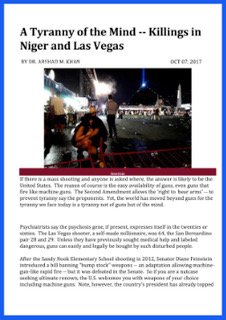
A Tyranny of the Mind -- Killings in Niger and Las Vegas

By: Dr. Arshad M. Khan

If there is a mass shooting and anyone is asked where, the answer is likely to be the United States. The reason of course is the easy availability of guns, even guns that fire like machine guns. The Second Amendment allows the 'right to bear arms' -- to prevent tyranny say the proponents. Yet, the world has moved beyond guns for the tyranny we face today is a tyranny not of guns but of the mind.

Modern Diplomacy Oct 07, 2017

Domestic Homicide Review Final Report

By: António Castanho

This report concerns the review of a domestic violence homicide situation that was the subject of case No. 2892 / 15.9JAPRT of the Comarca of Porto Este, whose final decision resulted from a judgment of the Court of Appeal of Porto, 22.2.2017.

In this case, B, a male, aged 60, was convicted of qualified homicide [articles 131 and 132, paragraphs 1 and 2 b), e) and i) Criminal Code] and attempted qualified homicide (art. 22, 23, 73, 131, 132, paragraphs 1 and 2 (a), (c), (e) and (h) Criminal Code) and sentenced to 23 years and 10 months’ imprisonment.

  • The events occurred on September 27, 2015.

  • The victim of the murder was his wife - M who was 58 years old.

  • The victim of the attempted murder was the father of the attacker - J, aged 87.

The report includes:

  • a) The presentation of as much information as is known about the incident, the behaviour patterns of the perpetrator, the factors that influenced him, as well as the responses and support provided to the victims and the perpetrator; and

  • b) Analysis of the above with the aim of extracting lessons from this case so that changes are made to reduce the risk of further homicides.

Agency contact and involvement with the victims and perpetrator were considered from 2010 and included justice, police and health.

The review process began on 04/17/2017; the preliminary report was drawn up on 9/1/2017; the review meetings were convened on 9/9/2017, 27/9 and 10/25/2017.

The Domestic Homicide Review Team (EARHVD) was composed of its permanent members plus a non- permanent member representing the Republican National Guard (Territorial Command of Porto), the police force that had jurisdiction in the area in which the events occurred.

Case no1/2017-AC

Evaluating Domestic Violence Programs Manual

By: Dr. Jeffrey L. Edleson

The purpose of this manual is to help you make informed decisions about doing evaluation, and to provide you with concrete ideas for evaluating a specific program or group of programs.

In a clear and simple style, the issues, elements, and procedures of beginning evaluation are examined. You will learn how to develop goals and outcome objectives that will focus your program and facilitate productive evaluation. Benefits and drawbacks of program evaluation are laid out, along with guidelines for assessing your agency’s ability to conduct an evaluation. The basic evaluation process is mapped out in step-by-step fashion, complete with sample forms and questionnaires. Throughout this manual you are encouraged to focus on how your study results will be used. Finally, you will learn the most effective ways to present your findings to various audiences when your evaluation is finished.

If you are being asked to cooperate with an outside evaluator, this manual will help you know what questions to ask about the proposed evaluation. It will give you a basis on which to decide, if you have a choice, whether to open your program to the evaluation. If you don’t have a choice, you will gain insights that will help you determine whether you are being fairly judged by an outside evaluation and how to gain some control over the process.

Evaluating Domestic Violence Programs is based on 14 years of a unique collaboration between research and services. Whether your program is new or long established, you can gain a more intimate knowledge of it through the kind of evaluation explained in this manual. This knowledge can help you increase your effectiveness as an administrator.

Domestic Abuse Project 1997

Sustainable Empowerment of DR Congo Rural Women Survivors of Rape

By: Mugisho Ndabuli Theophile

This book highlights that there is a wide room for women victims of rape during war and those who are expelled from their families because they have been raped for empowerment. In this vein, the book portrays the different possibilities the Congolese Females Action for Promoting Rights and Development (COFAPRI) is exploring in order to empower rural women victims of war rape and domestic violence in the rural villages of the Democratic Republic of Congo (DR Congo). The aim of this emancipation is to help these victims to scar up both their physical and moral wounds in order to reshape the meaning of their lives, as well as their FKLOGUHQ¶V and then trace a peaceful way toward a future that gives hope and confidence in their hearts.

COFAPRI is a women’s grassroots organization that is operating in remote and dangerous villages of the eastern DR Congo. The villages of this part of the world are still a hub for militia and hooligans who are intimidating, raping, killing pitilessly women, children and the ecosystem. The organization is closely and tirelessly working with rural women who are victims of local discriminatory traditions in order to empower them for a better future. Such liberation aims to break these discriminatory traditions that reduce women and girls to nothing, making them second class people who have no word in families and in the country.

Biased traditions remain alarming and worse in remote villages where most girls and women are illiterate. In these areas, these mores are men’s invention and they [traditions] are vigorously protected by the same men for their personal interests. The main reason behind this safeguard is that the DR Congo is a strong paternalistic system that protects by all costs these traditions, making the women to be subjugated to men and remain eternal second class people who must live in total obedience of and dependence on men.

The situation of these victims worsened with the advent of warfare that added more weight on their natural plights of cultures. The women and girls, no matter their age and status, have been raped since 1996 (for more than 20 years today) when the unending wars started. Since the target of the fighters were women and girls, rape has then been used in different contexts, sometimes the victims were raped in the eyes of their relatives, children, husband, friends and neighbors. Through such terror, rape became an easy arm of war used by the rapists. The evil doers have been directing rape toward women and girls of all ages. In this period of cyclic wars has never been discriminatory, as it applied to women, girls, men and boys. With focus on women and girls victims, the aim of the rapists was but to hurt the victim physically and morally by dehumanizing her, cutting her off of her family and her community in order to weaken her properly, and so she can die while alive.

This did cause the victim unbearable shame and moral death. The victims were killed twice while alive. Rape caused the victims moral and physical open wounds and ultimate detachment from families and communities. These women have been raped and some of them contaminated HIV/AIDS and STDs (Sexually Transmitted Diseases); many others got pregnancies that delivered fatherless children.

The children born of rape never knew their fathers. As earlier stated, the DR Congo is a patriarchal community where women follow blindly all decisions made by the masters of traditions. So, children born of rape become detached from the family of the mother and that of the husband of the mother. Not having a family because one has no father totally isolates and discriminates the innocent child, which sometimes traumatizes them.

It is in this context that COFAPRI initiated some ways that these victims can walk in order to reach the other side of the tunnel. As a way of remaking their lives, these victims are involved in various income generating activities in their different villages. The activities include, among others, sewing, animal rearing, knitting, beading and small business. In addition, they also involve in basic reading and writing in order to better involve in their developmental activities. The women also get hygienic education in order to improve on their life conditions. All these activities are done in teams where participants exchange on different issues regarding their lives in home and in community. In their teams, and in turns, each member is at the same time a learner and a teacher. All in all, this aims to promote the rights of women and children, as well as supporting them along their new life in order to overcome trauma and poverty.

The children born of rape also suffer protracted discrimination in their families since they are wrongly believed to be social cast and burden. COFAPRI helps these children to remake their lives for a harmonious future by facilitating them to get school enrolment. The children are also accompanied by the same organization in their studies; they are paid school fees and equipment. Being fatherless and social cast has often created a negative personal consideration in the minds of these children, which ultimately pushes them to join local militia or other gangs associations in order to revenge, which makes the cycle of wars become repeated and perpetual. This makes more women and girls to be raped, and more fatherless children to be born. Such children, due to the social disrespect they experience, decide to join local militia with the aim of revenging. The above mentioned organization is doing everything they can for the moment in order to hinder children from linking with the militia as this will certainly make them act the same way as their anonymous fathers behaved. It is in this context that the children are getting support from this incredible organization that is operating in the remote and dangerous villages of the DR Congo.

The writer of this book collected information via desk research along with data from the organization. The book is part of details from a video conference that the Co-Founder and Executive Secretary of COFAPRI presented to Red Hila, in their last meeting in Colombia in 2014. In order to support the story, some quotes from the women and the children we work with have been inserted in the story, along with some of their pictures. The women gave us full permission to use their photos and quotes, and we got consent, as well, from the mothers of the children. In the minds of the women and the children, using their pictures and stories will hugely contribute to spreading the word in the world about the quandaries they are living while confined to their remote villages in the eastern DR Congo. They also think this is a way the world can equally learn of the steps they have already walked toward developmental empowerment.

The different wars the country has been plunged in have caused moral harm, as well as physical one to the victims. Basing on this, the organization is also empowering the abusers and the victims to forgive each other in order to reach social harmony. By forgiving, the victims want the reality on how they were raped be told with assurance. This will help both the abuser and the abused as their morals will be stable. If the women victims are forgiving their abusers, harmony can settle in the hearts of the people and so they can work together as a united team that has a common goal.

The organization is also committed to educate the population at large on ways of scaling down the effects of traditional discriminatory rules that have negatively affected women and children in their areas. In the same vein, it focuses on making the victims of rape and domestic violence be confident and remake their lives after the predicament of warfare they have endured within themselves, in their homes and in families, as well as in the wider community. Through education, COFAPRI believes a new horizon can still work for these innocent victims. Education is so powerful that it can generate hope in hopeless minds, it can rebuild broken hearts by making women and children pillars of their families, communities and the nation in the future. This is eventually supported by Sydney J. Harris, as he states “the whole purpose of education is to turn mirrors into windows”.

LAP Lambert Academic Publishing 2016