
Open Access Free Library
CRIMINAL JUSTICE.jpeg

CRIMINAL JUSTICE

CRIMINAL JUSTICE-CRIMINAL LAW-PROCDEDURE-SENTENCING-COURTS

Posts in Addiction
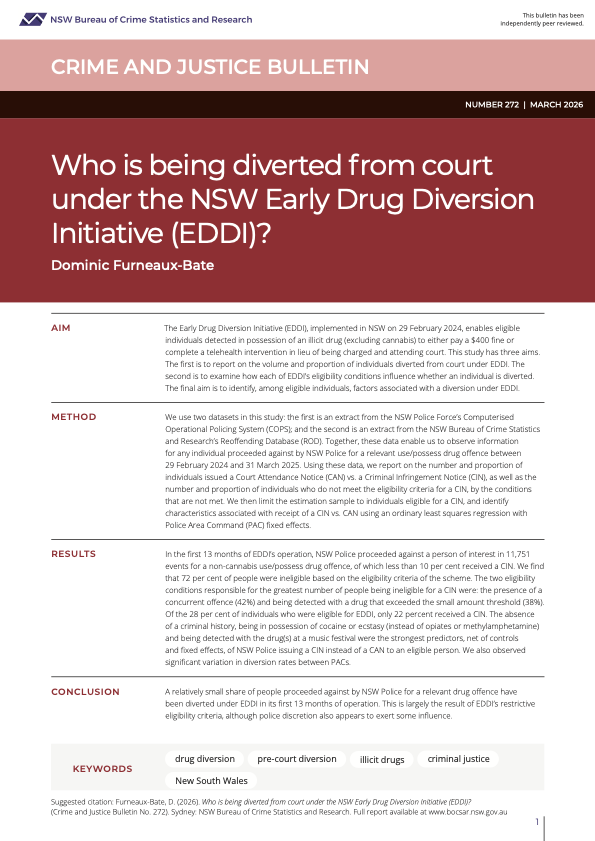
Who is being diverted from court under the NSW Early Drug Diversion Initiative (EDDI?)

By Dominic Furneaux-Bate

In 2024, the NSW Government introduced the Early Drug Diversion Initiative (EDDI), a statewide scheme designed to divert people detected with small amounts of illicit drugs away from the criminal justice system and toward a health-based response. Under EDDI, eligible individuals can receive a $400 Criminal Infringement Notice instead of being charged and attending court. The fine is waived if the individual chooses to complete a voluntary telehealth intervention.

Key findings: 

  • In the first 13 months of EDDI’s operation between 29 February 2024 and 31 March 2025, 11,751 people were proceeded against by NSW Police for use/possess offences involving drugs other than cannabis. Fewer than 10 per cent of these people were issued a Criminal Infringement Notice (CIN) and diverted from court.

  • Low diversion rates are largely driven by eligibility criteria, with almost three‑quarters (72%) of people found to be ineligible. Most were excluded because they had another offence at the same time or were carrying more than the “small” quantity threshold.

  • Among those who were eligible, only about one in five (22%) were diverted. The likelihood of receiving a CIN was highest among people with no prior contact with the criminal justice system, those detected with ecstasy or cocaine rather than methamphetamine, and people detected at music festivals.
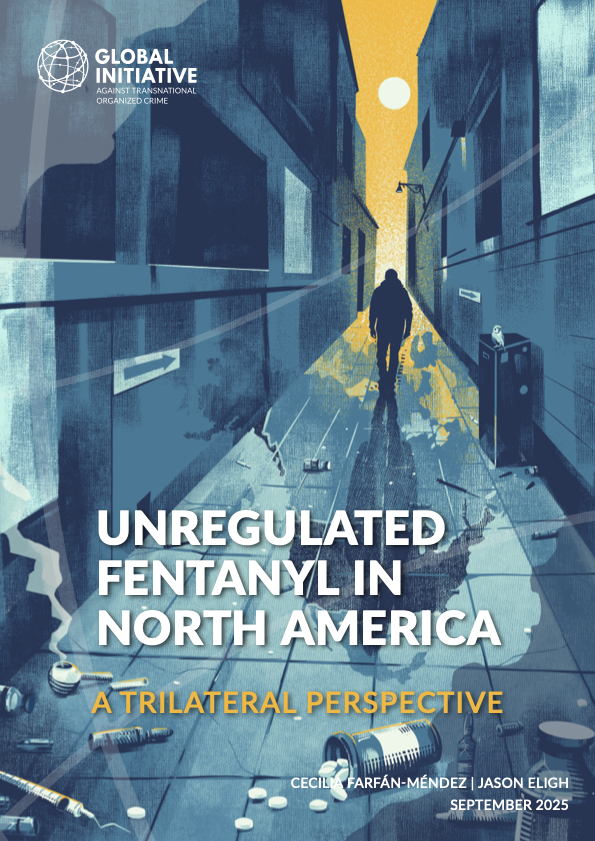
Unregulated Fentanyl in North America: A Trilateral Perspective

By CECILIA FARFÁN-MÉNDEZ | JASON ELIGH

More than 1.1 million people in the United States have died from opioid overdoses since 2000. In Canada, over 50,000 lives have been lost to opioid-related overdoses since 2016. Meanwhile, in Mexico, homicide—mostly committed with illegally trafficked firearms—is the leading cause of death among men aged 15 to 44. These overlapping crises reveal that the harms associated with synthetic opioids are not confined to one country but span all of North America.

This policy brief sheds light on how illicitly manufactured fentanyl (IMF) is produced and distributed within and across Mexico, the US, and Canada. The report reveals a complex and highly integrated system of production, tablet pressing, trafficking, and consumption. Far from being a product trafficked into North America, IMF is increasingly produced on its soil.

Key insights include the emergence of a new “golden triangle” of trafficking and violence between the Mexican states of Baja California, Sonora, and Sinaloa, where fentanyl production overlaps with high levels of firearm-related homicides. Fentanyl production in Mexico is closely linked to firearms trafficking from the United States, with Arizona emerging as a predominant source. In Canada, production largely serves the domestic market using chemical precursors imported directly and processed in clandestine labs. In the US, criminal actors engage in adulteration and tablet pressing—often making use of legal trade flows and customs loopholes to facilitate trafficking.

The paper also challenges common assumptions: 83.5% of those convicted of fentanyl trafficking in the US in 2024 were US citizens, and most trafficking across the Mexico–US border occurs through legal ports of entry, not between them.

Recommendations for all three countries focus on data transparency, coordinated public health responses, and transnational cooperation. The paper calls for more investment in evidence-based interventions and a shift away from unilateral or enforcement-only strategies.

Deaths in North America from overdoses and homicides linked to fentanyl are not inevitable. But addressing it requires governments to exchange know-how and coordinate action across borders, just as criminal networks do.

EU Drug Markets: In-depth analysis

By The European Monitoring Centre for Drugs and Drug Addiction and Europol

Illicit drugs are big business. They are one of the main profit-generating activities of organised crime and are estimated to represent around one-fifth of global crime proceeds. 'EU Drug Markets: In-depth analysis' is the fourth comprehensive overview of illicit drug markets in the EU by the EMCDDA and Europol and takes a broad view of these markets from production and trafficking, to distribution and use. Designed as a series of modules, each focuses on the market for a particular drug.

This resource offers a strategic and top-level summary for policymakers and decision-makers, to support the development and implementation of policies and actions in Europe, based on a robust understanding of the current drug landscape and emerging threats. It also serves practitioners working in the field and is intended to raise awareness among the general public about these issues.