Open Access Publisher and Free Library
CRIMINAL JUSTICE.jpeg

CRIMINAL JUSTICE

CRIMINAL JUSTICE-CRIMINAL LAW-PROCDEDURE-SENTENCING-COURTS

Posts in Databases
Mapping and Profiling the Most Threatening Criminal Networks in Latin America and the Caribbean- EL PAcCTO

By Jeremy McDermott,  Steven Dudley


“Connections between European and Latin American criminal networks have surged in recent years, with drugs, gold, and human trafficking proving particularly lucrative in the European market.

The number of European citizens linked to criminal networks arrested in Latin America has increased significantly, especially in Colombia, Peru, Brazil, the Dominican Republic, and Argentina. The strengthening alliance between Latin American and European crime groups now poses a global threat.

Today’s Latin America’s major criminal networks, unlike the cartels of the 1980s, operate in a world of subcontracting. Groups, or nodes in the network, often specialize in specific roles or stages of the supply chain. If a node is targeted by law enforcement, the network can quickly adjust and reconfigure itself, ensuring efficiency and the uninterrupted flow of criminal commodities.

These networks pose a serious threat to the rule of law, subverting it by establishing social norms through violence to exercise control with different forms of criminal governance. In Latin America and the Caribbean, they pose the single biggest threat to democracy in the region, using corruption to penetrate the state, and violence where bribery fails. This means it is the primary motor for human rights abuses and homicides. Corruption, like cancer, is spreading through state institutions in many nations of the region. Additionally, these networks harm economic stability development, distorting local economies, deterring foreign investment and affecting international financing.

Studying these networks is crucial to understanding the flow of illicit goods from Latin America to Europe, and essential to crafting effective strategies to combat these structures. After an analysis of different variables such as their criminal economies, geographical distribution or state response, EL PACCTO 2.0 and InSight Crime, with the support of the European Multidisciplinary Platform Against Criminal Threats (EMPACT), particularly within the Operational Action 8.3, of the High Risk Criminal Networks EMPACT, have ranked the 28 most active or relevant high-risk criminal networks in Latin America and the Caribbean, identifying key factors about their operations that reveal potential opportunities for combating organized crime in the region. This work has direct implications for both Latin America and Europe.

The list ranges from criminal networks with thousands of members to small brokers or gangs operating in Latin American countries, Caribbean islands or in Central America. In addition, the current report has sought to identify the connections or influence that high-risk criminal networks may have in different countries. This has led to the creation of a specific file for each criminal network with a specific individual map. Likewise, an aggregate map of all the information on the 28 criminal networks has been designed to provide a global overview.”

Washington, DC: Insight Crime, 2025. 114p
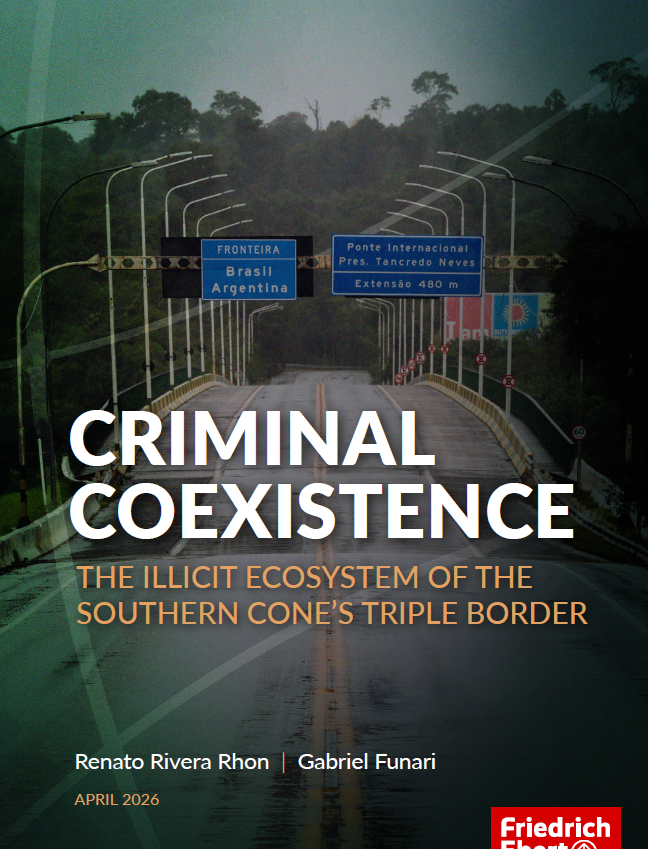
CRIMINAL COEXISTENCE.  THE ILLICIT ECOSYSTEM OF THE SOUTHERN CONE’S TRIPLE BORDER 

By Renato Rivera Rhon | Gabriel Funari

The Southern Cone tri-border area —comprising Ciudad del Este (Paraguay), Foz do Iguaçu (Brazil) and Puerto Iguazú (Argentina)— constitutes one of the most distinctive cross-border spaces in South America. Its particular geographical configuration combines densely populated urban areas with strategic riverine zones that facilitate intense cross-border circulation. More than 650,000 inhabitants coexist in an integrated social space marked by intense movement of people and one of the most heavily used commercial routes on the continent.

Within this environment of high mobility and commercial dynamism, smuggling has consolidated itself as the principal structuring axis of illicit economies. Since the creation of the free trade zone in Ciudad del Este in 1995, the region became a re-export centre for products destined mainly for the Brazilian market. Cigarettes, electronic products and alcoholic beverages enter Brazil as contraband, mobilized by local family clans and transnational illicit networks.

The report identifies a criminal ecosystem of coexistence characterized by interdependence, profitability and the historical continuity of illicit markets, sustained by commercial free movement, corruption and institutional fragility. Unlike other border areas in South America, the tri-border area presents high levels of criminal activity but low levels of violence, without armed disputes over territorial control or manifestations of criminal governance based on extortion or systematic coercion.

The report analyses the evolution of organized crime in the region, from the era of the “comboios” to the specialization of riverine routes and the “ant smuggling” model. It also examines the presence of the Primeiro Comando da Capital (PCC), which has consolidated control over clandestine ports in specific sectors of the Paraná River, without exercising generalized authority over the regional population.

Beyond smuggling, the report addresses cannabis trafficking produced in Paraguay, cocaine trafficking, arms trafficking and money laundering. Ciudad del Este emerges as a strategic financial node where commercial companies, real estate businesses, gambling houses and crypto-asset operations proliferate, facilitating the movement of illicit capital. The study also finds that the Argentinian side of the tri-border area has emerged as an increasingly prevalent smuggling hub over the past five years, generating new contraband routes and new security threats in the region.

The study is based on fieldwork and direct observation conducted in Ciudad del Este, Foz do Iguaçu and Puerto Iguazú, including interviews with members and former members of security forces, customs officials, judicial officials, academics and journalists specialized in the criminal dynamics of the tri-border area.

The Southern Cone tri-border area thus reveals a highly collaborative and adaptable criminal ecosystem, where smuggling functions as a base economy connecting flows, actors and routes used for drug trafficking, arms trafficking and other illegal goods. Its persistence is explained by its relatively non-violent character, informal regulation sustained by family clans and limited state capacities in the face of complex transnational dynamics.

Geneva: Global Initiative Against Transnational Organized Crime.. 2026. 31p.

Wrongful convictions in Spain: Systematic analysis of judgments from 1996 to 2022

By Nuria Sánchez , Guadalupe Blanco-Velasco , Linda M. Geven , Jaume Masip , Antonio L. Manzanero 

A comprehensive analysis of wrongful convictions in Spain was conducted. Out of 447 Supreme Court judgments made between 1996 and 2022, 243 cases involving a successful appeal made by a person claiming their innocence were examined in terms of the characteristics of wrongfully convicted individuals, the crime types, and the factors contributing to these judicial errors. An average rate of nine wrongful convictions per year was found, mostly for crimes against public safety and property, with a significant overrepresentation of foreign citizens. Legal professionals’ misconduct was identified as the main factor contributing to these wrongful convictions. The mean time between the judgment and the conviction being overturned was around 4.5 years. More than half of the cases were reopened due to evidence indicating that the alleged crime never occurred. While new evidence was the primary reason for reopening cases, only 3 % were reopened based on DNA evidence. The systematic methodology used in this research may serve as a model for future studies on wrongful convictions in other countries. To reduce wrongful convictions in Spain, several key measures must be implemented. Legal representation should be mandatory for all individuals accused of crimes, without exception. Legal professionals must receive enhanced training to minimize judicial errors. Furthermore, stricter forensic protocols should be established, and forensic experts must be properly accredited to prevent the misapplication of scientific evidence in legal proceedings. Additionally, reforms are needed to ensure that plea bargains are subject to more rigorous scrutiny, and that minor crimes are properly investigated.

Journal of Criminal Justice

Volume 103, March–April 2026,

How Fines and Fees in the Criminal Legal System Hinder Black Economic Mobility

By Aravind Boddupalli, LesLeigh D. Ford, Luisa Godinez-Puig

Criminal legal system fines and fees disproportionately impact Black households, entrenching poverty and creating significant barriers to economic mobility and wealth-building. These financial burdens, often imposed without regard to ability to pay, frequently lead to driver's license suspensions, increased debt, and incarceration, disrupting employment and housing stability. 

Urban Institute +3

Key Impacts on Black Communities:

  • Disproportionate Burden: Black households face criminal legal fines and fees at the highest rates compared to other racial groups.

  • Economic Mobility Barriers: These costs, often totaling hundreds or thousands of dollars, hinder the ability of Black families to build assets and improve their financial well-being.

  • Cycle of Debt and Punishment: Inability to pay can lead to driver's license suspensions, preventing individuals from traveling to work, as well as additional fines, interest, and jail time.

  • Family Well-being: As highlighted in this analysis by the Fines and Fees Justice Center, 57 percent of people with court debt reported food insecurity, while nearly 20 percent of those surveyed reported that they or a household member served time in jail due to an inability to pay.

  • Housing and Employment: Debt-related penalties, such as suspended licenses or a criminal record for nonpayment, make securing stable housing and employment more difficult. 

    Urban Institute +4

Washington, DC:  Urban Institute, 2026. 7p.

Due dignity: how are defendants treated in London magistrates’ courts?

By Fionnuala Ratcliffe and Penelope Gibbs

If they are to receive justice, defendants must be able to participate effectively in court proceedings. The principle of effective participation is at the heart of the right to a fair trial, guaranteed by Article 6 of the European Convention on Human Rights. Under Article 6, defendants’ minimum rights include the right to be informed about the nature and cause of the accusation against them; to have time and facilities to prepare their defence; to defend themselves in person or through legal assistance; to examine witnesses; and to receive free assistance from an interpreter where needed. Despite the central importance of effective participation, there are multiple aspects of everyday court practice that make it a struggle for defendants to participate actively in their case. This fifth report of the Transform Justice CourtWatch London project vividly conveys the extent and nature of these barriers to participation in London magistrates’ courts. At the most basic level, defendants often find it difficult to hear, let alone understand, what is going on at court – whether they are appearing via a shaky video link, or are physically present in the court but (as is most common) seated in the secure dock at the back of the room, behind a perspex screen. Courtroom language tends to be complex, convoluted and full of jargon: not easy for any lay person to understand, and more so for people who are anxious, tired, mentally unwell or otherwise vulnerable. For those whose first language is not English, obstacles to understanding are higher still, compounded by inadequate interpreting provision. And the large minority of defendants who are unrepresented face additional challenges as they seek to navigate the court process. Participation implies not only understanding the process, but also making oneself heard. Yet defendants’ voices are frequently silenced. Opportunities to speak during proceedings are limited, and again are impeded by the practical barriers imposed by the secure dock or remote attendance. There is an essential paradox that while criminal proceedings, at their core, are about the defendant – about what they have or have not done, and what is the appropriate penalty if they did commit the alleged offence – they are often pushed to the margins of the courtroom, more an absence than a presence.Closely linked to the theme of participation is the quality of treatment defendants receive at court. Most court professionals are conscientious and respectful. The courtwatchers observed judges, magistrates, lawyers and court staff who took time to explain proceedings; responded calmly and with compassion to displays of distress, confusion and anger; and offered extensive support to unrepresented defendants. Yet good treatment of defendants is by no means universal. Court professionals are working within an overloaded, creaking and under-resourced system. They are under pressure to complete cases quickly, in order to reduce the delays that permeate all stages of the criminal justice process. Consequences include an over-emphasis on speedy ‘processing’ of many cases and inadequate consideration of individuals’ specific circumstances and needs. And while the humanity of many court professionals shines through courtwatcher accounts, it is evident also that there are judges, magistrates, lawyers and court staff who are rude, dismissive and careless in their interactions with defendants. The treatment received by people in contact with the criminal justice system has significant repercussions. We know from existing research on procedural justice that people involved in legal processes are more likely to regard those processes – and indeed the wider justice system – as trustworthy and legitimate if they feel they have been treated with dignity and respect. Also essential to perceptions of good treatment is the experience of having a ‘voice’: that is, being acknowledged as an individual and being heard by those making the decisions. In other words, quality of treatment is integral to participation, and vice versa. The findings of the CourtWatch London project resonate with research that my colleagues and I have carried out over many years at Birkbeck’s Institute for Crime & Justice Policy Research. In our own work spanning the criminal (magistrates’, youth and Crown), family and coroners’ courts, we have repeatedly identified barriers to court users’ understanding of and engagement with legal processes. We have also seen how respectful, humane treatment can make a profound difference to people’s experience of justice. We have noted that seemingly small acts of kindness and attention can significantly enhance the sense of being supported and included; and, conversely, that professionals’ dismissive or thoughtless behaviour can be deeply damaging. What the courtwatchers have observed in magistrates’ courts across London should therefore be understood as one part of a much greater picture of how justice is delivered and experienced. There is much that can be done to strengthen participation, good treatment and fairness in court practice, and the recommendations in this report set out important steps for achieving this. 

London: Transform Justice, 2026. 41p.

The Scam Economy: The True Cost of Online Scams and Crimes in America

By  Consumer Federation of America

Federal agencies, third parties, and other groups report on scam losses each year, but these numbers are only the tip of the iceberg in measuring the size and devastation experienced by those who are targeted. Behind these reports and big spreadsheets describing reported losses are shattered families, rent money lost, and grandmothers exploited. Newer technology is leading to a rise in these scams – in both severity and number: AI is supercharging these scams, social media platforms are enabling the spread, and data brokers facilitate targeting of victims, allowing criminals to reach consumers at massive scales while exploiting highly precise profiling to victimize vulnerable people. One of the biggest problems in fully understanding the scope of these scams is underreporting. Due to reporting fragmentation and communication, as well as the understandable devastation, embarrassment, and confusion that victims often feel, estimates on how many people report their losses to scams put it extremely low – often in the single digit percent of the actual number, according to conservative key government estimations. CFA is proud to publish this report that takes the most conservative estimate of underreporting and uses it to estimate The True Cost of Scams. While this issue is complicated to solve completely, there are significant unrealized opportunities for legislators, enforcement agencies, and industry to step up to address it.

Washington, DC: Consumer Federation of America, 2026, 31p.

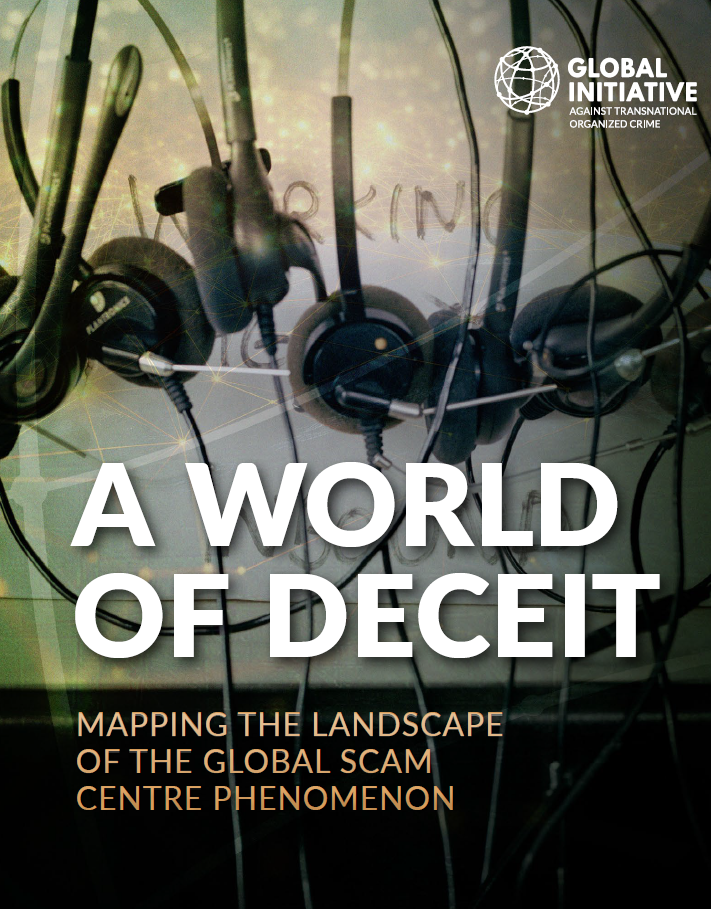
A WORLD OF DECEIT MAPPING:  THE LANDSCAPE OF THE GLOBAL SCAM CENTRE PHENOMENON

By Kristina Amerhauser | Alex Goodwin

Scams and fraud have undergone a profound evolution in recent decades, becoming one of the most sophisticated, pervasive and lucrative forms of organized crime globally. According to the Global Anti-Scam Alliance, 57% of adults worldwide reported experiencing a scam in the previous 12 months. Estimates suggest that more than US$1 trillion was generated from scams and fraud in 2024 alone


Rather than focusing on individual scam typologies – such as romance, investment or impersonation scams – this report examines the scam centre as a distinct organizational unit, mapping the various forms they take, the different economic models they use, and the broader ecosystem that allows them to operate and expand. 

Around the world, these hubs of scams appear in different shapes and sizes. Some are located in apartments, hotels or villas, which offer discretion and the ability to relocate quickly – and sometimes in-built security. Many rent office space, sometimes with legal call centres as neighbours, providing camouflage for criminal activities. At the largest scale, cyber scam compounds in South East Asia host extensive workforces and structured operations with management, financial services and technical infrastructure. In some contexts, they also operate from prisons or pre-trial detention centres, where a captive workforce and collusion with officials can facilitate criminal activity. 

This new research report finds that whatever form they take, size does not always correlate to impact. Small operations can also be highly effective, and may sometimes be linked to an overarching scam network, essentially making them nodes in a dispersed scam centre. 

Despite their varied physical footprints, scam centres are enabled by six common ‘glocal’ force multipliers that allow them to operate, scale and target victims worldwide: networked groups; technology and crime-as-a-service; money; political protection; people; and geopolitics. 

Technology is a critical driver of the scam economy. It enables scammers to reach victims around the world at minimal cost and provides tools to circumvent cyber defences. Some of the tools used include deepfakes, cloned applications, fake investment platforms and instant translation, as well as the use of data that enables precise social targeting of victims. 

Illicit financial flows generated through scams are handled through a combination of money mules, cryptocurrencies, fintech tools and physical assets. These mechanisms often operate simultaneously, making it difficult and time-sensitive for law enforcement to trace illicit proceeds. 

The report also highlights the central role of people in scam centre operations. Workers may be recruited locally with promises of lucrative salaries or trafficked from abroad and forced to work in exploitative conditions. In South East Asia alone, an estimated 300 000 people have been trafficked into scam compounds. 

Looking ahead, the research identifies three major risks: displacement, diffusion and de-globalization. These dynamics may lead scam centres to become more embedded in more places, especially in areas where governance is weak. Some countries may also become linked to the scam economy not by hosting scam centres themselves but by facilitating money laundering or enabling services. 

The report concludes that tackling scam centres requires addressing the interconnected nature of their operations. Single-strand approaches may disrupt individual operations, but they will not meaningfully affect the broader environment in which scam centres thrive. 

Geneva: Global Initiative Against Transnational Organized Crime., 

, 2026. 52p.

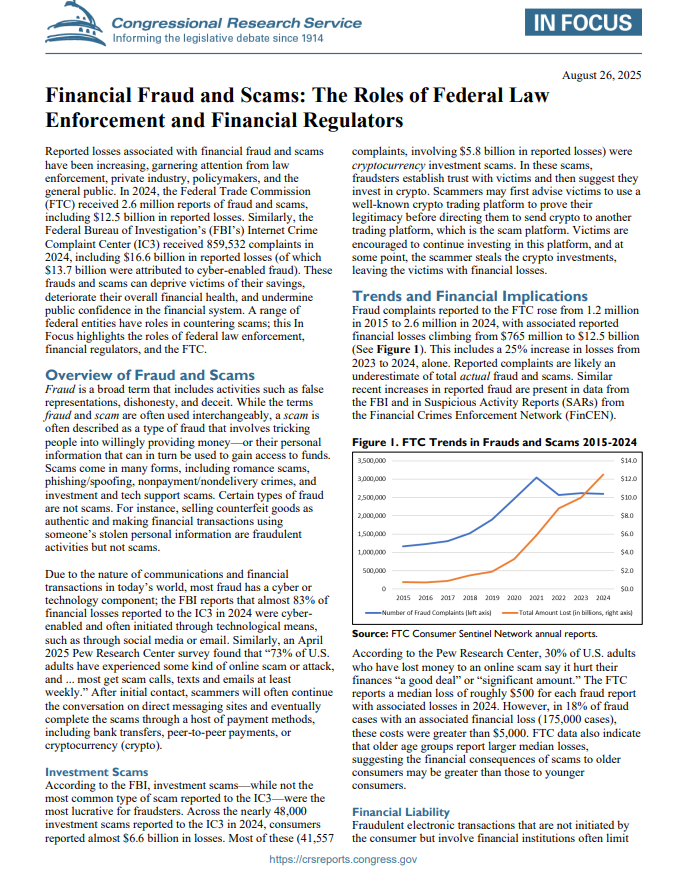
Financial Fraud and Scams: The Roles of Federal Law Enforcement and Financial Regulators

By the Federal Trade Commission

Reported losses associated with financial fraud and scams have been increasing, garnering attention from law enforcement, private industry, policymakers, and the general public. In 2024, the Federal Trade Commission (FTC) received 2.6 million reports of fraud and scams, including $12.5 billion in reported losses. Similarly, the Federal Bureau of Investigation’s (FBI’s) Internet Crime Complaint Center (IC3) received 859,532 complaints in 2024, including $16.6 billion in reported losses (of which $13.7 billion were attributed to cyber-enabled fraud). These frauds and scams can deprive victims of their savings, deteriorate their overall financial health, and undermine public confidence in the financial system. A range of federal entities have roles in countering scams; this In Focus highlights the roles of federal law enforcement, financial regulators, and the FTC.

Washington, DC: Federal Trade Commission, 2026. 3p.

State-Corporate Crime, Systemic Risk, and Governance Failures in Mass Transportation: Insights from the Tempi Train Tragedy

By Nikos Passas, Stratos Georgoulas, Christos Kouroutzas, Dimitris Paraskevopoulos 

This paper analyzes the Tempi railway tragedy of 28 February 2023 as a case of state-corporate crime and institutional corruption rather than a mere accident, focusing on the systemic endangerment of Greece’s mass transportation system. Drawing on qualitative content analysis of official documents and media records, 76 semi-structured interviews, and ongoing participant observation, the study reconstructs how safety-critical investments and controls were undermined by corrupt practices, regulatory neglect, and austerity-driven privatization. The analysis shows how criminogenic asymmetries, dysnomie, and the normalization of deviance allowed unlawful and “lawful but awful” policies to hollow out the railways’ safety function while serving mutually reinforcing state and corporate interests. These governance failures obscured systemic risk, facilitated the misrepresentation of violations as “human error,” and weakened transparency, accountability, and effective compliance in the rail sector. By situating Tempi within a comparative framework of state-corporate crimes and transport disasters, the paper highlights the blurred boundaries between financial crime, institutional corruption, and regulatory failure in critical infrastructure. It concludes with policy and compliance recommendations aimed at strengthening structural accountability, restoring institutional integrity, and reducing systemic risk in mass transportation governance.

Journal of Illicit Trade, Financial Crime, and Compliance, vol. 1, 205.

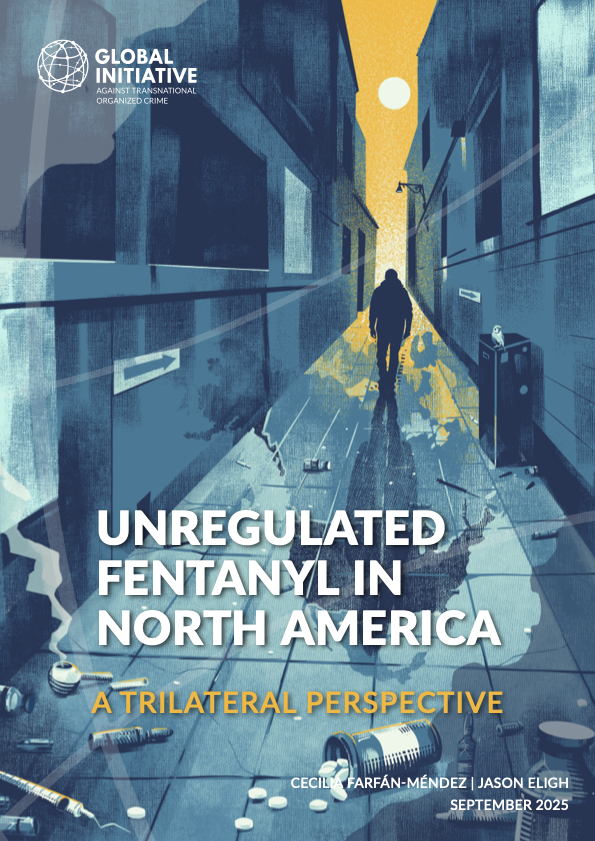
Unregulated Fentanyl in North America: A Trilateral Perspective

By CECILIA FARFÁN-MÉNDEZ | JASON ELIGH

More than 1.1 million people in the United States have died from opioid overdoses since 2000. In Canada, over 50,000 lives have been lost to opioid-related overdoses since 2016. Meanwhile, in Mexico, homicide—mostly committed with illegally trafficked firearms—is the leading cause of death among men aged 15 to 44. These overlapping crises reveal that the harms associated with synthetic opioids are not confined to one country but span all of North America.

This policy brief sheds light on how illicitly manufactured fentanyl (IMF) is produced and distributed within and across Mexico, the US, and Canada. The report reveals a complex and highly integrated system of production, tablet pressing, trafficking, and consumption. Far from being a product trafficked into North America, IMF is increasingly produced on its soil.

Key insights include the emergence of a new “golden triangle” of trafficking and violence between the Mexican states of Baja California, Sonora, and Sinaloa, where fentanyl production overlaps with high levels of firearm-related homicides. Fentanyl production in Mexico is closely linked to firearms trafficking from the United States, with Arizona emerging as a predominant source. In Canada, production largely serves the domestic market using chemical precursors imported directly and processed in clandestine labs. In the US, criminal actors engage in adulteration and tablet pressing—often making use of legal trade flows and customs loopholes to facilitate trafficking.

The paper also challenges common assumptions: 83.5% of those convicted of fentanyl trafficking in the US in 2024 were US citizens, and most trafficking across the Mexico–US border occurs through legal ports of entry, not between them.

Recommendations for all three countries focus on data transparency, coordinated public health responses, and transnational cooperation. The paper calls for more investment in evidence-based interventions and a shift away from unilateral or enforcement-only strategies.

Deaths in North America from overdoses and homicides linked to fentanyl are not inevitable. But addressing it requires governments to exchange know-how and coordinate action across borders, just as criminal networks do.

Gang Databases and Immigration Enforcement,

By Peter Honnef

On paper, gang databases look efficient and innocuous, providing law enforcement agencies with a shortcut to identify people suspected of having a connection to gang violence. But these local databases often contain inaccurate information that, when shared widely across agencies, can have life-altering consequences. The Center for Policing Equity’s (CPE) new white paper, Gang Databases and Immigration Enforcement, explores the disproportionate impact gang databases have on marginalized communities and the increased harm from immigration enforcement. By Peter Honnef

On paper, gang databases look efficient and innocuous, providing law enforcement agencies with a shortcut to identify people suspected of having a connection to gang violence. But these local databases often contain inaccurate information that, when shared widely across agencies, can have life-altering consequences. The Center for Policing Equity’s (CPE) new white paper, Gang Databases and Immigration Enforcement, explores the disproportionate impact gang databases have on marginalized communities and the increased harm from immigration enforcement. 

Center for Policing Equity, 2026. 11p.