Open Access Free Library
CRIMINAL JUSTICE.jpeg

CRIMINAL JUSTICE

CRIMINAL JUSTICE-CRIMINAL LAW-PROCDEDURE-SENTENCING-COURTS

Posts in Youth Justice
Building procedural justice in street-level drug law enforcement: An Australian and cross-national analysis COVID-19, school attendance and youth crime

By Adam Teperski and Ilya Klauzner
 

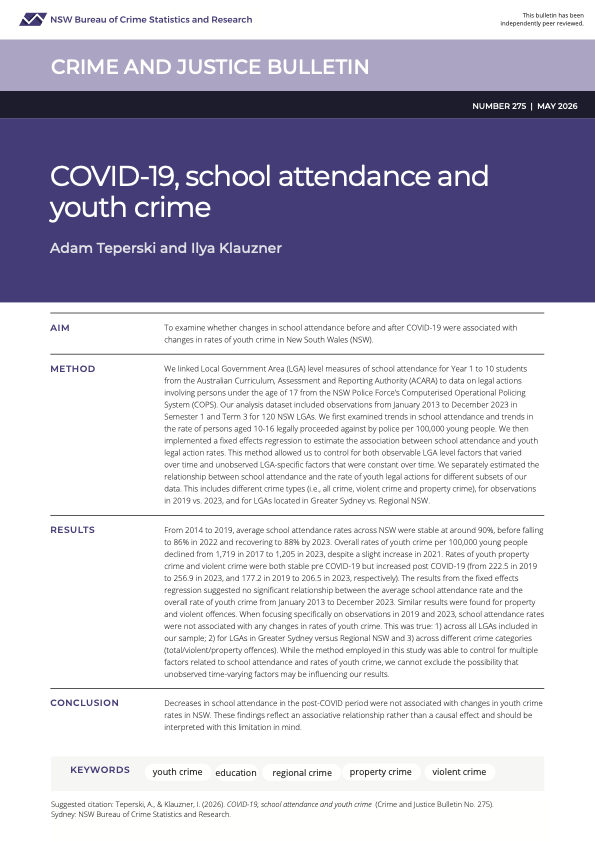
To examine whether changes in school attendance before and after COVID-19 were associated with changes in rates of youth crime in New South Wales (NSW). METHOD We linked Local Government Area (LGA) level measures of school attendance for Year 1 to 10 students from the Australian Curriculum, Assessment and Reporting Authority (ACARA) to data on legal actions involving persons under the age of 17 from the NSW Police Force’s Computerised Operational Policing System (COPS). Our analysis dataset included observations from January 2013 to December 2023 in Semester 1 and Term 3 for 120 NSW LGAs. We first examined trends in school attendance and trends in the rate of persons aged 10-16 legally proceeded against by police per 100,000 young people. We then implemented a fixed effects regression to estimate the association between school attendance and youth legal action rates. This method allowed us to control for both observable LGA level factors that varied over time and unobserved LGA-specific factors that were constant over time. We separately estimated the relationship between school attendance and the rate of youth legal actions for different subsets of our data.

This includes different crime types (i.e., all crime, violent crime and property crime), for observations in 2019 vs. 2023, and for LGAs located in Greater Sydney vs. Regional NSW. RESULTS From 2014 to 2019, average school attendance rates acrossNSW were stable at around 90%, before falling to 86% in 2022 and recovering to 88% by 2023. Overall rates of youth crime per 100,000 young people declined from 1,719 in 2017 to 1,205 in 2023, despite a slight increase in 2021. Rates of youth property crime and violent crime were both stable pre COVID-19 but increased post COVID-19 (from 222.5 in 2019 to 256.9 in 2023, and 177.2 in 2019 to 206.5 in 2023, respectively). The results from the fixed effects regression suggested no significant relationship between the average school attendance rate and the overall rate of youth crime from January 2013 to December 2023. Similar results were found for property and violent offences. When focusing specifically on observations in 2019 and 2023, school attendance rates were not associated with any changes in rates of youth crime. This was true: 1) across all LGAs included in our sample; 2) for LGAs in Greater Sydney versus Regional NSW and 3) across different crime categories (total/violent/property offences). While the method employed in this study was able to control for multiple factors related to school attendance and rates of youth crime, we cannot exclude the possibility that unobserved time-varying factors may be influencing our results. CONCLUSION Decreases in school attendance in the post-COVID period were not associated with changes in youth crime rates in NSW. These findings reflect an associative relationship rather than a causal effect and should be interpreted with this limitation in mind.

Problem-Solving Courts in New Zealand

By Oliver Fredrickson

New Zealand has a range of problem-solving courts which address common drivers of offending, such as substance use, mental health, homelessness and family violence. This report outlines the historical, political, and legal context in which problem-solving courts developed and continue to operate in New Zealand, before surveying the country's various problem-solving courts and reviewing the new model for the District Court of New Zealand, Te Ao Mārama, which seeks to integrate the best practice features from these problem-solving courts into the mainstream courts. This report was commissioned by the Centre and undertaken by Oliver Fredrickson, a New Zealand-qualified lawyer who completed a fellowship at the Centre.

On 7 August 2025, the UK Ministry of Justice announced its intention to expand Intensive Supervision Courts (“ISCs”). ISCs address the underlying causes of criminal offending and provide “enhanced community-based sentences” to divert those at risk of facing custodial sentences.a To this end, the Ministry circulated an Expression of Interest to gauge interest across England and Wales for potential new ISCs. With the Sentencing Bill receiving Royal Assent on 22 January 2026- becoming the Sentencing Act 2026- this ISC expansion is being realised, with the new sites due to be announced shortly. We are pleased to have supported the Ministry of Justice throughout the Expression of Interest process. We worked with all successful areas during the development of their proposals, supporting them to deepen their understanding of existing ISC and wider problem-solving court models, and supporting local partnerships to consider how these nationally defined models could be implemented in their local context.

Alongside this process – and to potentially spark some inspiration in how these run going forwards – the Centre for Justice Innovation has commissioned this report, which examines the experience of problem-solving courts in New Zealand. New Zealand has various problem-solving courts which address common drivers of offending, such as substance use, mental health, homelessness, family violence, and youth. This report surveys these problem-solving courts and outlines how their best practices features are now being integrated into the mainstream courts. This report adopts the following structure: • Part One outlines the historical, political, and legal context in which problem-solving courts developed and continue to operate in New Zealand. • Part Two surveys the various problem-solving courts in New Zealand, examining how (and why) they emerged, how they were established, how they currently operate, and how they have performed.

Stories that matter: learning from Aboriginal and Torres Strait Islander people’s experiences of the criminal legal system

By Hilde Tubex, Lorana Bartels, Ashlee Curtis Hunter Culbong, Emma Tufuga

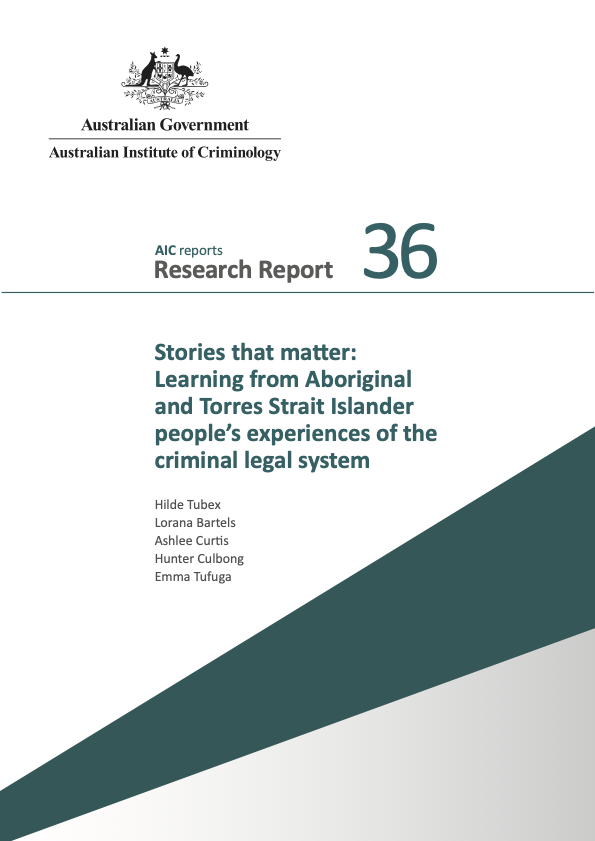
This research report describes the experiences of Aboriginal and Torres Strait Islander people with the criminal legal system in Western Australia, the Australian Capital Territory and Victoria. The findings confirm the lasting impacts of colonisation and intergenerational trauma, which create the conditions that lead Indigenous people into engagement with the criminal legal system.

Did raising the school leaving age reduce crime? Evidence from NSW

By Steve Yeong

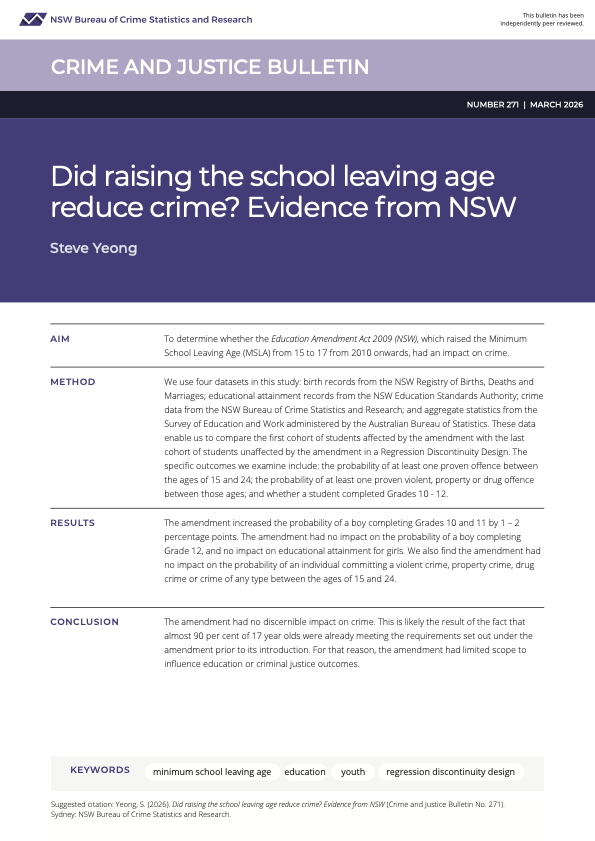
AIM To determine whether the Education Amendment Act 2009 (NSW), which raised the Minimum School Leaving Age (MSLA) from 15 to 17 from 2010 onwards, had an impact on crime. METHOD We use four datasets in this study: birth records from the NSW Registry of Births, Deaths and Marriages; educational attainment records from the NSW Education Standards Authority; crime data from the NSW Bureau of Crime Statistics and Research; and aggregate statistics from the Survey of Education and Work administered by the Australian Bureau of Statistics. These data enable us to compare the first cohort of students affected by the amendment with the last cohort of students unaffected by the amendment in a Regression Discontinuity Design. The specific outcomes we examine include: the probability of at least one proven offence between the ages of 15 and 24; the probability of at least one proven violent, property or drug offence between those ages; and whether a student completed Grades 10 - 12. RESULTS The amendment increased the probability of a boy completing Grades 10 and 11 by 1 –2 percentage points. The amendment had no impact on the probability of a boy completing Grade 12, and no impact on educational attainment for girls. We also find the amendment had no impact on the probability of an individual committing a violent crime, property crime, drug crime or crime of any type between the ages of 15 and 24. CONCLUSION The amendment had no discernible impact on crime. This is likely the result of the fact that almost 90 percent of 17 year olds were already meeting the requirements set out under the amendment prior to its ntroduction. For that reason, the amendment had limited scope to influence education or criminal justice outcomes.