
By Donovan Tan
Australia's recent anti-hate legislation, passed in January 2026, has ostensibly crippled domestic far-right organisations. The National Socialist Network’s disbandment, which immediately followed, has been celebrated by some. However, disbandment merely reframes the threat, as far-right elements have decentralised to avoid prosecution. Decentralisation disperses extremists instead of defeating them. This risks catalysing the very violence the legislation seeks to prevent. Without addressing ideological motivations, restrictive measures may prove inadequate, and even counterproductive.
By Sinclair Davidson
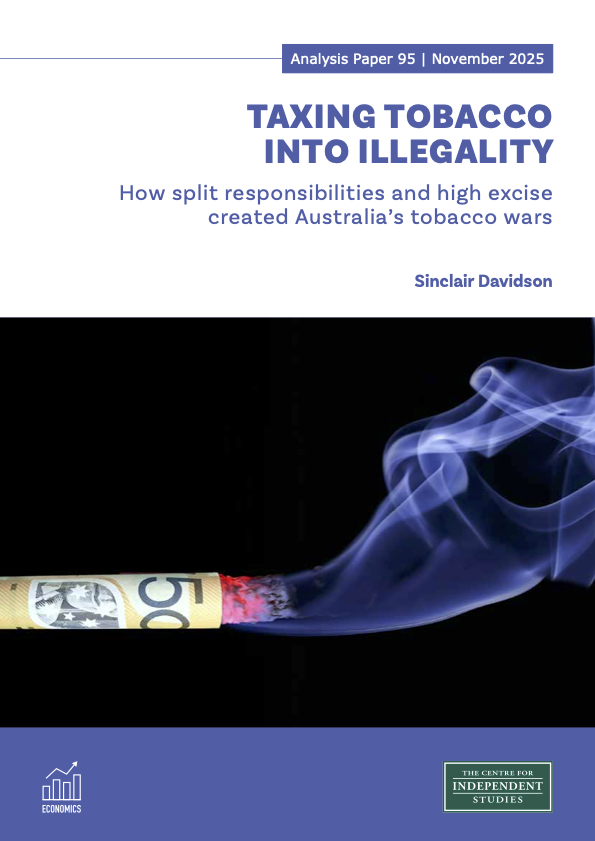
Australia’s tobacco control policy has reached a breaking point. For decades, bans on advertising and steady excise increases reduced the incidence of smoking and raised reliable revenue. Since 2019–20, however, revenue has persistently fallen short of Budget forecasts and a violent illicit market has expanded. This paper explains how split responsibilities and misaligned incentives have produced this outcome. The paper shows that excise has moved beyond the point where it is either efficient or corrective. It argues that the Commonwealth is rewarded for over-taxing while states and local communities bear the health, policing and insurance costs of the disorder that results. The paper concludes that Australia needs policy clarity and institutional reform. Tobacco control cannot be both a public health programme and a revenuemeasure. To stabilise the market, starve organised crime and bring control back to the legitimate sector, the paper calls for bold policy change.
By The Attorney-General's Department (Australia)
The report provides a summary of civil laws, criminal laws, reviews or reforms currently in progress, and best practice initiatives in response to antisemitism and Islamophobia in Australia – presenting anti-vilification measures for each state and territory government and the Commonwealth. The Australian Attorney-General's Department, alongside the Federal Government, has responded to rising antisemitism and Islamophobia by appointing Special Envoys, criminalizing hate symbols (e.g., Nazi salute), initiating legislative reforms against hate speech (Combatting Antisemitism, Hate and Extremism Bill 2026), and providing funding for community security. Department of Home Affairs Website
Key Responses and Actions (2024-2026):
Special Envoys: Appointed Ms. Jillian Segal AO as Special Envoy to Combat Antisemitism and Mr. Aftab Malik as Special Envoy to Combat Islamophobia in 2024/2025 to lead national responses, according to a Department of Home Affairs document.
Legislative Action: The government banned Nazi salutes and symbols (2024), and is developing the Combatting Antisemitism, Hate and Extremism Bill 2026 to strengthen laws against hate speech and discrimination, notes an article from Crikey.
Targeted Measures: The Attorney-General's Department is involved in creating a national strategy to combat violence and harassment. Specific actions include investigating laws against doxxing and delivering $25 million to enhance security at Jewish sites.
Education and Monitoring: An Antisemitism Education Taskforce chaired by David Gonski AC was established in December 2025 to tackle antisemitism in schools, according to a report from the Department of Home Affairs.
Consultation and Criticism: The Attorney-General's Department has consulted stakeholders on new hate speech laws, though some groups, such as the Australian National Imams Council (ANIC), have raised concerns about the breadth of the proposed legislation, according to Facebook posts from ANIC.
Implementation: The government adopted the Special Envoy's Plan to Combat Antisemitism in December 2025, committing to implement 13 recommendations to protect the Jewish community, says a report from Australian Policy Online.
By Hilde Tubex, Lorana Bartels, Ashlee Curtis Hunter Culbong, Emma Tufuga
This research report describes the experiences of Aboriginal and Torres Strait Islander people with the criminal legal system in Western Australia, the Australian Capital Territory and Victoria. The findings confirm the lasting impacts of colonisation and intergenerational trauma, which create the conditions that lead Indigenous people into engagement with the criminal legal system.
By The Parliament of Queensland. The Justice, Integrity and Community Safety Committee
This report presents a summary of an examination of Queensland's Fighting Antisemitism and Keeping Guns out of the Hands of Terrorists and Criminals Amendment Bill 2026. The committee’s task was to consider the policy to be achieved by the legislation and the application of fundamental legislative principles. The committee recommends that the Bill be passed.
By the National Anti-Corruption Commission (Australia)
This is the report on the investigation of corruption issues relating to the conduct of six persons referred by the Royal Commission into the Robodebt Scheme. The report found that two of the six individual engaged in serious corrupt conduct, and that the remaining four did not engage in corrupt conduct.
By Skye Predavec, Rod Campbell, Alice Grundy
To get a firearm licence in Australia requires having a “genuine reason” to own a gun. In most jurisdictions, this requirement can be satisfied by being a paid-up member of a sports shooting club. Shooting groups promote this fact, advertising that you can join “from the comfort of home”. This may explain why up to 253,000 NSW firearms licences list shooting sports or recreational hunting as a reason for gun ownership, but fewer than 36,000 people in NSW participated in either activity in 2025. Ever since the Port Arthur massacre, Australia has been united behind the principle that strict firearm controls are important for public safety. The thin practical requirements for getting a firearm licence are not in the spirit of that principle and allow for a worrying erosion of Australia’s gun control regime.