Open Access Free Library
CRIMINAL JUSTICE.jpeg

CRIMINAL JUSTICE

CRIMINAL JUSTICE-CRIMINAL LAW-PROCDEDURE-SENTENCING-COURTS

Posts tagged insanity
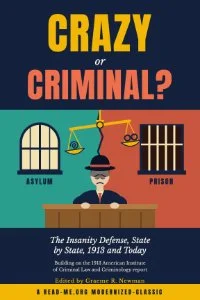
Crazy or Criminal? The Insanity Defense, State by State, 1913 and Today

Edited by Graeme R. Newman

When is a person too mentally ill to be blamed for a crime? What happens to a defendant who cannot understand his own trial? And what should society do with someone a jury acquits because he was insane?

In 1913, Committee B of the American Institute of Criminal Law and Criminology tried to answer these questions for the whole country. Under the chairmanship of Edwin R. Keedy, its members, among them Adolf Meyer, William A. White and Morton Prince, gathered every statute on insanity in criminal cases from the 48 states and the District of Columbia. The result was a unique snapshot of American law on six questions: the test of responsibility, competency to stand trial, commitment of incompetent defendants, the verdict when insanity is proved, commitment after acquittal, and discharge from the hospital.

This edition reprints that collection in full, corrected against the original printing. Each state's 1913 statutes are followed by a summary of its practice in 2026 under the same six headings, and Alaska and Hawaii are added so every state is covered. Readers can follow a single state across more than a century or compare all of them at once. They can see where M'Naghten survives, where the defense has been narrowed or abolished, how "guilty but mentally ill" verdicts spread, and how release passed from governors and legislatures to courts and review boards.

A new introduction and conclusion by Graeme R. Newman, Distinguished Professor Emeritus at the University at Albany, place the collection in historical context, and review and discussion questions make the book ready for classroom use. It is an essential reference for students, lawyers, forensic clinicians and anyone puzzled by one of the hardest questions in criminal justice.

Read-Me.Org Inc. New York-Philadelphia-Australia. 2026. 142.p

Mental Conditions Defences In The Criminal Law

By R. D. Mackay

Mental condition defences have been used in several high-profile and controversial criminal trials in recent years. indeed, mental abnormality is increasingly an important yet complex source of defence within the criminal trial process. The author offers a detailed critical analysis of those defences within the Criminal Law where the accused relies on some form of mental abnormality as a source of defence. Topics covered include: the defences of automatism, insanity, diminished responsibility, and infanticide; self-induced incapacity; and the doctrine of fault. It also includes a chapter on unfitness to plead, which although not a defence has been included because of its important relationship to mental disorder within the criminal process. Drawing upon a wide variety of legal, psychiatric, and philosophical sources, this is a timely contribution to a controversial and complex topic.

Oxford, UK; New York: Oxford University Press, 1996p. 278p.

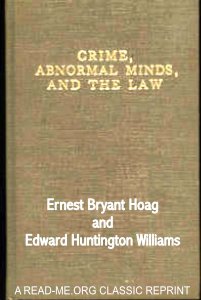
Crime, Abnormal Minds and the Law

By Ernest Bryant Hoag and Edward Huntington Williams

. “In presenting this book to the public the authors have in mind the need for brief but accurate account of the common mental defects and sociological factors encountered in study of adult criminals, and of delinquent children. From an extensive experience in criminological work, including the psychopathic laboratory and much expert testimony in court, they are convinced that many judges, lawyers, police officials and doctors will welcome the sort of information which is here given. They also have in mind the needs of social service workers, teachers, and students of sociology, and last, but not least, certain part of the general public, which is asking almost in vain for the explanation of the criminal and delinquent behavior which today, more than ever before, presents itself in every large community. The authors have not pretended to offer anything new to experts in the study of abnormal behavior, yet they hope that even some of these will find the case-histories, at least, interesting and perhaps valuable.”

Indianapolis: Bobbs-Merrill, 1923. 405p.